Hey there, tech enthusiasts and science buffs! If you're into cutting-edge tools for molecular analysis or field-theoretic diagnostics, buckle up. Today, we're diving into the UNNS Lab's latest update: v0.9.2. At first glance, it might seem like a minor bump from v0.9.1, but oh boy, is that a misconception. This version isn't just polishing the edges—it's adding entirely new dimensions to how we understand and evaluate τ-fields in molecular systems like RaF, CaF, and BaF. Think of it as evolving from a basic calculator to a smart AI diagnostician.
We'll break it down step by step, with some visual flair via SVG diagrams (including animations to show the "evolution" in action). Let's explore why v0.9.2 is structurally revolutionary, not incremental.
Remember v0.9.1? It was solid, focusing on nonlinear τ-projection, manifold grouping, ΔC + g_ω hyperfine coupling, and that trusty match → project → evaluate pipeline. But it lacked depth in self-diagnosis. Enter v0.9.2's star feature: Quality Geometry. This isn't a tweak; it's a whole new layer that didn't exist before.
Read more: Why UNNS Lab v0.9.2 is a Quantum Leap Forward: Beyond Just Tweaks
The first τ-Field Laboratory capable of evaluating not only molecular spectra,
but its own predictions — introducing the Quality Geometry layer.
Dimensionless Constants → Research τ-Field Geometry UNNS Chambers XIII–XXI τ-MSC v0.9.1 (CaF / SrF / BaF)
Classical physics treats the gravitational constant G, the speed of light c, Planck’s constant ħ and the fine-structure constant α as unrelated inputs: numbers to be measured and inserted into the equations. In the UNNS programme we instead view them as four projections of a single recursion fixed-point of the τ-Field substrate. This article consolidates evidence from the UNNS chambers, τ-field monographs and τ-Microstructure Spectral Chamber (τ-MSC) runs on real molecules to argue that G, c, ħ and α arise from one and the same geometric constraint on recursion.
We show how four apparently independent constants — G, c, ħ and α — can be interpreted as different stability channels of a single recursive field (the τ-Field) defined over the UNNS substrate. The argument proceeds in four steps. First, we define τ-curvature wells generated by mass as pacing defects in the recursion cycle and show how conservation of curvature across expanding τ-shells enforces an inverse-square law, fixing an effective gravitational constant G. Second, we recall how Maxwell-FEEC formulations on the substrate identify c as the maximum stable phase-alignment speed of recursion. Third, we review the Tauon Field Information Geometry results in which ħ emerges as the minimal resolvable τ-phase twist times curvature. Fourth, we connect these channels to the transverse torsion stiffness of recursion studied in the dimensionless-constant chambers (XIII–XVIII), where α appears as the stable coupling index for sideways τ-phase propagation.
The core empirical component of the argument is supplied by UNNS Lab experiments: Chambers XIII–XVIII for scale equilibrium and Weinberg angle emergence; τ-MSC Chamber XXI fits to real hyperfine spectra of CaF, SrF and BaF; and cross-validation dashboards verifying that a single τ-Field geometry can account for these seemingly disparate phenomena. Taken together, these results support the claim that G, c, ħ and α form a tightly constrained quadruple determined by a unique recursion fixed-point of the τ-Field substrate.
Read more: Empirical Proof of the τ-Field Fixed-Point — Unifying G, c, ħ, α
Research → Lab τ-Field Geometry τ-MSC v0.9.1 CaF • SrF • BaF
This article reads the CaF–SrF–BaF alkaline-earth fluoride chain through the lens of the τ-Microstructure Spectral Chamber (τ-MSC). Using a single τ-field engine configuration, we fit synthetic τ-MSC spectra to real hyperfine data for CaF, SrF and BaF and interpret the differences as changes in τ-curvature and τ-torsion geometry across the chain.
CaF, SrF and BaF share the same electronic ground state (X²Σ⁺, v=0) but differ strongly in nuclear charge and relativistic character. In this study we feed their measured hyperfine transitions into the τ-Microstructure Spectral Chamber and obtain τ-MSC comparison logs for each molecule. All three runs use an identical τ-field engine configuration (grid width 128, λ = 0.108, σ = 0.02, 400 steps, fixed seed), so any differences in the τ-MSC fit arise from how each molecule constrains τ-curvature and τ-torsion in the micro-chamber.
The τ-MSC comparison logs achieve unit match rate for all three species and sub-6 MHz root-mean-square residuals with r² > 0.9999. From these logs we reconstruct qualitative τ-curvature shells, torsion spirals and synthetic hyperfine “fingerprints” for the CaF–SrF–BaF chain. The result is a τ-field geometry narrative that tracks how curvature compresses and torsion tightens as we move from light CaF to heavy BaF.
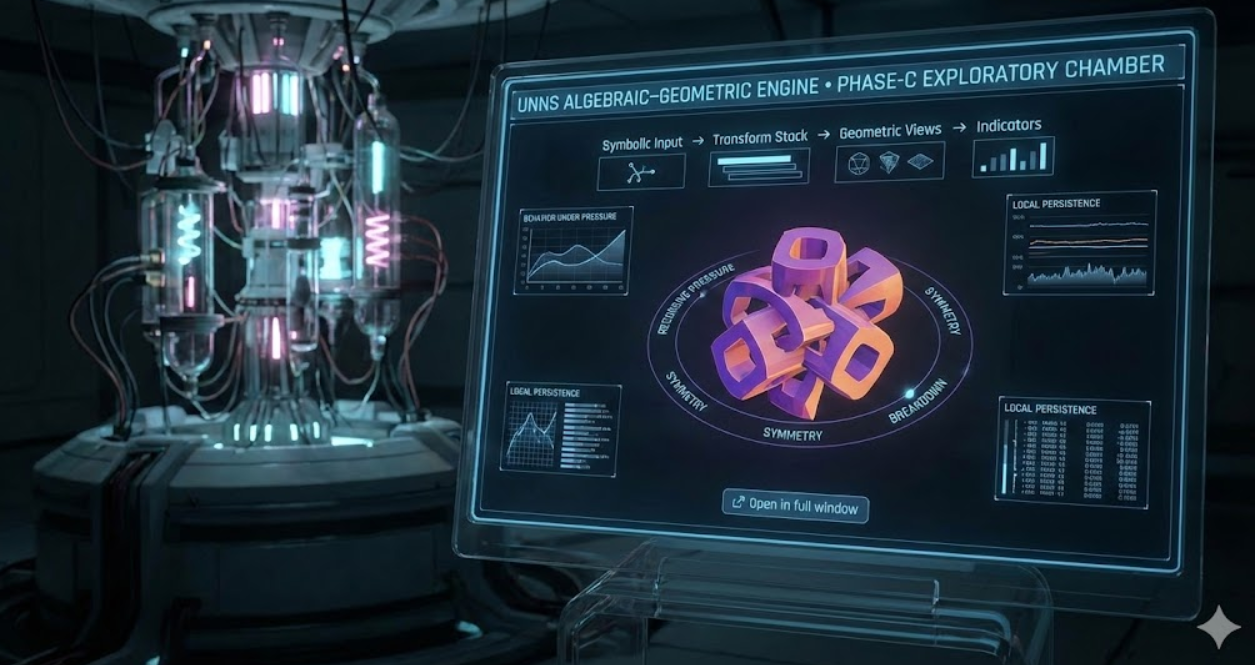
Chamber XXI is a microscopic τ-field playground. It renders τ-curvature microstructure, τ-torsion and a synthetic hyperfine response in a 4-pane layout, providing a visual analogue of magnetization-distribution effects and finite-size corrections in τ-field language.
The τ-Microstructure Spectral Chamber (τ-MSC) is a dedicated microscopic τ-field chamber inside the UNNS Empirical Testing Laboratory v0.4.2. It combines four synchronized panels: (1) a τ-field micro-chamber with radial shells and spiral microstructure; (2) a synthetic hyperfine spectrum; (3) an effective nuclear magnetization-distribution profile (Bohr–Weisskopf-like); (4) a diagnostic gauge cluster reporting ⟨κ⟩, ⟨τ⟩ and Eeff.
The goal is not to simulate a specific real molecule in detail, but to provide a τ-field template for how nuclear τ-curvature and τ-torsion could imprint themselves on electronic hyperfine structure. Calibration against real data (RaF) is supplied at the level of conceptual scale-matching, not as a hard constraint on the underlying UNNS dynamics.
Read more: Chamber XXI as a Bridge Between Nuclear Microstructure and Recursive Substrate
Page 23 of 32