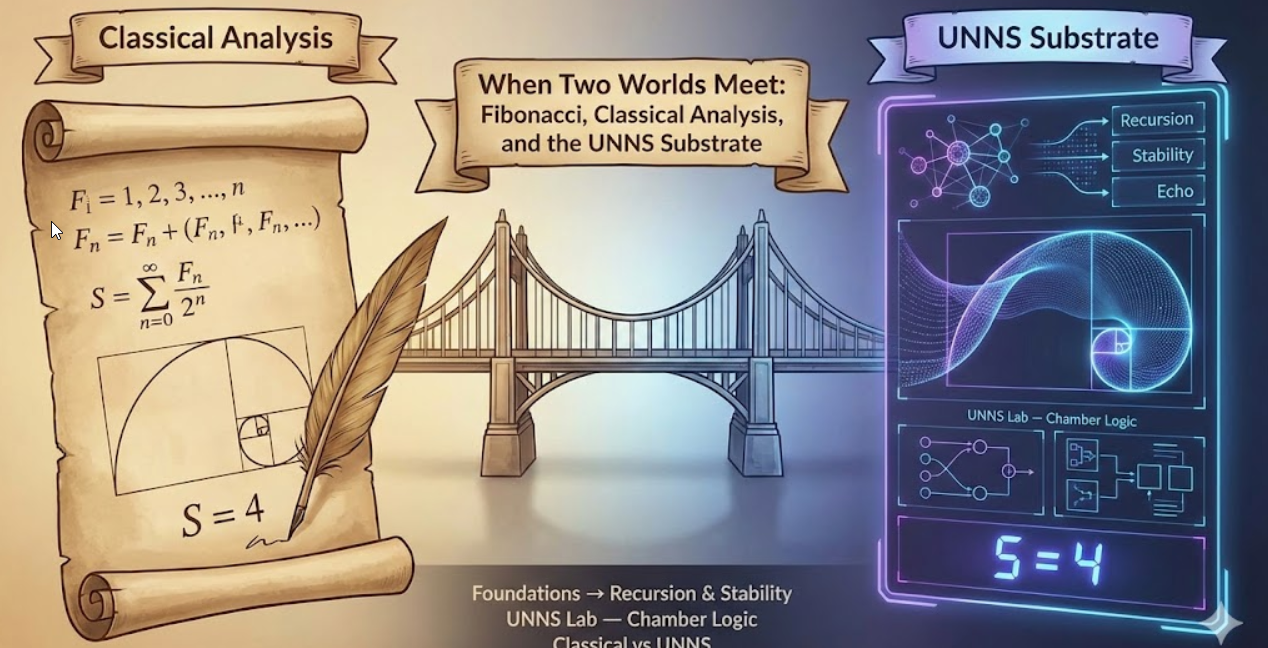
1. Classical Analysis — The Algebraic Route
The classical mathematician begins with familiar terrain: linear recurrences,
generating functions, analytic continuation, and geometric decay. The tools are
older than modern physics, older even than modern algebra. And they work.
1.1. The Shifted Fibonacci Sequence
Unlike the standard convention (0,1,1,2,3,5,...), we use the shifted initialization:
F0 = 1
F1 = 1
Fn+2 = Fn+1 + Fn
This one modification changes everything downstream.
1.2. The Generating Function
The shifted sequence has the clean generating function
S(x) = 1 / (1 - x - x2 ).
Classical analysis proceeds with mechanical efficiency: identify the radius of
convergence, substitute x = 1/2, and simplify:
S(1/2) = 1 / (1 - 1/2 - 1/4) = 1 / (1/4) = 4.
Result: S = 4.
1.3. Classical Perspective: Efficient, Effective, Opaque
Classical analysis obtains the number quickly and elegantly. Yet it offers no
structural intuition for why the answer is so clean — why a golden-ratio sequence
combined with a geometric decay gives a simple integer instead of a
φ-laced radical. The answer emerges from algebraic cancellation within the rational
function 1 / (1 - x - x²). Nothing in the classical pipeline explains the deeper
reason for this simplicity.
2. The UNNS Approach — Recursion as Dynamics
In the UNNS Substrate, the problem looks entirely different. We do not sum numbers.
We do not manipulate generating functions. We do not rely on analytic continuation.
Instead, we model the Fibonacci sequence as a recursive echo flow
propagating through the Substrate. The weighted series is not a sum but an
attenuated echo channel . And the result is not a coincidence:
it is the fixed point of a contractive dynamical system.
2.1. Seed → Nest → Echo
In UNNS, every linear recurrence decomposes into:
Seed — the initial echo packet (1,1)Nest — the operator that produces deeper echoesEcho Channel — the infinite flow of propagated echoes
The Fibonacci Nest carries an intrinsic amplification . This amplification
is not accidental — it is structurally encoded in the golden ratio φ, which acts
as the dominant resonance of the recursion.
2.2. Operator XIV — Extracting the Golden Echo
x2 = x + 1
The larger root φ = (1 + √5)/2 defines the rate at which deeper echoes reinforce
themselves. UNNS interprets this reinforcement as the internal echo ratio :
internal echo ratio = 1/φ.
This ratio quantifies how information density propagates through recursive depth.
2.3. Φ-Scale Attenuation — The Meaning of 1/2n
The classical approach treats 2-n as a multiplicative weight.
UNNS treats it as a compression operator :
r = 1/2.
At each depth, the echo amplitude shrinks by r.
The system now has two competing forces:
internal expansion (1/φ)
external compression (1/2)
The interaction of these produces the contraction coefficient.
Fibonacci Echo Channel under Φ-Scale Compression and Collapse
Seed
(1, 1)
Initial echo packet
× r
× r
× r
⋯
Each Nest depth attenuated by r = 1/2
Internal echo ratio ~ 1/φ
(Fibonacci growth structure)
Collapse
S = 4
contractive channel
Θ = 3/4
UNNS: the Fibonacci series is a contractive echo channel whose equilibrium amplitude under r = 1/2 is S = 4.
2.4. The Contraction Coefficient Θ
Θ = αr + βr2 .
For Fibonacci (α = 1, β = 1):
Θ = 1/2 + 1/4 = 3/4.
This tells us something powerful:
The combined action of golden-ratio expansion and geometric compression produces a
strictly contractive echo system . Contraction means one thing:
the channel has a stable fixed point.
2.5. Operator XII — Collapse to the Fixed-Point Amplitude
The Collapse operator computes the equilibrium amplitude of a contractive echo:
A = B / (1 - Θ),
where B is the Seed injection per cycle. For the shifted Fibonacci:
B = 1.
So:
Araw = 1 / (1 - 3/4) = 4.
The Substrate immediately yields the correct value — no index gymnastics,
no analytic manipulation, no algebraic accident. The equilibrium of the echo flow
is exactly the analytic sum.
For UNNS, the number 4 is not a cancellation. stable fixed point of a recursively attenuated golden-ratio echo channel.
3. Classical vs UNNS — The Grand Comparison
Now we bring the two worlds together and compare their explanatory power.
3.1. Structural Table
Aspect
Classical
UNNS Substrate
Primary object
Series of numbers
Recursive echo channel
Mechanism of propagation
Linear recurrence
Seed → Nest → Echo flow
Meaning of 2-n
Weight for convergence
Φ-Scale compression
Convergence criterion
|x| < √5 − 1
|Θ| < 1
Why does S = 4?
Algebraic cancellation
Stable fixed point of a contractive channel
Contraction Coefficient Θ = αr + βr² (Fibonacci: α = β = 1, r = 1/2)
strength
0
αr = 1/2
βr² = 1/4
1 (non-contractive)
Θ = 3/4
contractive region
α r = 1 · 1/2
“first echo branch”
β r² = 1 · (1/2)²
“second echo branch”
Θ = αr + βr² = 1/2 + 1/4
If Θ < 1 → contractive channel → unique fixed point A = B / (1 − Θ)
3.2. Explanatory Asymmetry
Classical analysis is excellent at computing. It produces the number efficiently.
But classical mathematics treats the final integer as a happy accident —
the product of a rational-function identity.
UNNS gives us something deeper:
why the system must converge,
why the fixed point is simple,
why attenuation balances expansion,
and why the golden ratio disappears from the final value.
Classical mathematics describes the behavior of the series.
UNNS explains the cause .
4. Final Reflection — Two Worlds, One Truth
Classical analysis and the UNNS Substrate align numerically:
S = 4.
But they disagree on why.
For classical mathematics, the value is a side-effect of manipulating a rational
function. For UNNS, the value is the inevitable equilibrium of an attenuated
recursive structure driven by golden-ratio dynamics and collapse operators.
This is the essence of the Substrate:
UNNS does not replace mathematics — it reveals the structures beneath it.
Classical Mathematics
S = Σ
Fₙ / 2ⁿ
S(x) = 1/(1−x−x²)
φ = (1+√5)/2
Algebra • Convergence • Generating Functions
UNNS Substrate
Φ
XII
Nest
Collapse
Seed • Nest • Echo Flow • Φ-Scale • Contraction Θ
Translation Layer
classical → substrate
algebra → dynamics
reinterpretation
The Fibonacci series is not a sum.
It is a channel.
It collapses.
And its equilibrium is 4.