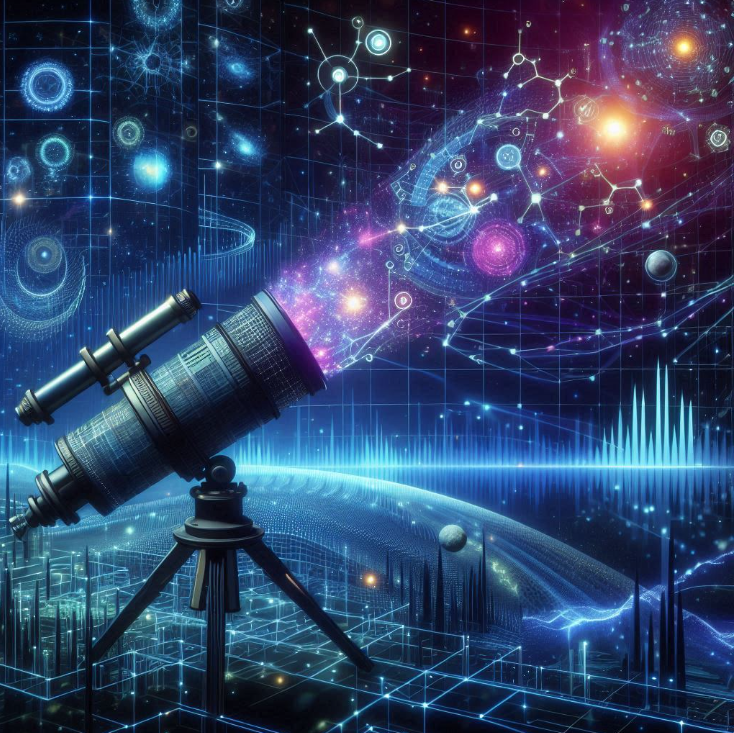
The Reality Bridge Telescope is an interactive UNNS Lab chamber that visualizes how a structured recursion layer reacts when it is driven by hybrid volatility streams — a mixture of synthetic oscillations and real-world signals (market, solar, weather, seismic).
Reality Stream · Diagnostics
The top-left panel displays the current state of the hybrid field. It reads like a “weather report” for the Surface Reality Layer:
- Market Volatility – main driver for particle speed and flare density.
- Solar Activity – adds cyan flares and long, smooth pulses.
- Seismic Energy – produces red micro-shocks in the grid.
- Quantum Entropy – how noisy the hybrid engine currently is.
- Prime Density – number-theoretic tension inside the grid.
- Golden Ratio Δ – deviation from a Φ-balanced configuration.
These values do not predict markets or earthquakes. They show how the UNNS substrate reacts to the incoming information flow.
Surface Grid · Reaction Field
The central green grid is the Surface Reality Layer. Every cell is a tiny probe watching for changes in hybrid volatility:
- Higher volatility → faster particle motion and brighter scatter points.
- Higher coherence → smooth teal trace line; lower coherence → jitter and knots.
- Prime-driven events occasionally light up individual cells as brief flares.
In UNNS terminology, the grid is a live visualization of how Operator VII (Structure) responds to forced hybrid dynamics.
Navigation & Lab Controls
On the right side, the Navigation block controls how the chamber explores the field:
- Auto Explore – lets the chamber drift through resonance bands on its own.
- Find Resonance – nudges the configuration toward interesting response zones.
- Toggle Gravity – changes how strongly particles are pinned to the grid.
Think of these controls as “camera moves” through the hybrid field rather than physical gravity.
Display & Energy Modes
The Display Modes determine how much of the internal engine becomes visible:
- UNNS Full Mode – complete grid, particles, flares, and diagnostics.
- Minimal – removes decorative layers; shows structural motion only.
- Poetic – focuses on smooth color flows and visual rhythm.
- Operator XII Mode – overlays residue/echo hints from the collapse operator.
- High-Energy Mode – increases micro-movement and highlight spikes, keeping values in the 0–40 range for visually rich but readable dynamics.
- Lab Guide – in-chamber help overlay (future extension).
These modes do not change the underlying data; they change the way the field is rendered.
Hybrid Diagnostics Panel
The slide-out Hybrid Diagnostics panel is the console for the hybrid engine:
- Shows which JSON feeds are online/offline.
- Displays current hybrid volatility and JSON volatility.
- Maintains a rolling fetch log (SUCCESS / FAIL) per source.
This turns the chamber into an actual lab instrument: you can see when reality goes offline.
Inputs & Mixing
The Reality Bridge combines three classes of input:
- Live JSON feeds – market, weather, seismic, solar (when available).
- Stable synthetic oscillators – ensure the chamber never freezes.
- UNNS structural noise – prime-driven and recursion-driven deviations.
These are blended into a single hybrid volatility value that controls most dynamic behaviors in the chamber.
What It Measures (and What It Doesn't)
The chamber does not attempt to predict markets or physical systems. Instead it measures:
- How a structured recursion field reacts to changing inputs.
- How coherence and volatility trade off over time.
- Where resonance zones and phase transitions visually appear.
It is an exploratory visualization tool, not a forecasting engine.
Outside UNNS
Even though UNNS is not used as a predictive theory, the Reality Bridge design hints at several real-world uses:
- Data Storytelling – presenting multi-source data (finance, climate, telemetry) as a single live field.
- Risk Dashboards – visualizing “stress” states in large systems, without claiming precise forecasts.
- Education – teaching chaos, coherence, resonance and hybrid systems in an intuitive way.
- Art & Installations – long-running gallery pieces where reality itself becomes the animation driver.
In all cases the chamber acts as a reaction surface: it shows how structure responds to incoming signals.
Why We Call It a “Reality Bridge”
The telescope bridges four layers at once:
- Raw reality – external feeds and numerical data.
- UNNS recursion – operators, prime structures and hybrid noise.
- Visual field – surface grid, particles, and high-energy pulses.
- Human perception – intuition, pattern recognition and curiosity.
It is a telescope pointed not at stars, but at the zone where information touches structure.