
When Plasma Finds Its Boundary:
H-Mode as Route Preservation
The Discovery in One Paragraph
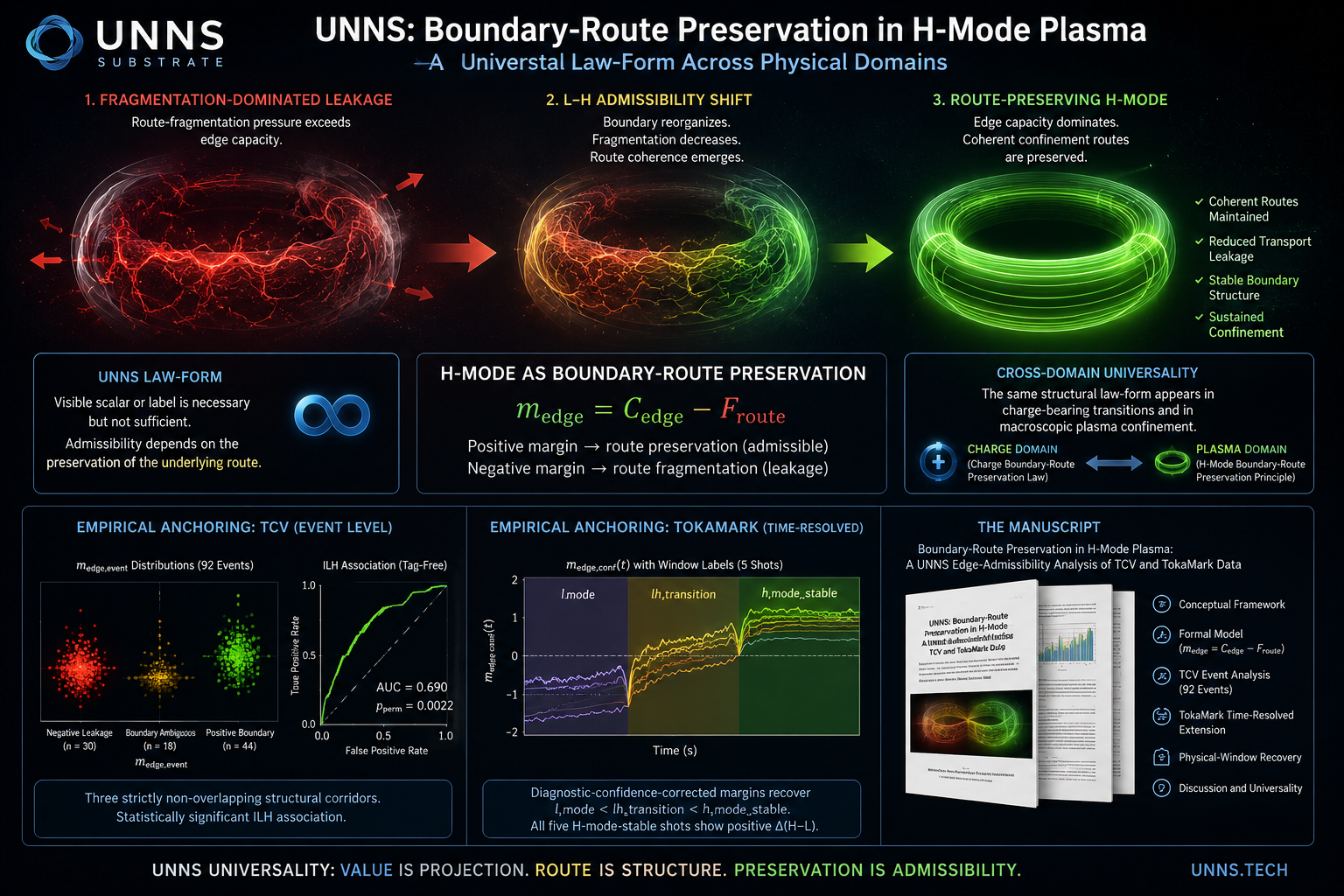
The H-mode manuscript establishes the first empirical UNNS formulation of plasma confinement as boundary-route preservation. It introduces the margin medge = Cedge − Froute, validates strict corridor ordering in a reviewed TCV subset, extends the structure to a 92-event TCV corpus, and recovers the ordered sequence l_mode < lh_transition < h_mode_stable in TokaMark/MAST physical windows under a diagnostic-confidence-corrected margin. Its main scientific value is not binary prediction but structural interpretation: it separates fragmentation-loaded H-mode access from edge-response-dominant route preservation. The deeper theoretical gain is cross-domain alignment with the Charge Boundary-Route Preservation Law — in both charge transitions and plasma confinement, visible balance or access is necessary but not sufficient; admissibility depends on preservation of the underlying route. This supports UNNS universality as law-form recurrence across domains, backed by domain-specific empirical constructions.
⚡ The Problem With "Power Crosses Threshold"
H-mode is the most important confinement regime for magnetic fusion energy. Since its discovery in 1982, it has been characterized as follows: when heating power crosses a threshold PLH, the plasma edge suddenly reorganizes — forming a steep temperature pedestal, an edge transport barrier, and approximately doubling confinement time. Standard physics identifies the key mechanisms: radial electric field formation, E×B velocity shear, turbulence suppression, and the role of the ion heat channel near threshold.
These accounts are physically correct and experimentally well-constrained. But they share a common framing: H-mode is a threshold-access event. Either power crosses the threshold and H-mode happens, or it doesn't. The binary label ILH = 1 carries the story.
The Hidden Structural Non-Uniformity
What the binary label does not tell you is how the plasma edge reaches H-mode. Two shots can both carry ILH = 1 — and yet occupy completely opposite structural configurations. One may have crossed into H-mode under high transport load, high power-balance pressure, and low edge-response: a fragmentation-loaded brute-force threshold crossing. The other may have crossed via edge-response dominance, low fragmentation pressure, and coherent boundary reorganization: a structurally clean route-preserving transition. Standard plasma variables treat these as the same event. The UNNS analysis separates them.
This is the central contribution of the H-mode manuscript: it introduces a structural coordinate — the edge-admissibility margin medge — that reveals what kind of boundary route produced each H-mode transition, not merely whether the transition occurred.
🔬 The Formal Model: medge = Cedge − Froute
The UNNS H-mode manuscript formalizes the structural balance in a single equation:
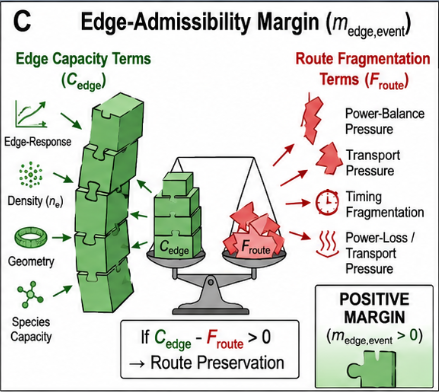
where Froute = route-fragmentation pressure = 0.35 · Spb + 0.35 · Str + 0.30 · Sti
and Cedge = edge-preserving capacity = 0.45 · Ser + 0.25 · ρdens + 0.15 · γgeom + 0.15 · σsp
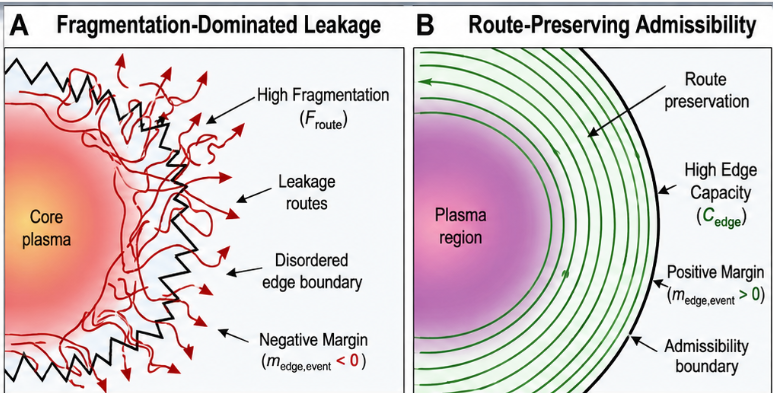
A positive margin corresponds to route-preserving admissibility.
A negative margin corresponds to fragmentation-dominated leakage.
Route Fragmentation (Froute)
- Spb — power-balance pressure (Ptotal / PRyter ratio)
- Str — transport pressure (χeff elevation, Ploss)
- Sti — timing fragmentation (transition-event spread)
High values = boundary under heavy structural load. Leakage-corridor shots: Str ≥ 0.960, Spb ≥ 0.961.
Edge Capacity (Cedge)
- Ser — edge-response score (candidate divertor/edge signal; dominant term)
- ρdens — density support (ne / nRyter percentile)
- γgeom — geometry stability (q95, κ, δ)
- σsp — species position (H/He fraction context)
High values = organized edge. Positive-boundary shots: Ser ≥ 0.945, Str ≤ 0.182.
Box 1 — Candidate Edge-Response Signal
Ser is a composite candidate edge-response proxy, not a direct Er or E×B measurement. It is constructed from divertor emission candidates, edge-profile sharpening proxies, and soft-X consistency signals in the TCV Zenodo corpus and TokaMark/MAST arrays. The primary quantitative carrier in TCV is divertor_signal_candidate. Direct validation against Er, E×B shear, pedestal-gradient evolution, or turbulence diagnostics remains future work. This transparency strengthens rather than weakens the result — the model explicitly acknowledges where confirmation is still needed.
Three Margin States
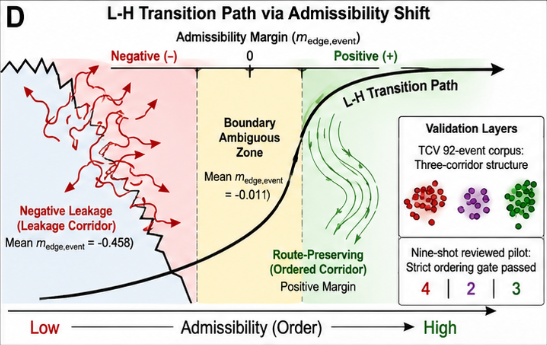
The margin medge,event maps each discharge event to one of three structural states. These states are thresholds, not continuous quantities — they describe the qualitative structural regime of the plasma boundary:
📊 Three Empirical Layers: From Nine Shots to Physical Windows
Layer 1 — TCV Nine-Shot Pilot: Strict Ordering
Nine manually reviewed TCV discharge events (from the TCV Zenodo 14996664 corpus) were scored using the edge-admissibility model. The nine shots were selected via a fragment-isolate mapping stage and suspect-shot identification procedure, then manually reviewed for physical consistency and labeled with branch-family tags (power_balance, transport, timing, edge_divertor_response). The result:
Layer 2 — TCV 92-Event Full Corpus
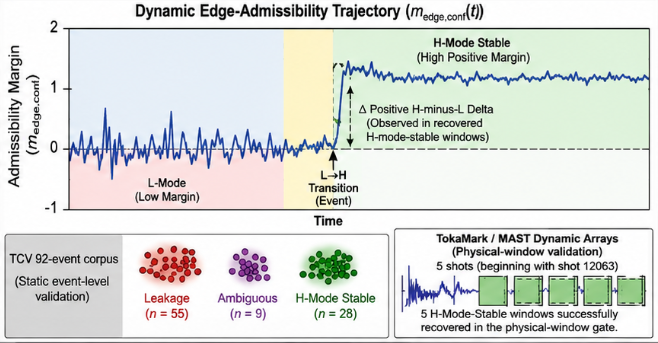
A tag-free numerical generalization of the model (v0.2) applied the same formula to all 92 canonical events from 66 unique TCV shots without manual branch-family tagging. The three-corridor structure persists at scale:
| Corridor State | n | Mean medge | 95% CI | ILH=1 Rate |
|---|---|---|---|---|
| Boundary Ambiguous | 68 | −0.038 | [−0.061, −0.015] | 0.956 |
| Negative Leakage | 11 | −0.356 | [−0.450, −0.270] | 0.636 |
| Positive Boundary | 13 | +0.341 | [+0.297, +0.395] | 0.923 |
Why AUC 0.690 Is the Right Answer
Standard plasma variables already classify ILH at LOO AUC = 1.000 on this corpus. The UNNS margin does not improve binary ILH prediction — and that is not a failure. The margin is a structural coordinate, not a binary classifier. Its value is revealing what kind of boundary route produced each event, not whether the event was H-mode or not. AUC 0.690 with permutation p = 0.0022 means the margin has a real, statistically significant association with ILH — but it is asking a different question than "did H-mode happen?"
Layer 3 — TokaMark/MAST: Time-Resolved Physical Windows
The time-resolved extension constructs medge(t) from public TokaMark/MAST HTTP diagnostic arrays, then applies a diagnostic-confidence correction medge,conf(t) to penalize incomplete-diagnostic intervals. Physical window labels (l_mode, lh_transition, h_mode_stable) were assigned from diagnostic evidence — with a strict non-circularity rule: labels were never informed by the UNNS margin itself. After conservative hardening (HARDENED_v0.2), 17 eligible windows were recovered from 5 shots.
| Label | Windows | Median medge,conf | Median Qdiag | conf+ fraction |
|---|---|---|---|---|
| L_MODE | 6 | −1.120 | 0.06 | 0 |
| LH_TRANSITION | 6 | −0.289 | 0.889 | 0 |
| H_MODE_STABLE | 5 | +0.053 | 1.000 | 0.261 |
Confirmed Ordering: L_MODE < LH_TRANSITION < H_MODE_STABLE
The expected structural ordering is confirmed in medge,conf: −1.120 < −0.289 < +0.053. The L_MODE windows sit at the diagnostic-confidence floor (Qdiag = 0.06, all critical diagnostics missing), so this is a confidence-corrected structural separation, not a raw-margin separation. The within-shot comparison (where each shot contributes its own L_MODE and H_MODE_STABLE window) directly controls for this confound — and all five shots show positive deltas.
🔭 The Main Discovery: H-Mode Access Is Structurally Non-Homogeneous
The most important finding is not that the UNNS margin correlates with ILH. It is that the margin reveals something binary ILH cannot: the structural route by which a plasma accessed H-mode.
Three Concrete Cases From the Corpus
Shot 68001 — ILH=1 (mixed), Negative Leakage, m = −0.227
This shot carries an H-mode indicator (in at least one time window), yet lands in the negative leakage corridor. Component values: Spb = 0.989, Str = 0.973, Ser = 0.287, Froute = 0.773, Cedge = 0.546. Structural reading: this shot reaches or briefly crosses the H-mode threshold in a fragmentation-loaded configuration — high power-balance and transport pressure dominate, despite moderate edge response. Consistent with the mixed ILH outcome (H-mode in one window, not in another).
Shot 67992 — ILH=1, Negative Leakage, m = −0.258
This shot is scored ILH=1 — H-mode obtained — yet it sits in the negative leakage corridor. Spb = 0.961, Str = 0.960, Ser = 0.282, Froute = 0.753, Cedge = 0.495. Structural reading: H-mode was obtained under high fragmentation load. The boundary was crossed by brute heating, not by edge reorganization. This is the clearest case of structural / binary-ILH divergence: predictive outcome is positive, structural coordinate places it at the fragmentation-dominated end of the ILH=1 set.
Shot 66445 — ILH=1, Positive Boundary, m = +0.528
All diagnostics present — no missing χeff or Ploss. Spb = 0.240, Str = 0.135, Ser = 0.970, Sti = 0.290, Froute = 0.218, Cedge = 0.746. Structural reading: this shot approaches H-mode through a configuration where edge capacity definitively exceeds fragmentation pressure across all fully diagnosed channels. Edge-response dominance (Ser = 0.970) is the defining feature. This is what the UNNS positive-boundary corridor looks like from the inside.
⚛️ Cross-Domain Alignment: The Charge Boundary-Route Law Recurs in Plasma
The deepest theoretical gain from the H-mode manuscript is not the empirical result on TCV or TokaMark. It is the demonstration that the same structural law-form that governs charge-bearing transitions also governs macroscopic plasma-boundary confinement.
Charge Domain
- Visible projection: scalar charge Q, charge balance Qi = Qf
- Structural invariant: route/closure coherence
- Forbidden: route-incoherent charge-balanced transition
- The law: charge balance is necessary but not sufficient; boundary-route preservation is the structural invariant
Plasma Domain
- Visible projection: threshold power, ILH label, H-mode access
- Structural invariant: edge-route preservation
- Fragmentation-loaded: H-mode access through brute heating without edge reorganization
- The law: threshold access is necessary but not sufficient; edge-route preservation is the structural invariant
The Repeated UNNS Pattern
In compact form: value is projection · route is structure · boundary preservation is admissibility · balance alone is not enough.
In the charge domain: Q is projection; route/closure is structure. In the plasma domain: ILH / threshold access is projection; edge-route preservation is structure. The H-mode manuscript gives this pattern a serious physical example in a macroscopic, noisy, time-dependent plasma-boundary setting. The same law-form survives the transfer from charge-bearing particle transitions to plasma confinement — without reducing everything to the same physical mechanism. That is what makes the result important for UNNS theory.
🔥 What This Adds to Plasma Physics
The manuscript does not replace standard H-mode theory. It does not derive E×B shear, radial electric fields, pedestal formation, or the power threshold. Standard plasma physics asks: what physical mechanisms produce H-mode? UNNS asks: what boundary-route regime does the transition occupy? These are complementary questions.
The Structural Reorganization of Standard Variables
| Standard Plasma Quantity | UNNS Role | Model Term |
|---|---|---|
| Heating power vs threshold | Route-fragmentation driver | Spb → Froute |
| Transport (χeff, Ploss) | Leakage pressure | Str → Froute |
| Transition timing stability | Transition fragmentation | Sti → Froute |
| E×B shear / divertor response | Edge-preserving capacity (proxy) | Ser → Cedge |
| Density ne | Support term | ρdens → Cedge |
| Geometry (q95, κ, δ) | Route-stabilizing context | γgeom → Cedge |
| Ion species | Capacity context | σsp → Cedge |
A New Interpretive Coordinate for Shot Analysis
The practical contribution is a new diagnostic overlay. It enables post-shot classification of events as:
- Fragmentation-loaded access — H-mode obtained under high transport and power-balance load, low edge reorganization
- Boundary-ambiguous transition — structural balance near the admissibility threshold
- Edge-response-dominant route preservation — H-mode accessed through genuine boundary reorganization
This distinction may matter for pedestal behavior, stability, ELM susceptibility, and H-L back transition analysis. It creates a path toward control-relevant diagnostics once medge,conf(t) is validated against direct edge measurements.
Robustness: Weight Sensitivity Analysis
The weight assignments in Froute and Cedge are fixed nominal values. To test whether the corridor structure is an artifact of the specific weight choice, all 14 single-weight perturbations of ±10%, ±20%, and ±30% were computed:
The robust result is ordered group separation, not absolute invariance of every threshold label. One boundary-ambiguous case approaches the +0.10 threshold under the Ser +30% perturbation, but remains far below the positive-boundary cluster (gap = 0.389 units). Combined or adversarial multi-weight perturbations are not tested — external anchoring to physical diagnostics remains the appropriate next step.
🔍 The Observability Lesson: No Admissibility Claim Without Diagnostic Support
One of the most important methodological discoveries in this project emerged from the TokaMark probe: shots 11776 and 11768 showed inflated positive-boundary fractions in the v0.1 margin — not because the edge was structurally organized, but because missing diagnostics meant low fragmentation evidence was available. The margin was measuring diagnostic absence, not genuine edge capacity.
This led to the diagnostic-confidence-corrected margin medge,conf(t), which penalizes intervals with incomplete coverage:
where Qdiag(t) ∈ [0,1] is the diagnostic quality score (coverage of NBI power, D-alpha, Thomson scattering Te/ne, soft-X, transport, geometry) and Pmiss(t) penalizes missing critical diagnostics. This connects directly to the UNNS Observability–Admissibility Duality: no structural claim is trustworthy without observability support.
🧭 What Has Been Established — and What Comes Next
Established
- A UNNS edge-admissibility margin organizes TCV and TokaMark/MAST plasma-transition data into interpretable boundary regimes
- TCV nine-shot pilot: strict corridor ordering (PASS)
- TCV 92-event corpus: three-corridor persistence (AUC 0.690, p=0.0022)
- TokaMark: L_MODE < LH_TRANSITION < H_MODE_STABLE in medge,conf
- All five within-shot H-minus-L deltas positive (+1.062 to +1.326)
- Charge boundary-route law-form recurrence in plasma domain
- Complete reproducible computational corpus [C1]
Still Required
- External anchoring: recovered H_MODE_STABLE windows vs expert-verified L-H timing records
- TCV positive-boundary corridor time traces (shots 66445, 69892, 68719 not yet in LH_DATA.h5)
- Direct validation of Ser against Er, E×B shear, pedestal gradients, turbulence diagnostics
- Cross-machine replication (FAIR MAST, AUG, DIII-D, or JET)
- Real-time control-relevant formulation
The Big Implication: A Domain-Independent Language for Boundary Transitions
The pattern identified in this manuscript — fragmentation pressure versus edge capacity, with admissibility as the balance condition — may extend beyond plasma. UNNS theory predicts the same structural law-form should appear wherever systems undergo transitions between fragmentation-dominated and route-preserving organized states. Possible future domains include ELM onset and boundary overload, H-L back transitions, power-grid cascading instability, materials fracture versus cohesion, biological membrane integrity, and network congestion and route collapse. The H-mode work matters because it gives this pattern a serious physical example backed by empirical data.
📁 Project Resources
Boundary-Route Preservation in H-Mode Plasma: A UNNS Edge-Admissibility Analysis of TCV and TokaMark Data
Full working manuscript: formal model, TCV nine-shot validation, 92-event full corpus extension, TokaMark time-resolved analysis, HARDENED_v0.2 physical-window gate, interpretive case studies, weight sensitivity appendix, cross-domain alignment with Charge Boundary-Route Law, full UNNS corpus bibliography [U1–U16].
UNNS-H Mode Project Research Corpus [C1]
Complete computational archive. Adapters, processed canonical data, STRUC-I/STRUC-PERC-I chamber inputs, 12 analysis scripts, per-shot model scores with all component values, full corpus extension outputs, TokaMark metadata scan, m_edge(t) probe, diagnostic-confidence revision, HARDENED_v0.2 labels, H-mode-stable evidence recovery (Doc 33), project manifests and reports.
TCV + TokaMark Edge-Admissibility Analytics Dashboard
Full interactive analytics companion. §1–§14 covering validation summary, formal model, TCV nine-shot corridor bars, ILH alignment, branch-family means, scope and limitations, 17-stage data provenance, 92-event full corpus (AUC, single-variable ranking), TokaMark m_edge(t) temporal probe, and physical window recovery gate with by-label table and within-shot L→H delta bars.
References
- Charge Boundary Routing: Fractional Coordinates, Composite Closure, and Route-Preserving Transitions
- The Charge Boundary-Route Law
- The Margin-Confinement Law: Structural Non-Crossability in Admissibility Space
- The Universal Structural Law v6
- Percolative Realizability Principle
- Admissible Cluster Geometry
- Beyond Fragmentation: The Forced Coherent Collapse Regime
- Connectivity Margin as a Coordinate of Realizability Space
- Bounded Structural Rigidity and Representation-Driven Structure
- Local Geometry of Realizability Boundaries in the UNNS Substrate
- Structural Realizability and Dual Observability
- Interaction Unification in the UNNS Substrate
Companion Manuscripts
Data: TCV Zenodo 14996664 · TokaMark/MAST public HTTP arrays · Instruments: STRUC-I v1.0.4 · STRUC-PERC-I v2.5.0
All derived numerical results generated through the UNNS-H Mode Project computational archive [C1]. Caution: Ser is a candidate edge-response proxy, not a direct Er measurement. Physical window labels are 2_SUPPORTED — internally consistent but not yet externally anchored to expert-verified L-H timing records. Results are ready for broader external anchoring and cross-machine validation.