
From ∅ to Structure:
Von Neumann’s Ladder
and the UNNS Substrate
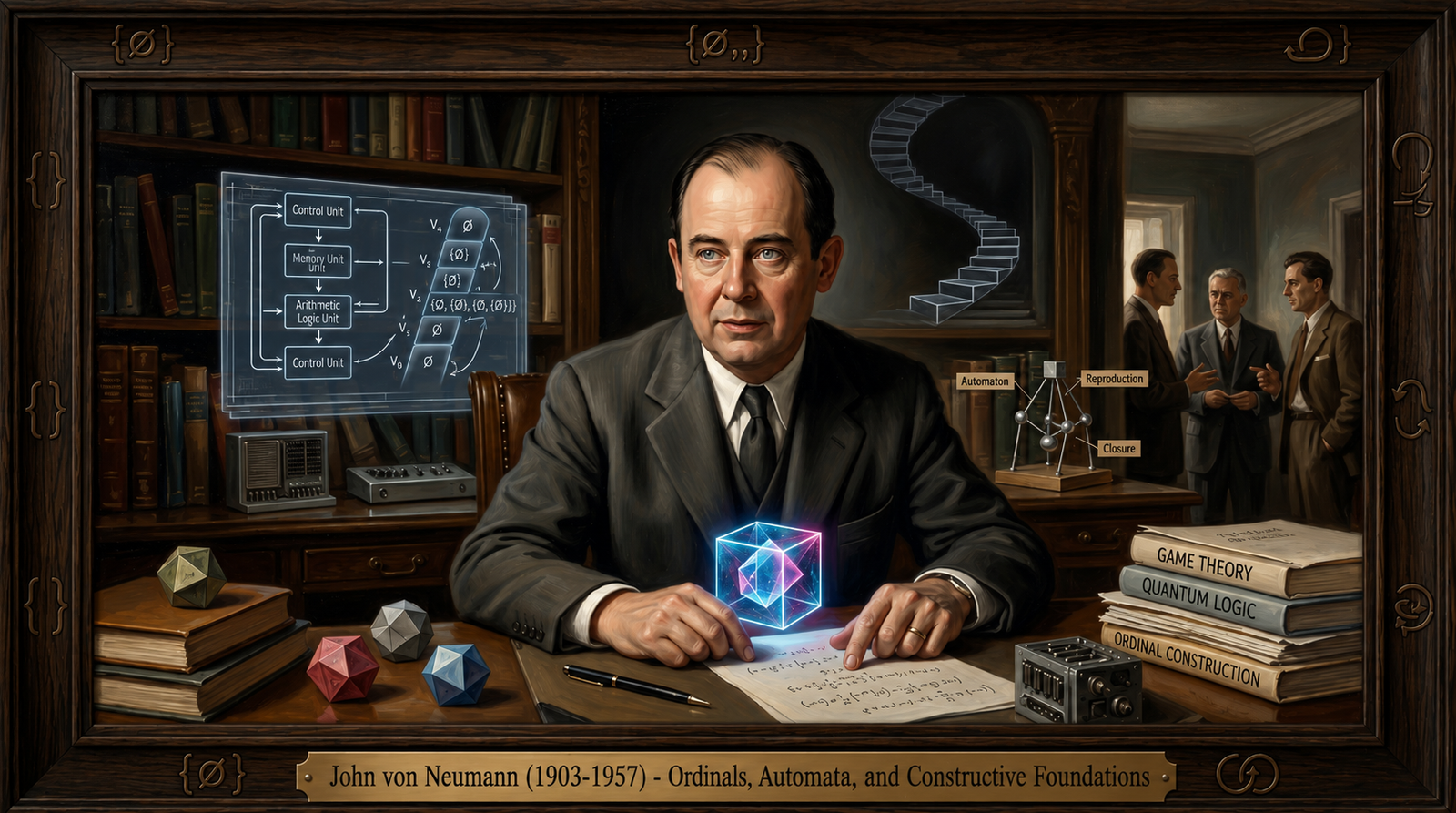
From this single null object, John von Neumann showed how the entire universe of natural numbers could be built by recursion alone. For the UNNS Substrate, this is not a historical curiosity. It is a foundational archetype. Von Neumann’s ladder shows how a universe of form can begin from a null seed — provided there is a rule of recursive containment. UNNS extends that insight across all of physics, computation, and mathematics: admissible structures may emerge through nested generative sequences whose survival depends on closure, coherence, and boundary preservation.
① The Number That Contains Its Ancestors
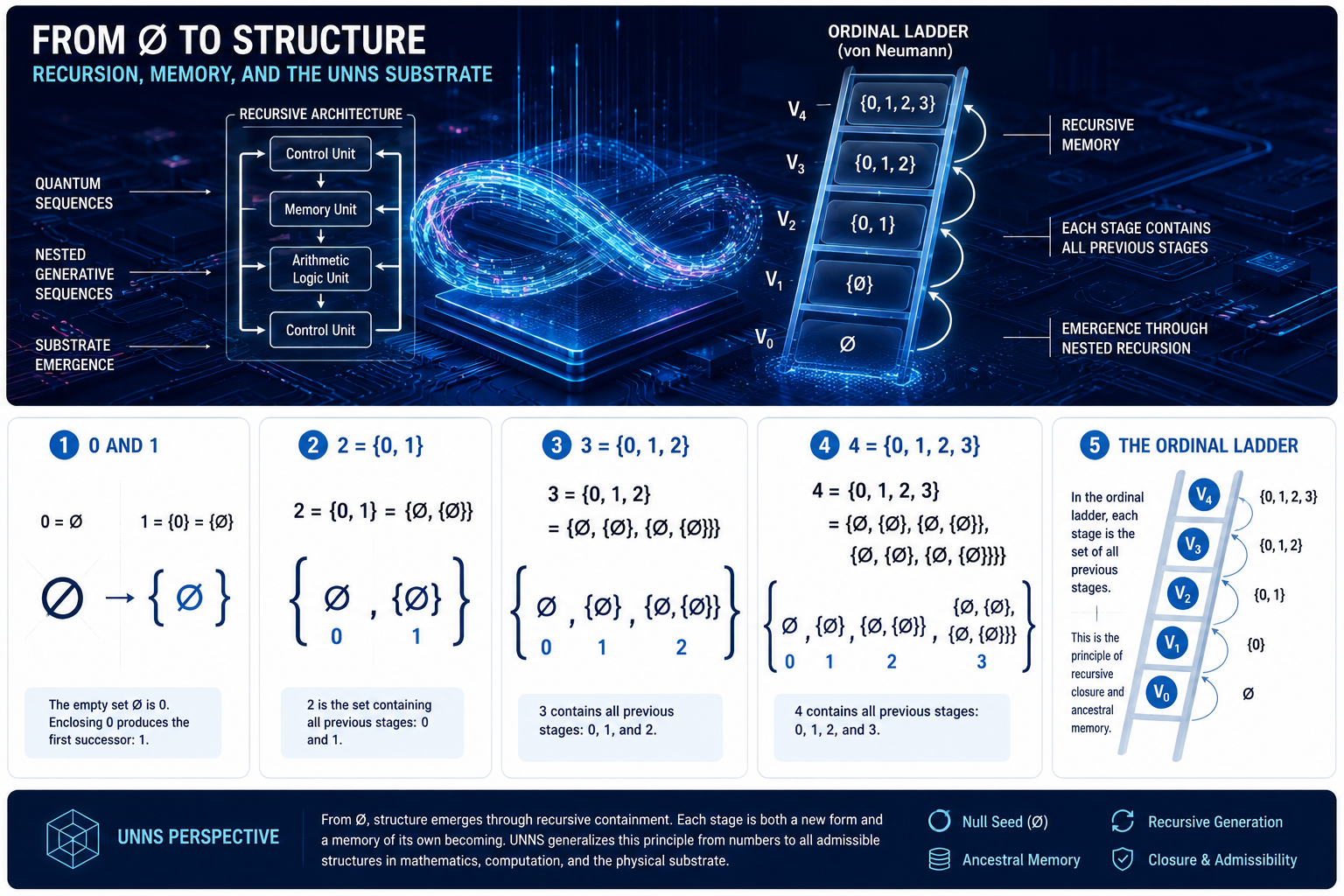
The von Neumann ordinal construction begins with a radical act of redefinition. A number is not a mark, a sound, a quantity, or a primitive object. It is defined entirely by its position inside a growing recursive hierarchy. Each natural number is the set of all natural numbers that precede it.
3 = {0, 1, 2} · 4 = {0, 1, 2, 3} · … · n = {0, 1, …, n−1}
Each stage contains all previous stages. Each new level preserves the previous levels inside itself.
General rule: Sₙ₊₁ = Sₙ ∪ {Sₙ} — every next stage is the closure over the prior admissible history.
The number 4 is not merely “four things.” It is the closure of the prior sequence — it contains 0, 1, 2, and 3 inside itself as members. Each stage accumulates its ancestry. A new number is not merely placed after the earlier ones; it contains them.
From the UNNS perspective, this is already a primitive ladder: V₀ → V₁ → V₂ → V₃ → V₄ → … The ladder does not grow by adding external material. It grows by recursively collecting what has already become admissible. This is why von Neumann ordinals are more than a definition of number — they are a mathematical demonstration that order, hierarchy, and complexity can arise from an empty origin when a lawful generative rule is present.
The Radical Idea — Relation Is Prior to Substance
Von Neumann’s construction was not a simplification. It was a revolution. It showed that a number need not be a primitive object — it can be a position in a recursively built structure. Substance is not required. What is required is a rule, and the permission to close over what the rule produces. This is the exact insight that UNNS generalizes to the physical substrate.
② Emptiness as a Generative Seed
The empty set is usually treated as absence — the trivial, the base case, the unremarkable. But in the von Neumann construction, ∅ behaves profoundly differently. It is absence that can be enclosed, referenced, repeated, and structurally amplified.
Once ∅ is allowed to function as a seed, a remarkable transformation becomes possible. Each step is not creation from nothing — it is creation by relation:
UNNS does not begin with a finished object. It begins with generative admissibility: a structure may emerge if it can be recursively formed, coherently retained, and closed without contradiction. The empty set, in the von Neumann construction, is exactly this — a stable ground state that licenses the first step of a generative sequence. Not void, but potential. Not absence, but origin.
This interpretation is developed in detail from the UNNS side in The Role of Zero in UNNS (UNNS Research Notes, September 2025), where zero — the UNNS substrate vacuum — is formalized not merely as absence but as: a universal fixed point of homogeneous recurrences (Lemma 3.1), a neutral baseline for all operator action, a stability threshold (spectral radius condition, Lemma 4.1), and a latent capacity field from which structured patterns may emerge under inletting. A near-critical vacuum (ρ(C) ≈ 1) acts as an amplifier for small perturbations — the substrate is sensitive, not inert. In set theory, ∅ seeds the von Neumann ordinals; in the UNNS substrate, 0 plays the analogous role of vacuum state and operational ground for the full Octad of UNNS operators.
③ Von Neumann’s Ladder as a UNNS Prototype
UNNS — the Unbounded Nested Number Sequences framework — studies structures that arise through recursive nesting, transformation, and admissibility. A UNNS structure is not merely a sequence of entries. It is a generative ladder whose stages preserve, transform, or re-encode earlier stages. Von Neumann’s ordinals provide a canonical prototype for exactly this.
Von Neumann’s Ordinal Ladder
- Each stage contains all previous stages
- Each stage is generated by a fixed, simple rule
- Each stage preserves its full ancestry
- Each stage is structurally distinguishable
- Every stage remains admissible — without exception
UNNS Generative Ladder (General Form)
- Each stage carries its generative history
- Each stage produced by an admissible operator sequence
- Each stage may transform — but preserves core relational structure
- Each stage evaluable by STRUC-I / STRUC-PERC-I instruments
- Admissibility is a survival condition — not a guarantee
In UNNS language: S₀ = ∅ and Sₙ₊₁ = Sₙ ∪ {Sₙ}. Or, more conceptually: the next stage is the closure over the prior admissible history. The ladder is not merely sequential. It is ancestral. Every new stage carries the memory of its own becoming.
Conceptually: next stage = closure over the prior admissible history
The ladder is not merely sequential. It is ancestral — every new stage carries the memory of its own becoming.
The Key Alignment — Ancestral Memory as Structural Invariant
Von Neumann showed one perfect ladder — every step valid, every stage admissible, the construction monotone and cumulative. UNNS studies the broader geometry of possible ladders and asks which ones survive. The ordinal construction is the limiting case of perfect admissibility: the ladder that never fragments, never collapses, never fails to close. The zero-crossing ladder. The universal reference point of UNNS structural analysis.
Number in UNNS — A Layered Structure
In the von Neumann construction, a number is a position in a recursive hierarchy — its identity includes the process that generated it. UNNS extends this into a full taxonomy formalized in Zero and Number in UNNS (UNNS Research Notes, September 2025). A number in UNNS may be simultaneously: a Number-as-Event (recurrence output uₙ at step n), a Number-as-Nest (depth index ℓ in the hierarchical lattice), a Number-as-Coefficient (propagation strength cⱼ shaping spectral properties), a Number-as-Echo (asymptotic spectral constant, e.g. φ from Fibonacci), and a Number-as-Perceptual-Form (Trans-Sentified rendering into a sensory channel). Von Neumann’s ordinal ladder instantiates all five simultaneously: 0, 1, 2, 3 are events (ordinal outputs), nest-depth indices (hierarchy addresses), implicit coefficient inputs (unit propagation), precursors to eigenvalue echoes, and in principle renderable perceptual forms.
④ UNNS Adds Admissibility — The Crucial Extension
Von Neumann’s ordinal ladder is beautifully clean. Every step works. The construction is monotone, cumulative, and stable. But UNNS asks a more general and more difficult question.
This is the point where UNNS moves beyond the ordinal construction. Von Neumann showed one perfect ladder. UNNS studies the broader space of possible ladders and asks which ones are admissible. A structure must not only be generated — it must remain coherent under recursive pressure, preserve enough closure to continue, and avoid collapsing into contradiction, incoherence, or non-existence.
The Real Problem — How Structure Survives
The real problem is not only how structure begins. The real problem is how structure survives. The von Neumann ladder becomes a privileged example of an admissible recursive structure — stable, nested, memory-preserving, closure-consistent. But UNNS also asks what lies outside such stability: the space of recursive processes that fragment, collapse, or reach boundaries they cannot cross. The UNNS empirical corpus — 15,000+ ladder evaluations across 16+ domains — maps exactly this broader geometry.
⑤ Operators Hidden Inside the Ordinal Construction
The von Neumann construction can be read through the UNNS operator lens. The empty set begins as a null seed. The first distinction appears when ∅ is enclosed. Each subsequent level admits the previous levels into a new container. The ladder normalizes itself by repeating the same rule at every stage. This disciplined sequence corresponds naturally to core UNNS operators:
An Operator Sequence in Disguise
From the UNNS viewpoint, the ordinal construction is one of the purest known examples of recursive structural generation. It demonstrates that even the simplest possible null state can, under appropriate operators, generate an infinite and internally consistent hierarchy — provided the operators respect closure, coherence, and ancestry at every stage. Von Neumann’s ladder is not merely a mathematical construction. It is an operator sequence performing the same disciplined transformation that UNNS instruments evaluate across physical, computational, and mathematical domains.
⑥ The Formula — Why ∅ Alone Is Not Enough
It is tempting to say that von Neumann built numbers from nothing. In one sense, this is true — the construction begins with ∅. But nothing alone does not generate number. The empty set must be paired with a rule. Without a recursive rule, ∅ remains ∅. With a recursive rule, ∅ becomes the seed of a hierarchy.
The Incomplete Picture
∅ alone remains ∅.
Without a recursive rule to carry it forward, the empty set generates nothing. Structure does not emerge from emptiness through passive existence — it requires a generative law to actualize its latent potential.
The Complete Picture
∅ + admissible recursion → hierarchy.
The empty set paired with a closure-preserving recursive rule becomes the seed of an infinite hierarchy. The rule performs the work. Closure provides the stability. Admissibility supplies the boundary of survival.
The empty set supplies the seed. The recursive rule supplies the motion. Closure supplies the stability. Admissibility supplies the boundary of survival.
The formula is not nothing → everything. The formula is null seed + admissible recursion → structured ladder. UNNS does not claim that structure magically appears from emptiness. It claims that structure emerges when a null or primitive condition is placed under a generative law that can preserve coherence across stages. Von Neumann demonstrated the simplest possible case. UNNS maps the full geometry.
⑦ From Number to Computation to Self-Reproduction
Von Neumann’s work did not stop at set theory. He shaped the foundations of computing, game theory, cellular automata, and — most remarkably — the abstract theory of self-reproducing machines. The same hidden pattern returns in each domain.
A self-reproducing automaton must contain not only a body of operations but also a description that can be copied and interpreted. It must preserve a generative grammar of itself — a structure and a code for reconstructing that structure. This is strongly UNNS-like: a system that persists not by existing, but by carrying the instructions for its own continuation.
| Domain | Von Neumann Contribution | UNNS Parallel |
|---|---|---|
| Set Theory | Ordinal construction from ∅ | Null seed → recursive ladder → admissible hierarchy |
| Computer Architecture | Stored-program machine (code = data) | Structure carries its own generative description |
| Cellular Automata | Local rules → global structure | Local relational constraints → substrate-level coherence (USL) |
| Self-Reproduction | structure + code → reconstruction | Admissible structure + generative grammar → persistence through time |
| Game Theory | Strategic closure under rational play | Admissibility as closure condition for structural survival |
The Abstract Logic of Persistence
Von Neumann did not predict the biochemical structure of DNA — but he did anticipate, at an abstract level, the logic of self-reproduction by encoded instruction. That is precisely the type of insight UNNS is designed to generalize: a system persists when it does not merely exist at one stage, but carries the admissible instructions by which its structure can continue. Structure + code → reconstruction. Operator + description → reproduction. Body + grammar → continuity. Von Neumann saw all of these as instances of one deeper pattern. UNNS is the formal framework for studying when and why that pattern holds.
⑧ The Ladder and the Substrate
The UNNS Substrate can be understood as a generalization of the ladder idea. In von Neumann’s construction, the ladder is purely mathematical. In UNNS, the ladder becomes structural — a principle about the conditions under which any form of ordered existence, across any domain, can persist.
The shift from mathematical ladder to substrate ladder is important. Von Neumann gives a way to construct number. UNNS asks whether similar principles underlie broader domains: physical states, computational processes, charge routing, admissibility spaces, and the emergence of coherent systems across atomic, nuclear, cosmic, and biological scales.
The Substrate Principle
A structure is real within the substrate not merely because it can be named, but because it can be generated, nested, stabilized, and carried through transformation. In this sense, the von Neumann universe is not only a set-theoretic construction. It is an ancestral image of substrate formation — showing that form can arise when recursion preserves its own history. UNNS turns this image into a falsifiable research program spanning 30+ computational chambers and 16+ physical domains.
⑨ The UNNS Interpretation — And Why It Matters
UNNS is the study of what kinds of ladders reality can admit.
The Pattern That Recurs Everywhere
The importance of von Neumann’s construction is not only that it defines natural numbers. Its deeper importance is that it demonstrates a pattern that recurs throughout every domain UNNS has studied:
- A null origin can become a universe of distinctions
- A simple rule can generate unbounded hierarchy
- A stage can contain its ancestry — memory is structural, not merely symbolic
- A structure can be both an object and a record of its own formation
The same logic reappears whenever a system is not merely assembled, but recursively generated. In mathematics when numbers arise from sets. In computation when programs act on encoded instructions. In biology when reproduction depends on stored generative information. In physics when structures persist only through admissible boundary conditions and closure relations.
The observation extends to the nature of number itself. In UNNS, number is not a primitive given but a layered construct: an event in a recurrence, a depth index in a nest, a coefficient shaping spectral properties, an asymptotic echo, a perceptual form. This structure — developed formally in Zero and Number in UNNS — reveals that the same number, read from different vantage points in the UNNS framework, carries fundamentally different information. Von Neumann’s construction already embeds this: the identity of each ordinal includes the process that generated it, not just the label it carries. UNNS formalizes number as processual rather than fixed: a record of the recursion that produced it, an address in a hierarchy it helps to build, and a coefficient in the law it obeys.
The Universal Question
Von Neumann’s ladder gives us a pure mathematical icon of this principle. UNNS turns the icon into a broader scientific question: What kinds of ladders can reality admit? Which generative sequences close coherently? Which fragment? Which survive at the boundary between admissibility and collapse? The ordinal construction answers the question for the simplest possible case — from ∅ to ω. UNNS answers it for the full range of physical, computational, and mathematical existence — from atomic spectra to cosmological trajectories, from seismic waveforms to biological fitness landscapes, from heliospheric plasma to nuclear detonation sequences.
The First Door
The empty set is often introduced as the symbol of nothing. But in the von Neumann universe, ∅ is not the end of thought.
It is the beginning of structure.
Once ∅ can be enclosed, remembered, and recursively carried forward, number appears. Once number appears, hierarchy appears. Once hierarchy appears, the possibility of a substrate appears.
This is why von Neumann’s construction belongs naturally beside UNNS. It shows, in the most minimal possible form, that the origin of structure is not necessarily substance.
It may be recursion under closure.
UNNS begins where this insight becomes general — not only numbers from nothing, but admissible worlds from nested generative law.
∅ is not merely empty. It is the first door.
Resources & Related Work
-
Zero and Number in UNNS — Primary Internal Reference:
unns.tech — Zero and Number in UNNS: Substrate Vacuum, Modular Structure, and the Multi-Faceted Nature of Number. UNNS Research Notes, September 24, 2025. — Formalizes zero as both absorbing nest and universal modulus anchor (Theorem 4.4); develops the five layered definitions of number in UNNS (Number-as-Event, Number-as-Nest, Number-as-Coefficient, Number-as-Echo, Number-as-Perceptual-Form); proves spectral stability lemmas and gives the Octad operator taxonomy relative to the vacuum. Primary internal UNNS reference for this article’s treatment of zero, number, and recursive emergence. -
The Role of Zero in UNNS — Technical Support:
unns.tech — The Role of Zero in UNNS: Formal Definitions, Fixed-Point Lemmas, and Operational Significance. UNNS Research Notes, September 23, 2025. — Proves zero is a universal fixed point for UNNS recurrences (Lemma 3.1); establishes spectral contractive stability (Lemma 4.1); formalizes zero as substrate vacuum, neutral baseline, stability threshold, and latent capacity field for operator action. Technical support for this article’s treatment of ∅/0 as generative origin and active substrate condition. -
The Margin-Confinement Law (Manuscript):
unns.tech — The Margin-Confinement Law: Structural Non-Crossability in Admissibility Space — Proof that ∂ℳ_adm is a dynamically non-penetrable invariant manifold for identity-preserving flows. 15,401 evaluations · 0 genuine crossings. -
Admissibility in Living Matter (Article):
unns.tech/labs/admissibility-in-living-matter — UNNS framework extended to biological fitness landscapes and NK-model systems. Published March 2026. -
Von Neumann Ordinal Construction (Primary Source):
J. von Neumann, “Zur Einführung der transfiniten Zahlen,” Acta Scientiarum Mathematicarum (Szeged), 1923. — Original formulation of ordinals as sets of all preceding ordinals: the first ladder from ∅. -
Von Neumann Self-Reproducing Automata (Primary Source):
J. von Neumann, Theory of Self-Reproducing Automata, University of Illinois Press, 1966 (ed. A. Burks). — Abstract theory of self-reproduction by encoded instruction — a direct UNNS archetype. -
The Universal Structural Law
Empirical manuscript establishing the Universal Structural Law and the admissibility-bound framework for ordered physical ladders.
UNNS Substrate Research Program · From ∅ to Structure: Von Neumann’s Ladder and the UNNS Substrate · Conceptual Bridge Series · 2026 · Instruments: STRUC-I v1.0.4 · STRUC-PERC-I v2.5.0 · unns.tech