Why Some Real Things Cannot Appear Alone:
Color Confinement and the UNNS Principle of Admissible Closure
In Short
Color confinement — the fact that no experiment has ever isolated a single quark or gluon — is one of the most robust and conceptually stubborn facts in particle physics. This research does not try to explain why quarks are confined; QCD and lattice gauge theory already own that question. Instead, it asks a UNNS-shaped question: what does confinement look like as a statement about admissibility?
The answer sharpens a distinction that had, until now, mostly lived at the structural level of the UNNS Substrate: internal reality is not the same thing as external admissibility. A colored quark is genuinely, physically present inside a hadron. It is simply never an admissible free output. Under attempted separation, the system does not fail — it repairs the inadmissible route into a new color-neutral composite. That reframing, and a bounded diagnostic coordinate built to test it, are what this article walks through.
⛓️ The Central Gain: Confinement Becomes Admissibility-by-Closure
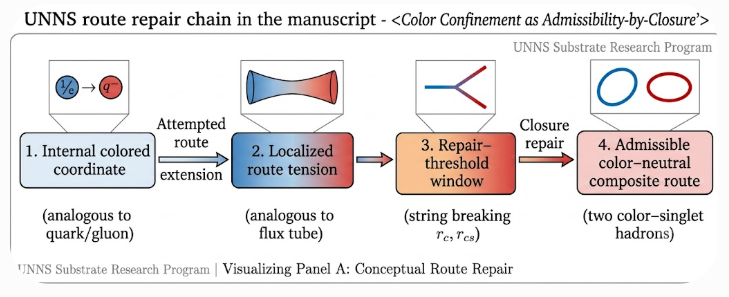
The ordinary phrasing — "quarks cannot escape" — is not wrong, but it is incomplete. It describes an absence. It does not describe what happens instead. The UNNS reading fills that gap with a five-stage route chain, and that chain is the conceptual heart of the entire research program:
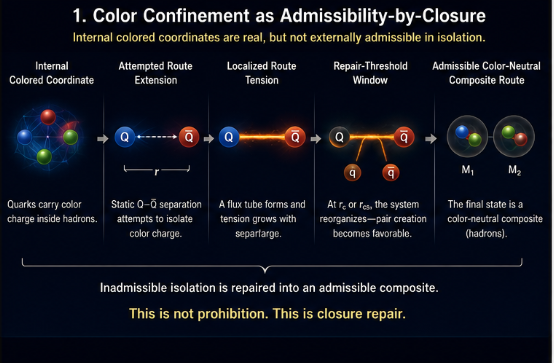
Why does this matter beyond a relabeling exercise? Because internal reality ≠ external admissibility had, until this research, been mostly a structural claim inside the UNNS Substrate — abstract, hard to anchor. Color confinement became a physical test case for the idea that something can be real inside a system while being inadmissible as a free external output. That is a major gain for the UNNS framework, and it is why this manuscript treats color confinement as a benchmark, not a derivation.
📖 A UNNS Structural Dictionary for Confinement
The manuscript's mapping table is one of the strongest deliverables of the project, because it turns a physical phenomenon into a structural dictionary — a relabeling of already-established QCD phenomenology in UNNS route language, introducing no new physics of its own.
| QCD confinement object | UNNS reading |
|---|---|
| Colored quark / gluon | Internally real route-coordinate |
| Isolated color charge | Externally inadmissible primitive |
| Color-neutral hadron | Admissible closed composite |
| Static Q–Q̄ separation r | Route-extension coordinate |
| Static spectrum V₀(r), V₁(r), V₂(r) | Boundary-pressure / route-tension spectrum |
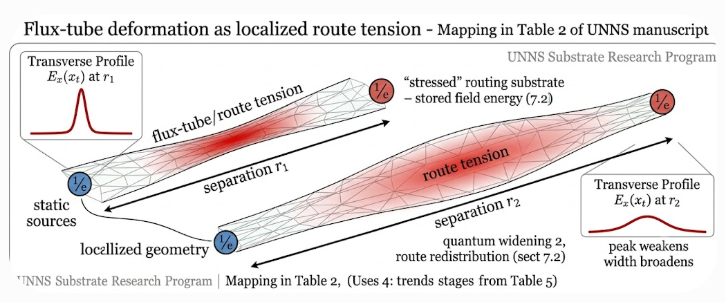
| Flux tube | Localized route tension |
| Flux-tube transverse profile Ex(xt) | Localized route geometry |
| String-breaking threshold | Repair-threshold marker |
| Quark–antiquark pair creation | Closure repair |
| Two-meson / screened channel | Repaired admissible composite route |
| Absence of free quarks in the spectrum | Observability constrained by admissibility, not raw non-existence |
Revelation — Observability Is Not the Same as Reality
Perhaps the most philosophically important result: the absence of isolated colored particles does not mean colored constituents are unreal. UNNS expresses this cleanly — observable objecthood requires admissible closure, not merely internal existence. That distinction reaches well beyond QCD.
🔧 Repair, Not Prohibition
The manuscript's "repair instead of illegal decomposition" section is, arguably, its most original conceptual contribution. The forbidden route is not what most informal descriptions imply:
Not this
hadron → free quark + free quark (forbidden)
But this
hadron under separation → route tension → quark–antiquark creation → new hadrons
A Boundary Violation Can Be Constructive
A boundary violation does not necessarily destroy structure; it may force recomposition into a new admissible closure. Confinement, on this reading, is not merely prohibitive — it is reparative. This connects directly to broader UNNS themes: catastrophe routing, repair geometry, boundary preservation, transition admissibility.
The two reported repair-threshold markers in the diagnostic corpus give this idea a concrete anchor — the light and strange static-light screening channels reported in the underlying lattice literature:
As route tension increases toward these markers, the system does not approach "where free color appears." It approaches a window where the inadmissible route reorganizes into a screened, color-neutral composite channel. The threshold marks reorganization, not escape.
📈 Diagnostic Realization: The Boundary-Pressure Coordinate Πboundary(r)
Concept alone is not enough — the research also built a bounded diagnostic layer to test whether the repair-window idea can be coordinatized: turned into a single, well-behaved structural observable. The result is Π_boundary(r), combining channel-gap compression, proximity to the nearest repair marker, and gap-reorganization slope into one static-only boundary-pressure coordinate.
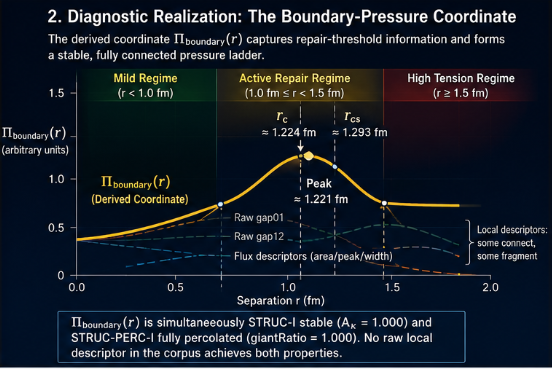
Below is the same relationship plotted directly from the 17-row repair-window corpus — not a stylized rendering, but the actual reported Π_boundary(r) values against separation r, with the two repair thresholds marked:
A methodological — not physically calibrated — three-band classification places the 17 rows into Mild Tension (7 rows), Active Repair Window (9 rows), and High / Near Repair (1 row). The single high-band row sits at r = 1.22094 fm, immediately adjacent to the reported light-channel threshold r_c = 1.224 fm:
Revelation — The Correct Coordinate May Be Derived, Not Raw
The strongest object in the whole diagnostic package was not a raw flux peak, width, or gap taken alone — it was the derived coordinate Π_boundary(r). UNNS should not always look for the "true signal" directly in raw observables. Sometimes the structural coordinate appears only after normalization, combination, threshold localization, and repair-window encoding.
🧪 Chamber Result: Admissibility Meets Connectivity
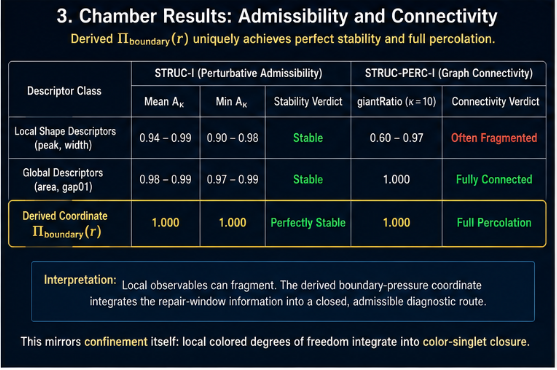
Nine chamber-ready ladders, all derived from quality-controlled rows only, were run through two independent instruments: STRUC-I, which tests admissibility under perturbation, and STRUC-PERC-I, which tests gap-connectivity. A ladder can pass one test and fail the other — and several do.
| Ladder | n | STRUC-I | mean Aκ | STRUC-PERC-I verdict |
|---|---|---|---|---|
| flux_FULL_area_trusted | 15 | GP / Weak Persist. | 0.99996 | FULL_PERCOLATION |
| flux_FULL_peak_trusted | 15 | GP / Weak Persist. | 0.95826 | HARD_FRAGMENTATION |
| flux_FULL_width_trusted | 15 | GP / Weak Persist. | 0.99999 | HARD_FRAGMENTATION |
| flux_NP_area_trusted | 13 | GP / Weak Persist. | 0.99974 | FULL_PERCOLATION |
| flux_NP_peak_trusted | 13 | GP / Weak Persist. | 0.99558 | FULL_PERCOLATION |
| flux_NP_width_trusted | 13 | GP / Weak Persist. | 1.00000 | HARD_FRAGMENTATION |
| static_gap01_repair_window | 17 | GP / Stable Structure | 0.99849 | FULL_PERCOLATION |
| static_gap12_repair_window | 17 | GP / Stable Structure | 1.00000 | HARD_FRAGMENTATION |
| Π_boundary(r) | 17 | GP / Stable Structure | 1.00000 | FULL_PERCOLATION |
Finding — Local Descriptors Can Fragment
Four of the eight raw local-descriptor ladders reach HARD_FRAGMENTATION under STRUC-PERC-I despite being individually STRUC-I admissible; the other four reach FULL_PERCOLATION. The pattern separates global route-integral coherence (area, gap₀₁) from local shape sensitivity (peak, width, gap₁₂). No single raw observable should be treated as "the confinement signal."
Finding — Π_boundary(r) Is the Strongest Chamber Result in the Package
It is simultaneously STRUC-I Geometric Persistence / Stable Structure (mean Aκ = 1.000, min Aκ = 1.000) and STRUC-PERC-I Full Percolation (giantRatio = 1.000, κ_connect = 10, 0 isolated nodes of 17). No raw local descriptor achieves both properties at once — the derived coordinate is a coordinatizing observable, taking fragmented lower-level descriptors and producing a stable, fully connected pressure coordinate.
🖥️ Explore the Full Diagnostic Analytics
Every number in this article — corpus counts, QC dispositions, chamber verdicts, and the Π_boundary(r) ladder — is drawn from the full interactive analytics dashboard below. It is embedded live; scroll within the frame to explore the complete source-provenance registry, all nine chamber ladders, and the finding-by-finding breakdown.
🛡️ Data Status and the Evidentiary Boundary
This is the section that protects everything above it. The package underlying the diagnostics is documented, in its own provenance records, as a data seed — a source-indexed, QC-annotated diagnostic starting point — and explicitly not a raw lattice-data repository.
- The static-source energy levels are model-reconstructed by diagonalizing the published 3×3 Hamiltonian of Bulava et al. (2019) — not raw GEVP lattice points.
- The Baker flux-tube profiles are author-ancillary pointwise data, usable only after the quality-control pass reported above.
- Every row carries a source identifier, a source URL/arXiv/DOI, and a
row_provenancetag drawn from a controlled vocabulary of nine values. - Cardoso et al. (2013) is registered as a secondary, pure-gauge control source but has not yet been extracted into any data table used here.
What This Manuscript Explicitly Does Not Claim
It does not derive QCD confinement. It does not derive the QCD mass gap. It does not replace the gauge-theoretic account of color confinement. It does not use raw GEVP tables. It does not claim that Π_boundary(r) is a physical potential or a physical law — the weights in its definition are specific to one working version, not universal.
The relation to QCD stays carefully bounded throughout: QCD explains the dynamics. UNNS gives a structural admissibility interpretation of the observed confinement pattern. These are not competing theories in this manuscript — UNNS is an admissibility framework layered over already-known physical structures, not a substitute for them.
🌐 The Principle in the Wider UNNS Program
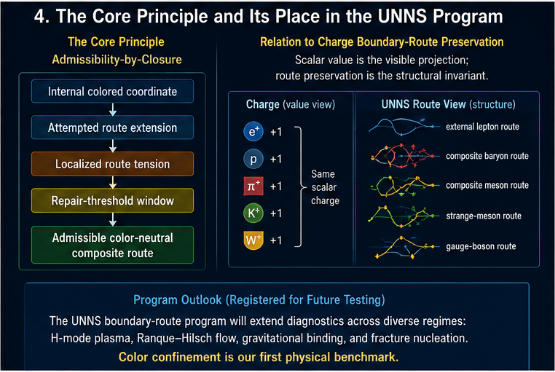
The UNNS program has separately studied electric charge as a boundary-route quantity. The two results reinforce each other through a shared structural pattern:
Charge Boundary Routing
Scalar charge value is a projection. Route preservation is the structural invariant. Scalar charge balance is necessary but not sufficient for structural admissibility.
Color Confinement
Colored constituent identity is internal. Color-neutral closure is the admissible external route. Local/internal identity does not determine admissible external structure.
Both support a broader UNNS principle: local value or internal coordinate does not determine admissible external structure — route closure does. That is a program-level gain, not just a result specific to QCD.
Registered, Not Claimed: Future Cross-Regime Tests
The manuscript deliberately keeps these outside its own result. They are motivated extensions, listed here as context for where the boundary-pressure idea may travel next — none of them are chamber-tested yet.
H-Mode Plasma Confinement
Edge-admissibility margin m_edge,event proposed for comparison against Π_boundary(r).
Not yet chamber-testedRanque–Hilsch Flow
Thermal route separation as a candidate boundary-pressure analogue.
Not a result of this manuscriptGravitational Binding
Boundary pressure and reorganization under extreme binding regimes.
Not a result of this manuscriptFracture Nucleation
Stress boundary and crack-route repair as a mechanical analogue of closure repair.
Not a result of this manuscript🎬 Watch: The Idea in Motion
🗺️ Supplementary Diagrams
Two lighter-weight schematic illustrations complement the dashboard-style figures above: one zooms into the flux-tube geometry that gives route tension its physical shape, the other summarizes the entire repair chain as a single visual sequence.
✅ Final Synthesis: What the Research Establishes
This work establishes color confinement as a physical benchmark for the UNNS idea of admissibility-by-closure. It does not claim a new solution to QCD confinement; instead, it shows how an established confinement phenomenon can be read structurally: an internal colored coordinate may be real inside the system while remaining inadmissible as a free external object.
The diagnostic contribution is the derived coordinate Πboundary(r), which organizes repair-window information into a chamber-stable and fully connected UNNS structure. In that limited but meaningful sense, the research turns confinement from a purely negative statement — “free color is not observed” — into a constructive route principle: attempted externalization is repaired through color-neutral closure.
Resources & References
-
Primary Manuscript (PDF):
Color Confinement as Admissibility-by-Closure: A UNNS Boundary-Route Interpretation
Full derivation, QCD→UNNS mapping table, repair-threshold reading, diagnostic corpus, and chamber results. UNNS Substrate Research Program · 2026. -
Analytics Dashboard (Interactive HTML):
Color Confinement — UNNS Analytics
Full source-provenance registry, all nine chamber ladders, QC dispositions, and finding-by-finding breakdown. -
Data and Corpus Construction (Archive):
color_confinement_data_seed_v0_1_1_provenance.zip
Source-indexed data seed pack: static-level and flux-profile CSVs, provenance manifest, QC validators, chamber-input/output files.