
Charge Is Conserved as a Value — But Structured as a Route
The central revelation
Phase 3C shows why charge conservation alone is not enough. A transition can balance total charge and still fail the deeper route/closure admissibility test. The forbidden boundary does not appear as simple graph disconnection — it appears as route-transition collapse.
What the manuscript changes
Electric charge is usually treated as a conserved scalar: a number carried by a state, balanced before and after a transition. That representation is indispensable. But it is also compressed. A positron, proton, positive pion, positive kaon, and W+ boson all carry Q/e = +1; in scalar bookkeeping they project to the same value. Structurally, they are not the same kind of object.
Charge Boundary Routing I asks whether that difference can be made testable. Its answer is yes: charge-bearing systems can be represented by layer, route, closure, composition, and boundary-status coordinates. In that representation, charge conservation remains true — but it is not the whole admissibility law.
1. The core idea: value is projection, route is structure
In ordinary notation, charge conservation says that the total charge before a process equals the total charge after it. The equation is visible and powerful. But it hides the route by which the value is carried. A free lepton, a composite baryon, a meson, a strange meson, and a gauge boson can all project to the same charge value while belonging to different structural regimes.
The UNNS (Unbounded Nested Number Sequences) view treats this as a boundary-routing problem. The scalar value Q is preserved, but the structural question becomes: which route carries the charge value, how does fractional charge close, and where does externalization terminate?
Standard scalar view
Charge is represented by its externally visible value. If two objects have Q/e = +1, they match in scalar projection.
UNNS route view
Objects also carry layer, route, closure, and boundary information. Same charge value does not imply same structural route.
2. What was built: a six-phase empirical chain
The manuscript does not rest on one diagram or one example. It builds a sequence of six tests. Each phase closes a different objection: that the layers are arbitrary, that the route coordinates are cosmetic, that same charge might erase all structure, that allowed transitions might not preserve routes, or that forbidden examples might be indistinguishable from allowed ones.
| Phase | Test | Main result | Interpretation |
|---|---|---|---|
| 1 | 40 charge-boundary objects | Four structural regimes | Charge-bearing systems are not a flat scalar class. |
| 2 | AB, BC, CD, ABC, BCD bridges | Charge topology and route topology differ | Coordinate choice determines which structure is visible. |
| 2C-P | Five Q/e = +1 objects, ten pairs | structural_route_pair_code reaches Stable Structure, Aκ = 1.000 | Equal charge is not route equivalence. |
| 3 & 3B | Allowed transitions | Route and closure transition encodings become Boundary-Stabilized | Allowed transitions preserve route/closure geometry. |
| 3C | Allowed + forbidden + constrained contrast | Graph remains connected; route_transition_code collapses to SB/TS | Forbiddenness is route-admissibility pressure, not graph disconnection. |
3. The four layers of charge-boundary structure
The first discovery is ontological: charge-bearing objects separate into four regimes. Layer A contains free external closure states such as leptons, photons, and gauge bosons. Layer B contains confined fractional coordinates such as quarks and antiquarks. Layer C contains composite closures, where internal fractional routes close into externally admissible integer or neutral states. Layer D contains terminal boundary absences and constraints.
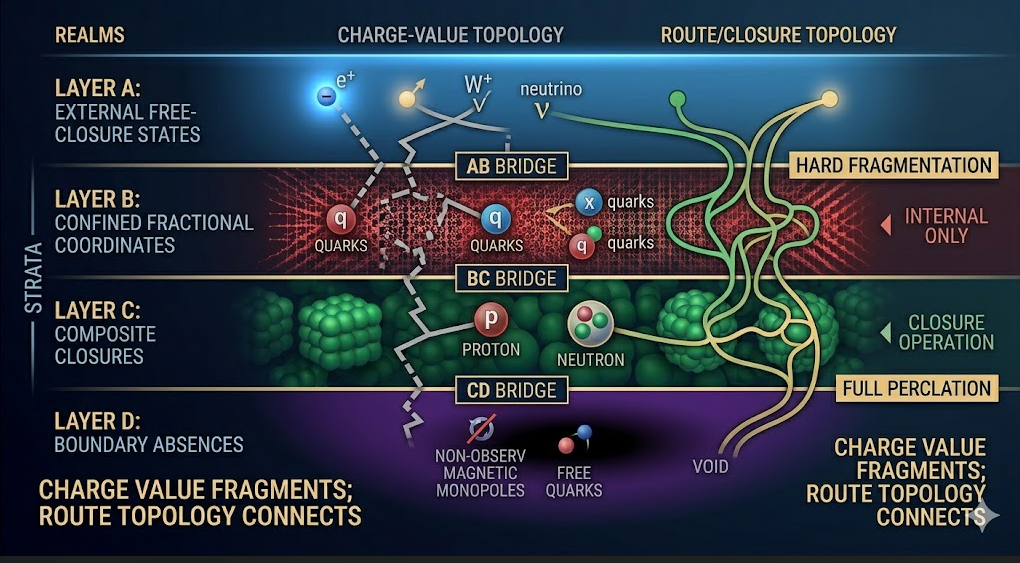
Fractional charge becomes a route coordinate
Quark charges such as +2/3 and −1/3 are valid internal coordinates, not free external closure states. The route framework treats confinement as a boundary-routing condition: fractional coordinates are real internally, but their externalization is blocked.
Composite charge becomes a closure operation
A proton is not merely 2/3 + 2/3 − 1/3 = +1. It is a composite closure in which confined fractional routes become an externally admissible integer charge state.
Key gain
The corpus no longer looks like a list of charges. It becomes a stratified charge-boundary system: external closure, internal fractional coordinate, composite closure, and boundary absence.
4. Same charge, different structural route
The cleanest control is Phase 2C-P. It fixes the scalar value at Q/e = +1 and asks whether anything remains structurally visible. The objects are the positron, proton, positive pion, positive kaon, and W+ boson. Every pair has charge difference zero. If charge value were the whole story, the control would collapse into trivial sameness.
That is not what happened. The route-pair encodings reached Geometric Persistence / Stable Structure with mean Aκ = 1.000 and min Aκ = 1.000. The chamber did not reward the charge invariant; it detected route separation inside equal charge.
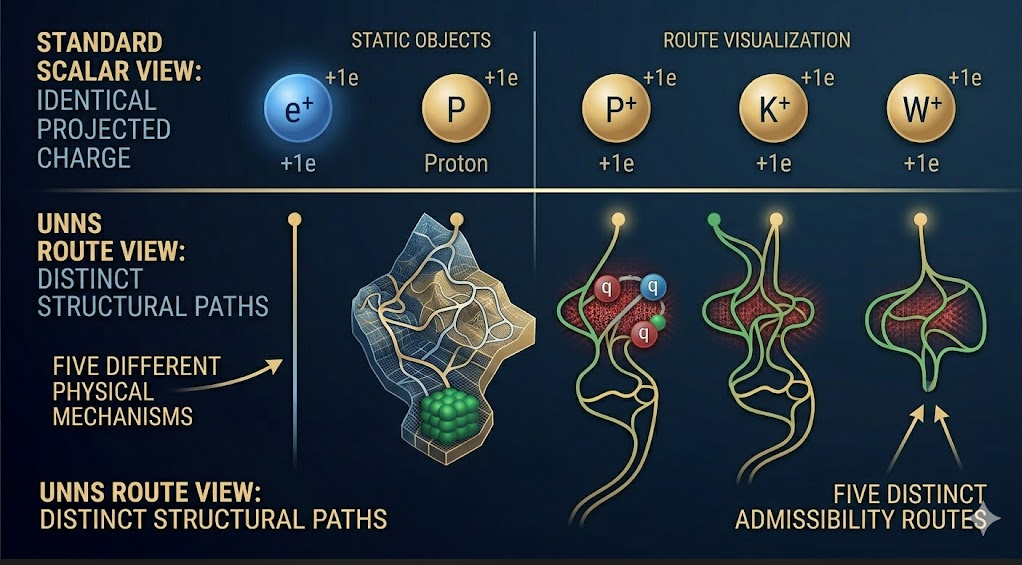
5. Allowed transitions preserve route and closure geometry
The transition phases move from static objects to dynamics. Phase 3 begins with seven allowed seed transitions. Phase 3B expands the test to 38 allowed transitions across eight families. In both cases, charge is conserved. But the decisive question is whether route and closure transition coordinates remain stable.
They do. In Phase 3B, route_transition_code and closure_transition_code reach Geometric Persistence / Boundary-Stabilized, with mean Aκ approximately 0.985 and 0.984. This shows that the seed result is not a seven-transition artifact. Allowed transitions preserve route/closure geometry across the expanded corpus.
Key gain
Charge conservation is embedded in a richer transformation law. The visible equality is total charge balance. The structural invariant is route/closure preservation across the transition.
6. Phase 3C: charge balance is necessary, not sufficient
Phase 3C supplies the missing contrast. It combines 48 rows: allowed controls, charge-violating mocks, free-fractional externalization attempts, selection-rule violating comparisons, route-incoherent charge-conserving mocks, and constrained boundary cases. This is the test that turns the manuscript from a one-sided allowed-transition story into an allowed/forbidden boundary framework.
The result is subtle. The mixed corpus remains globally connected under STRUC-PERC-I: 42 completed ladders, 42 Full Percolation, 0 Hard Fragmentation. So forbiddenness is not a crude graph cut. But under STRUC-I, route_transition_code falls from Boundary-Stabilized in Phase 3B to Structural Boundary / Transitional Structure in Phase 3C.
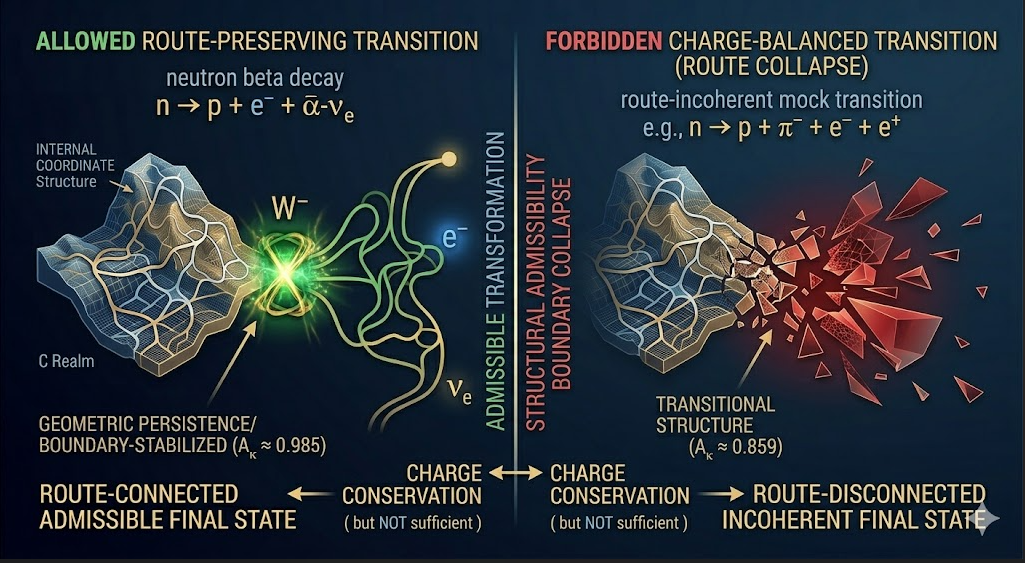
| Encoding | Phase 3B allowed corpus | Phase 3C mixed corpus | Meaning |
|---|---|---|---|
| route_transition_code | GP/BS, Aκ = 0.9851 | SB/TS, Aκ = 0.8592 | Route admissibility collapses in boundary corpus. |
| closure_transition_code | GP/BS, Aκ = 0.9839 | GP/BS, Aκ = 0.9979 | Closure classification remains stable. |
| category_transition_code | GP/BS, Aκ = 0.9776 | GP/BS, Aκ = 0.9945 | Category remains stable. |
| boundary_pressure_index | not used | SB/TS, Aκ = 0.9178 | Boundary pressure sits below persistence threshold. |
7. The dashboard: inspect the full chamber profile
The interactive dashboard gives the complete visual summary: corpus layers, bridge outcomes, same-charge controls, transition-family results, and the decisive Phase 3B vs Phase 3C contrast. Open it fullscreen for the clearest view.
8. Why this matters
For charge representation
Scalar charge remains essential, but it is no longer the only structural coordinate. The useful object becomes Q plus layer, route, closure, composition, and boundary status.
For transition analysis
Allowed transitions are not merely charge-balanced. They are route/closure-preserving transformations. Phase 3C shows that charge-balanced route-incoherent mocks can fail admissibility.
For boundary science
Absences and upper bounds become structural boundary objects. They are not empty cells; they mark where externalization fails or where a route cannot continue.
Relation to existing theories
| Theory or framework | What it supplies | What Charge Boundary Routing adds |
|---|---|---|
| Standard Model | Particle content, charge assignments, allowed processes. | A route/closure/boundary classification layer over Standard-Model-aligned data. |
| U(1) and Noether structure | Scalar charge conservation. | A structural reading of how charge-bearing transformations remain route-admissible. |
| QCD and confinement | Dynamical explanation of quark confinement. | A structural representation of fractional charge as internal route coordinate whose externalization is boundary-blocked. |
| Selection rules | Which physical transitions are allowed or constrained. | A chamber profile showing that forbidden/constrained contrasts degrade route-transition admissibility. |
| Topology and percolation | Connectivity structure of encodings. | The distinction between graph connectivity and perturbative admissibility. |
What is not claimed
The work does not derive the electric charge unit e, replace U(1) gauge theory, prove quark confinement, derive the Standard Model, or claim that diagnostic mock transitions are proposed physical processes. The claim is corpus-scoped: within the tested Charge Boundary Routing I corpus, scalar charge value does not determine structural route, and charge balance is necessary but not sufficient for transition admissibility.
9. Boundary routing beyond charge
Charge Boundary Routing also belongs to a broader UNNS pattern. Across other manuscripts, systems often remain connected while changing admissibility character; boundary behavior appears as route pressure, branching anomaly, or terminal obstruction rather than simple disappearance. The same logic appears in Stellar Boundary Dynamics, where compact inheritance and branching anomaly regimes distinguish different structural transition routes.
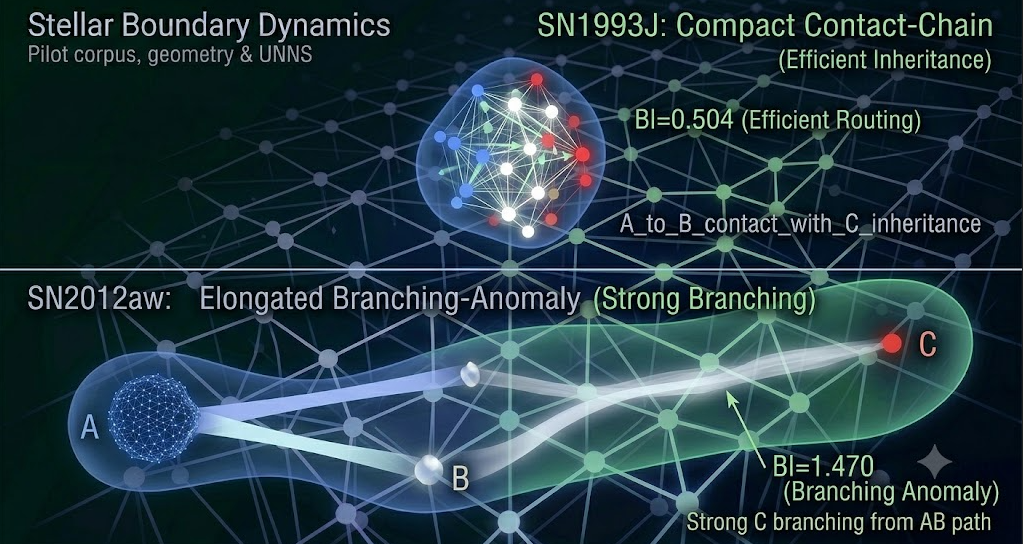
Broader implication
Charge Boundary Routing is not a foundation paper replacing physics. It is a physical-domain realization of a general UNNS principle: observable values are projections of deeper admissible route structures.
10. Connection to other theories
Charge Boundary Routing is not presented as a rival to the Standard Model, U(1) charge conservation, quantum chromodynamics, or conventional decay theory. Its role is complementary: it adds a structural classification layer over successful scalar and dynamical descriptions. The familiar charge value remains valid; the new question is how that value is routed through layers, closures, boundaries, and admissible transitions.
Relation to the Standard Model
The Standard Model provides the charge assignments, particle families, gauge structure, and allowed processes. Charge Boundary Routing takes those successful inputs and studies their organization in route/closure space: external free closures, confined fractional coordinates, composite closures, and boundary absences.
The BC bridge gives the clearest example. QCD explains how quarks form hadrons dynamically; the UNNS route view shows that the fractional-to-composite interface is structurally route-connected, with route/closure encodings percolating where simple charge-value topology may fragment.
Relation to U(1) charge conservation
U(1) gauge symmetry and Noether’s theorem explain scalar charge conservation: total charge before and after an allowed transition must balance. Charge Boundary Routing does not derive or replace this law. It reframes scalar conservation as the visible projection of a deeper route-preservation condition.
Phase 3C sharpens this point: a mock transition can conserve total charge and still fail route-transition admissibility. Charge balance is necessary, but not sufficient.
Relation to quark confinement and QCD
QCD explains confinement dynamically through the behavior of the strong interaction. Charge Boundary Routing represents confinement structurally: Layer B fractional coordinates do not externalize as free Layer A states, and Layer D marks the boundary where attempted free fractional externalization fails.
This is not a proof of confinement. It is a route/closure description of the confinement fact: fractional charge behaves as an internal coordinate that reaches observable charge only through composite closure.
Relation to the quark model
The quark model computes hadron charges by summing constituent quark charges. Charge Boundary Routing keeps that arithmetic but adds the structural operation behind it. A proton is not only 2/3 + 2/3 − 1/3 = +1; it is a composite closure in which confined fractional routes become an externally admissible integer charge state.
Layer C is therefore not merely a list of summed charges. It is the closure layer where internal fractional coordinates become observable composite states.
Relation to decay and selection rules
Standard decay theory uses conservation laws and selection rules: charge, baryon number, lepton number, flavor constraints, energy, and interaction channels. Charge Boundary Routing adds a structural invariant: allowed transitions preserve route and closure transition geometry.
Phases 3 and 3B show the positive side: allowed transitions stabilize route_transition_code and closure_transition_code. Phase 3C supplies the contrast: forbidden and constrained candidates remain percolatively connected, but route_transition_code falls into Structural Boundary / Transitional Structure.
Relation to topology and admissibility geometry
STRUC-PERC-I shows graph connectivity: charge-value encodings can fragment while route/closure encodings percolate. STRUC-I measures perturbative admissibility: a connected corpus can still become boundary-transitional.
This is the Phase 3C lesson. The mixed allowed/forbidden corpus remains connected, but route admissibility collapses. Connectivity is not the same as admissibility.
| Established framework | What it explains | What Charge Boundary Routing adds |
|---|---|---|
| Standard Model | Particle content, charge assignments, gauge structure, and observed decay channels. | A structural classification layer: route classes, closure states, boundary regimes, and transition admissibility. |
| U(1) / Noether conservation | Why scalar electric charge is conserved in allowed processes. | A route-level reading of conservation: charge balance is visible projection; route preservation is structural invariant. |
| QCD confinement | Why quarks are not observed as free isolated particles. | A boundary-routing representation: fractional charge is an internal coordinate whose externalization terminates at Layer D. |
| Quark model | How composite hadron charges are calculated from constituent quark charges. | A closure interpretation: composite charge is not only arithmetic summation, but route closure into an externally admissible state. |
| Selection rules | Which transitions are allowed, forbidden, or constrained. | A chamber profile showing that forbiddenness appears as route-admissibility pressure, not merely graph disconnection. |
| Topology / percolation | How encoded systems connect or fragment as graphs. | The distinction between connectivity and admissibility: Phase 3C remains connected while route_transition_code collapses. |
Broader UNNS alignment
This result connects Charge Boundary Routing to the wider UNNS library: Margin-Confinement, Admissible Cluster Geometry, Admissible Boundary Routing, and structural phase-transition work all share the same underlying pattern. Observable values are projections; routes carry structure; closure marks admissibility; forbiddenness appears as boundary pressure.
What this framework does not claim
Charge Boundary Routing does not derive the value of e, replace U(1), replace QCD, prove confinement, derive the Standard Model, or derive all selection rules. It provides a higher-level structural language for expressing known charge phenomena as routed boundary problems inside an admissibility geometry.
Resources and references
- Charge Boundary Routing: Fractional Coordinates, Composite Closure, and Route-Preserving Transitions
- The Charge Boundary-Route Preservation Law
- Data and Corpus Construction package
- Charge Boundary Routing Analytics
- Charge Boundary Routing Dashboard
- Dashboard video