
Where Structural Margin Shapes Physical Interaction
The Puzzle: Why These Four?
Physics has four fundamental interactions. It has had exactly four for over fifty years.
Strong. Electromagnetic. Weak. Gravitational. Each with a different range, a different strength, a different mediator, a different symmetry group. The Standard Model describes all of them — but it does not explain why there are four, why they have these particular scaling behaviours, or what would make a fifth force structurally impossible rather than merely unobserved.
These are not technical questions. They are foundational. And they do not have answers in the current framework, because the current framework treats the four interactions as independent primitives. Each force has its own gauge group, its own coupling constant, its own ontology.
The Structural Question
Is there a single underlying structure that constrains all four interactions — that makes exactly this hierarchy inevitable, that explains why the regimes are what they are, and that tells us what a fifth force would need to be to even be possible?
The UNNS Substrate provides a structural answer.
The Breakthrough: One Parameter
They are structural regimes of a single parameter:
the connectivity margin m(L).
The connectivity margin m(L) is a structural stability parameter measuring the distance of a physical system's ordered spectrum from the nearest qualitative change in its correlation structure — analogous to the distance from a thermodynamic phase boundary. It is computed directly from the gap sequence of an admissible ladder: the ordered spectrum of energy levels, frequencies, or mode amplitudes that encodes the system.
As m(L) varies continuously from large (deep structural interior) to small (approaching a boundary) to near-zero (global limit), the interaction regime transitions through a predictable sequence: strong → electromagnetic → weak → gravitational. This is not a fitting exercise. It is a structural constraint derived from the topology of the vulnerability graph Gκ(L) and the Percolative Realizability Principle.
The Structural Bridge
This result does not stand alone. It extends a broader theoretical programme called the Structural Bridge — a framework connecting the UNNS Substrate's realizability structure to stability, capacity, and now interaction behaviour across domains.
The Structural Bridge was first established in the context of Ising models, Hopfield networks, and quantum annealing: the connectivity margin m(L) simultaneously governs deformation stability (Principle of Bounded Structural Rigidity), Hopfield storage capacity (αeff ∼ 1/m²), and quantum circuit convergence rates. The interaction classification extends this to the full hierarchy of physical forces: the same marginal parameter that explains why physical spectra resist fragmentation also classifies why forces differ in strength, range, and mass-coupling.
The Structural Bridge Reveals
Not a coincidence. Not a fit. Not a model adjustment. A unifying constraint: every observable interaction regime, from the confined interior of the strong force to the global limit of gravity, is a different face of the same structural object.
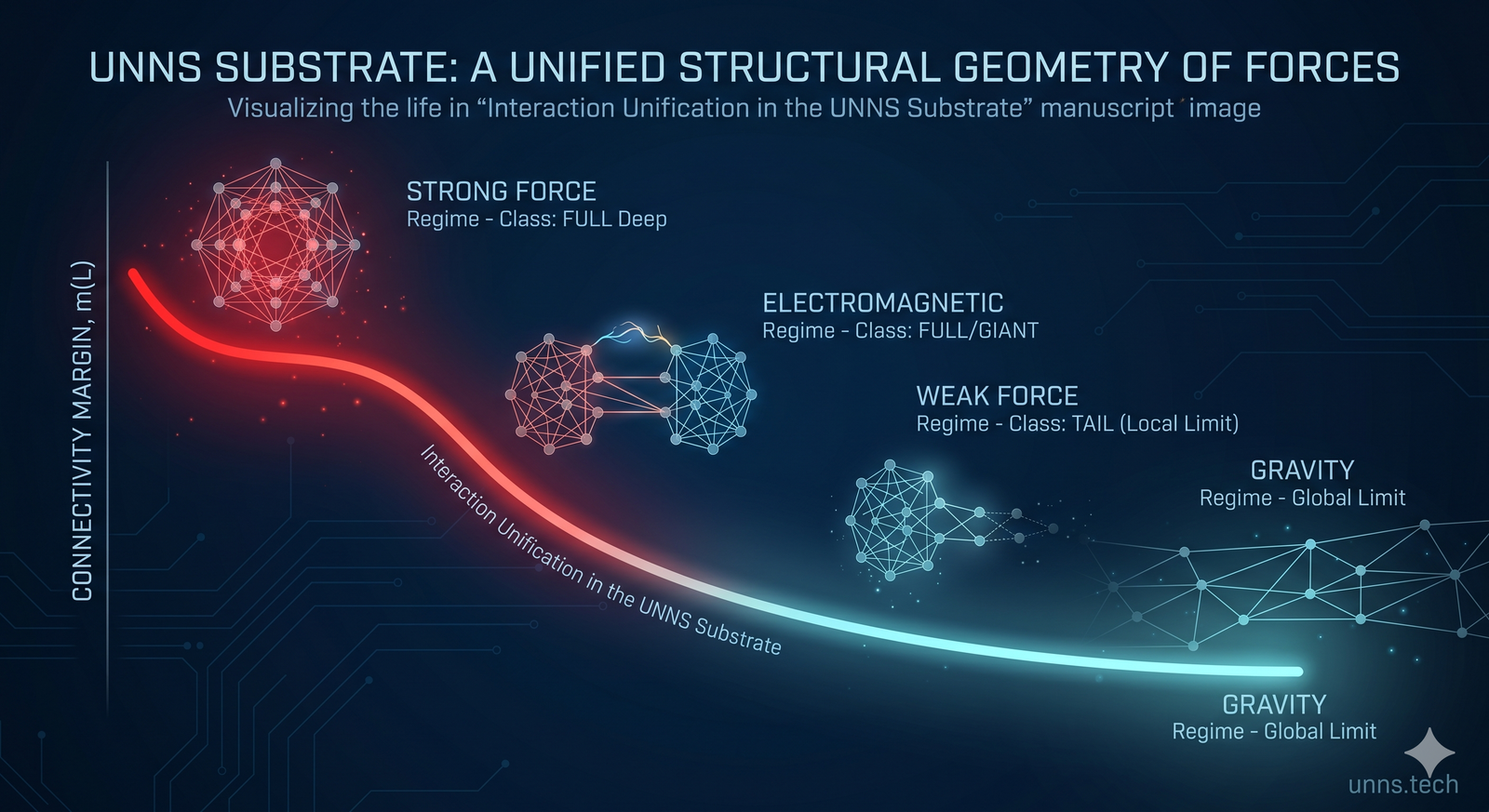
The Four Regimes
Each interaction corresponds to a distinct asymptotic behaviour of the margin-parameterised functional Φ(m(L), r, χ(L)). The mapping is qualitative but precise: the asymptotic class — power-law, scale-invariant, exponential decay, long-range global — is determined entirely by the regime of m(L).
Deep Interior
Maximum vulnerability-graph connectivity. All gaps belong to the dominant backbone. No isolated vertices. Deep inside the FULL realizability class.
Corpus: He, Li QM-I · m ≈ 0.5–1.0
Power law · ConfinedStable Backbone
Persistent stable backbone across scales. Non-decaying connectivity. FULL / GIANT realizability class. Running coupling: weak logarithmic correction.
Corpus: Rydberg · m ≈ 1.2 × 10⁻²
Scale-invariant · Long-rangeBoundary Approach
Dominant backbone with persistent outlier gaps. TAIL realizability class. Interaction range λ(m) → 0 as m → 0: exponential suppression.
Corpus: Zeeman · m ≈ 3 × 10⁻³
Exponential decay · Short-rangeGlobal Limit
Strictly positive but asymptotically small margin. Global curvature of the regime space. No screening. Long-range 1/r² behaviour without cutoff.
Corpus: CMB Planck · m ≈ 2 × 10⁻⁴
Long-range · UnscreenedNo equations required to read this map. The force hierarchy is the m(L) hierarchy.
No Fifth Force: A Structural Constraint
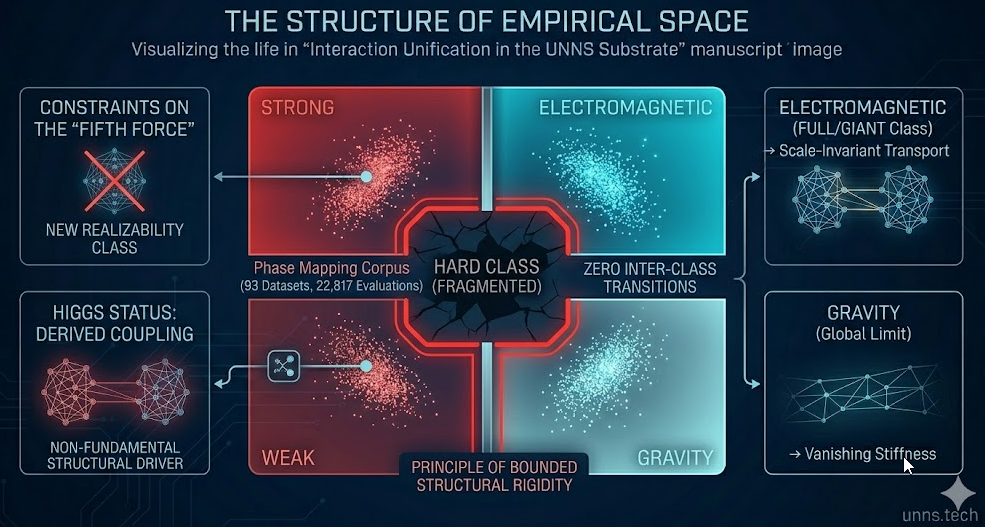
The Percolative Realizability Principle (PRP) establishes that {Full, Giant, Tail, Hard} is a complete and exhaustive partition of all admissible ladders. There is no fifth class. Every conceivable ordered physical sequence falls into one of these four structural categories.
Since each interaction corresponds to an asymptotic regime of m(L) within this taxonomy, the number of structurally distinct interaction regimes is bounded by the number of qualitatively distinct boundary behaviours as m(L) varies. The four known forces correspond exactly to these four behaviours.
What a Fifth Force Would Need
A hypothetical fifth fundamental interaction would require a distinct realizability class in Gκ(L) — a new structural regime not representable as any asymptotic limit of the existing four. The PRP's exhaustive partition makes this a structural impossibility, not merely an observational absence.
This is derived from structure, not from experimental accident, not from parameter tuning. The constraint is not "no fifth force has been found." The constraint is "no fifth force can exist as a structurally independent regime."
The Higgs: Derived, Not Fundamental
The Higgs mechanism has a structural interpretation within this framework. The Higgs-induced interaction satisfies three conditions that place it outside the category of structurally fundamental interactions:
- It depends on structural weight — the coupling is proportional to particle mass.
- It is exponentially short-range — the range vanishes as the margin approaches zero.
- It induces no independent realizability class — it lies within the existing exponential-decay (weak-like) regime.
The Structural Reinterpretation
The Higgs mechanism appears not as a new interaction, but as a structural coupling emerging from proximity to a boundary. Mass is not a primitive — it is a derived structural weight encoding how close a gap component is to the nearest instability boundary ∂ΩL. Massless particles (photon, gluon) sit deep inside the FULL regime; massive particles (W±, Z) sit near the boundary.
Electroweak symmetry breaking, in this reading, is a shift of gap components from deep interior (symmetric, massless) to near-boundary (broken, massive). The Higgs field encodes the distance to structural instability, not an independent force.
Note: this does not replace quantum field theory. It provides a structural layer that constrains interaction behaviour. The gauge groups of the Standard Model determine which sequences are admissible ladders; the connectivity margin then determines interaction strength within each class.
The Canonical Ladder: Resolving Encoding Dependence
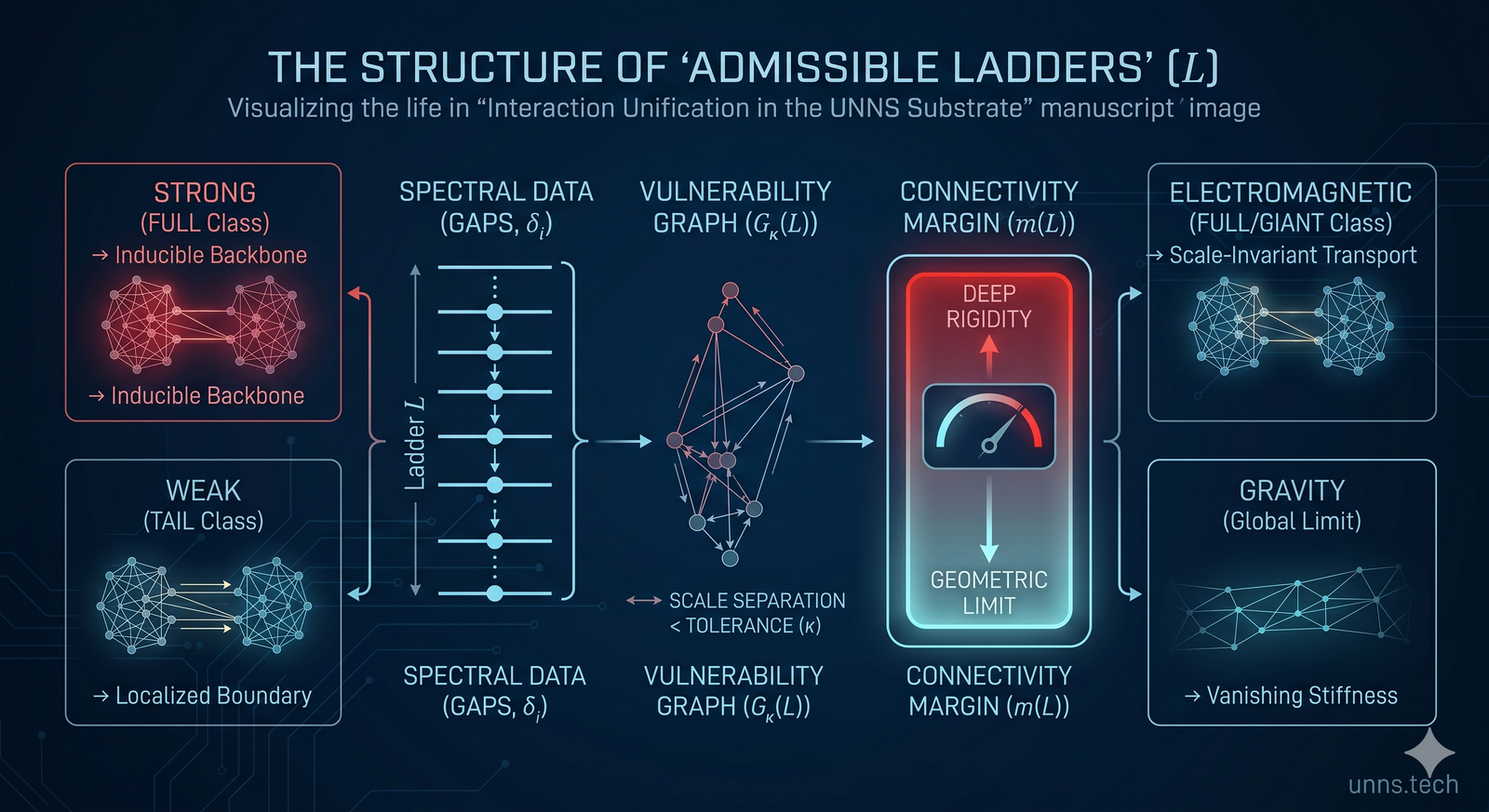
The realizability class — and therefore the interaction regime — depends on how a physical system is encoded as a ladder. Different encodings of the same system can yield different structural classes: helium under QM-I encoding returns FULL; under Zeeman encoding, TAIL. This is representation dependence, and it is a genuine structural feature, not a defect.
The Maximum-Margin Principle selects the canonical class: the interaction regime assigned to a physical system is the regime corresponding to the encoding that maximises m(L). This selects the deepest stable structural regime — the encoding closest to the system's intrinsic organisation.
Empirical Validation Across All Corpus Splits
The Maximum-Margin Principle has been tested across all documented representation splits in the corpus: Helium (QM-I → Full, m ≈ 0.012 vs. Zeeman → Tail), Sodium (Zeeman → Tail), HD molecule (higher-margin sub-ladder → Full), crystallographic normalisations. In every case, maximum-margin selection produces a consistent interaction classification.
This remains conditional on proving monotonicity of m(L) with respect to class boundaries — the highest-priority open problem in the framework. Proving that m(L) strictly decreases as one approaches a realizability boundary from the interior would make the canonical selection mathematically guaranteed, not just empirically validated.
The Evidence: Cross-Domain Micro-Tests
The framework makes a testable quantitative prediction: the ordering of m(L) should track the ordering of observable scaling behaviour. Larger margin → deeper interior → power-law scaling. Smaller margin → boundary approach → exponential decay. Near-zero margin → global limit → long-range weak correlations.
This prediction has been checked across three independent physical domains:
Atomic Spectra
Rydberg-series ladders LN = {E1,...,EN}. Margin stable across truncations (N=10,20,30). Observable: dipole transition rates follow n⁻³ power law throughout.
Source: Rydberg formula, Structural Bridge Theorem 9.1
Statistical Mechanics
Transfer-matrix spectra at T/Tc = 1.20, 1.05, 1.01. As T→Tc, m(L)↓ while correlation length ξ↑. Monotonic: structural stability tracks proximity to phase transition.
Source: Onsager (1944), finite-size estimate N=20
CMB Power Spectra
Planck 2018 TT, TE, EE power spectra. All three channels return small positive margin m ∼ 10⁻⁴ — consistent across datasets. Observable: long-range correlations, weak amplitude, no exponential decay.
Source: Planck Collaboration 2020
The Ordering Holds Across Domains
mhydrogen ~ 10⁻² ≫ mIsing ~ 10⁻³ ≫ mcosmology ~ 10⁻⁴. The same ordering appears in three independent physical domains. This shifts the claim from "interesting structural analogy" toward "this might be real."
These tests do not prove that m(L) uniquely generates physical observables. They establish that the ordering of m(L) is reflected in observable scaling behaviour — a quantitative bridge that goes beyond qualitative analogy.
What This Framework Is — and Is Not
- Replace quantum field theory
- Derive coupling constants from first principles
- Predict particle masses numerically
- Supersede Standard Model gauge structure
- Claim completeness of the derivation
- A structural layer that constrains interaction hierarchy
- A single parameter (m(L)) governing all regime ordering
- A structural reason for the four-regime taxonomy
- A principled constraint on fifth-force existence
- Quantitatively consistent cross-domain ordering
The gauge groups SU(3)×SU(2)×U(1) determine which ordered sequences are admissible ladders in each domain. The connectivity margin then classifies interaction strength within each admissible class. The frameworks are complementary: quantum field theory operates at the dynamical level; the UNNS Substrate operates at the structural level below it.
Falsifiability: Eight Explicit Criteria
The framework can be falsified. The following conditions, if observed, would require revision or rejection:
| # | Falsification Condition | Status |
|---|---|---|
| 1 | New realizability class outside {Full, Giant, Tail, Hard} | Not observed |
| 2 | Two systems with identical m(L) but different interaction hierarchy | Not observed |
| 3 | Phase transition in C(L) without m(L) crossing a realizability boundary | Not observed |
| 4 | Corpus breakdown scan: interaction flips class without m(L) → 0 | Not observed (93 datasets) |
| 5 | Principle 1 falsification: admissible ladder with no stability neighbourhood of (1,1) | Not observed |
| 6 | Maximum-margin counterexample: two canonical encodings → different classes | Not observed |
| 7 | Scaling-class mismatch: observed scaling contradicts m(L) regime prediction | Not observed |
| 8 | Monotonicity failure: m(L) = 0 system with non-zero rigidity region ΩL | Open (unresolved) |
The Takeaway
The Standard Model gives us a beautiful description of the four forces. What it does not give us is a reason why those four — or what would make a fifth structurally impossible.
The UNNS Substrate offers a structural answer: the interaction hierarchy is not a set of independent gauge symmetries but the regime-asymptotic footprint of a single structural invariant. As the connectivity margin m(L) decreases from large to small, the system transitions through all known interaction regimes in sequence. The diversity of forces is not fundamental — it is the visible manifestation of a single structural parameter approaching its limits.
It is the visible manifestation of
a single structural parameter approaching its limits,
providing a structural interpretation of force diversity
in terms of proximity to instability.
If this is correct, it changes how we think about interactions — not as primitive entities defined by symmetry groups, but as structural regimes of an underlying margin field. Whether it is correct is an open question. The falsification criteria are explicit. The framework is testable. The work continues.
Manuscripts & Resources
- Interaction Unification in the UNNS Substrate: All Fundamental Forces as Margin-Regulated Structural Regimes — full manuscript (April 2026)
- Bounded Structural Rigidity and Representation-Driven Structure — Phase Mapping corpus, 93 datasets, 22,817 evaluations
- Phase Mapping Corpus Analysis α–μ Joint Operator Deformation — interactive analysis
- UNNS Rigidity as the Missing Principle Behind Associative Memory Systems — Structural Bridge manuscript
- Percolative Realizability Principle (PRP) — four-tier exhaustive taxonomy
- Structural Realizability and Dual Observability — dual coordinate framework