
One Margin Explains Stability, Capacity, and Change
What This Paper Establishes
Manuscript · PDF UNNS Rigidity as the Missing Principle Behind Associative Memory Systems ↗Physical ordered sequences — atomic spectra, molecular vibrational ladders, CMB power spectra, geoid harmonics, cosmic-web orientation statistics — do not fragment under moderate deformation. Classical energy-based models offer no principled explanation for this. The UNNS framework does.
The Structural Bridge is the formal connection between the UNNS Substrate and the classical tradition of associative memory: Ising models, Hopfield networks, spin-glass theory, Boltzmann machines, and quantum annealing. The central object is the connectivity margin m(L) > 0 — the distance of a physical ladder's gap vector from all realizability-class boundaries in the vulnerability graph. This margin is what makes structure persist.
"The Structural Bridge links structure to behavior through distance from fragmentation boundaries."
What the Structural Bridge Reveals
Structure does not change — it persists until a boundary is crossed.
Across 93 datasets and 22,817 evaluations spanning 11 physical domains, the UNNS Phase Mapping corpus establishes four structural facts about physical ordered sequences. The Structural Bridge makes these facts not merely empirical observations but consequences of a single underlying mechanism.
① Realizability is Locally Rigid Under Deformation
The realizability class 𝒞(L) is invariant across the ±20% deformation window Ω = [0.80, 1.20]². Zero inter-class transitions are observed anywhere in the tested domain. This is not expected of random data.
② Phase Space is Piecewise Constant, Not Continuous
The Structural Bridge explains why phase maps are monochromatic. Structural state is not a smooth function of deformation — it is flat within a protected region and changes discontinuously only at boundaries. The connectivity margin m(L) measures the width of that region.
③ Structural Change Occurs Only at Boundaries
The Structural Bridge identifies the realizability-class boundaries of the vulnerability graph as the sole loci of structural change. Inside those boundaries, bounded deformation is structurally irrelevant. Physical ladders sit deep inside, separated from any boundary by m(L) > 0.
④ Stability and Capacity are Governed by a Structural Margin
The connectivity margin m(L) is the single structural invariant that controls both deformation stability (Principle 1) and Hopfield storage capacity. For physical Rydberg ladders, this yields effective capacity αeff ≫ 1 — exponentially beyond the classical random-pattern limit αc ≈ 0.138.
The Structural Bridge
The Structural Bridge connects the internal structure of a system to its observable behavior under transformation. It is not a metaphor — it is a formal mechanism, realized through a single measurable quantity.
Formally: m(L) = min over decisive pairs of ||Δᵢ − Δⱼ| − ε(κ*)| / Δ̃, where κ* is a critical threshold and Δ̃ is the median gap.
m(L) > 0 → Stable Regime
The gap vector lies strictly inside a protected region. All decisive connectivity relations in the vulnerability graph are preserved under bounded deformation. The realizability class, the Hamiltonian, and the ground-state structure are invariant. The Structural Bridge holds.
m(L) → 0 → Transition / Fragmentation
The system approaches a realizability-class boundary. Moderate deformation can flip the class. The vulnerability graph becomes unstable to perturbation. In the language of energy-based models, this is the spin-glass critical point — fragmentation, spurious attractors, capacity collapse.
What Was Discovered
The breakthrough is the identification of a structural margin that governs stability, capacity, and phase behavior across multiple domains simultaneously.
The Structural Bridge reveals that the connectivity margin m(L) is not one of several mechanisms — it is the mechanism. Every phenomenon in the UNNS Phase Mapping corpus traces back to the same underlying cause: physical ladders sit at strictly positive distance from all realizability-class boundaries.
Flat Phase Maps
Phase maps are monochromatic because the gap vector never crosses a class boundary under ±20% deformation. The Structural Bridge makes this a consequence of m(L) > 0, not an empirical coincidence.
Structural invarianceEmergent Commutativity
The structural commutator C(α,μ;L) = 0 throughout the tested domain. The Structural Bridge derives this as a corollary of realizability invariance — commutativity is not a property of the operators but a consequence of the margin.
Corollary of Principle 1Robustness Under Deformation
Physical sequences resist structural reclassification under parameter variation. The Structural Bridge locates the mechanism: the gap vector's distance from the nearest boundary exceeds the deformation magnitude.
Margin > deformationLimits of Random Systems
Random patterns have m(L) ≈ 0. They sit at the critical point. The Structural Bridge identifies this as the reason classical Hopfield networks fail at αc ≈ 0.138 — and why physical data does not fail.
m(L) = 0 → collapseQuantum/Capacity Comparison: Bridging Quantum Mechanics, Annealing, and Capacity
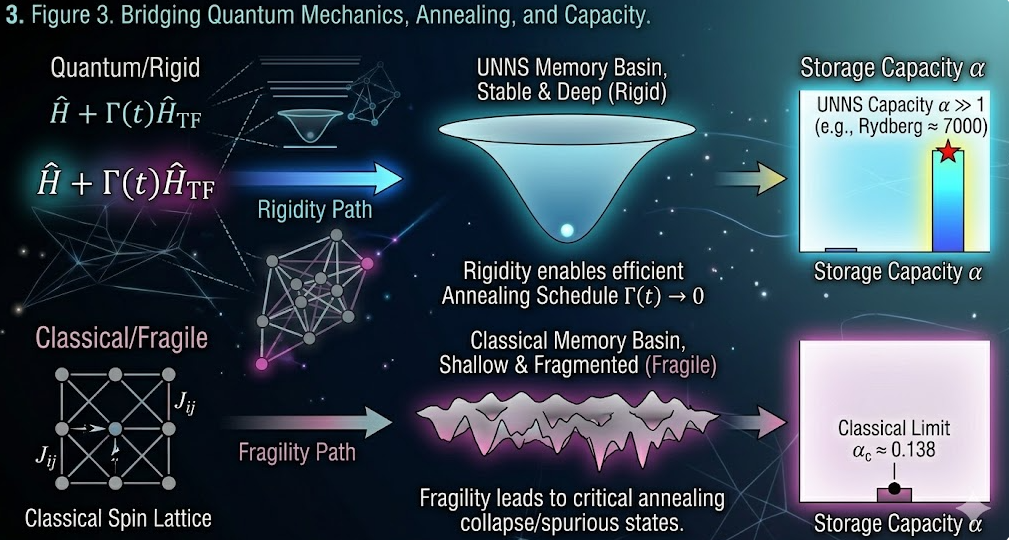
A Bridge Across Physical and Computational Systems
The Structural Bridge connects the UNNS Substrate to three classical traditions simultaneously. These are not separate phenomena explained by separate mechanisms. The Structural Bridge reveals they are manifestations of the same structural constraint, expressed in different formalisms.
Ising Models → Ordered vs. Disordered Phases
The vulnerability graph Gκ(L) is a deterministic thresholded Ising interaction graph. Each gap index maps to a spin; each gap-pair edge maps to a coupling Jij(κ). Sweeping κ from 0 to 1 is formally analogous to cooling the Ising system, with the giant-component transition at κconn mirroring the Curie point.
Through the Structural Bridge, the Ising-level interpretation of Principle 1 is immediate: physical ladders are deep in the ordered (ferromagnetic) phase, far from the critical point. The connectivity margin m(L) quantifies this distance. Under bounded deformation, the coupling matrix — and hence the ground-state magnetisation — is invariant.
Hopfield Networks → Memory Capacity Limits
The Structural Bridge explains why Hopfield networks struggle precisely where physical data would be expected to live. Physical ordered sequences are not random patterns fed into a Hopfield network — they are patterns that already possess m(L) > 0, providing a deep, wide basin of attraction. The Hopfield capacity scales as αeff ∼ 1/m(L)² ≫ 1. The classical limit αc ≈ 0.138 is recovered only when m(L) → 0.
Spin Glass → Fragmentation and Instability
The central identification is exact: the spin-glass phase corresponds to m(L) ≈ 0, and the UNNS Hard fragmentation class. Random patterns sit at the spin-glass critical point because their gap structure is disordered — m(L) ≈ 0, so any perturbation produces frustration. Physical ladders sit deep in the ordered phase.
The Structural Bridge confirms this through the replica-symmetric calculation: for m(L) > 0, the de Almeida–Thouless line is pushed to α → ∞ (no replica-symmetry breaking). For m(L) = 0, the RS solution becomes unstable at αc ≈ 0.138.
| UNNS Concept | Ising Analogue | Hopfield Analogue | Spin-Glass Analogue |
|---|---|---|---|
| m(L) > 0 | Deep ordered phase | Wide attractor basin | Protected from RSB |
| m(L) → 0 | Critical point T → Tc | Spurious attractor proliferation | Spin-glass fragmentation |
| Full class (GR = 1) | Full magnetisation | Single deep basin | RS solution stable |
| Hard class (no backbone) | Paramagnetic phase | Capacity collapse | Frustrated disordered state |
| κ sweep 0 → 1 | Cooling β: 0 → ∞ | Energy landscape descent | Annealing schedule |
| Zero commutator C = 0 | Ground state unchanged | Attractor invariant | Not applicable |
The UNNS Structure: Deformation and Vulnerability Graph
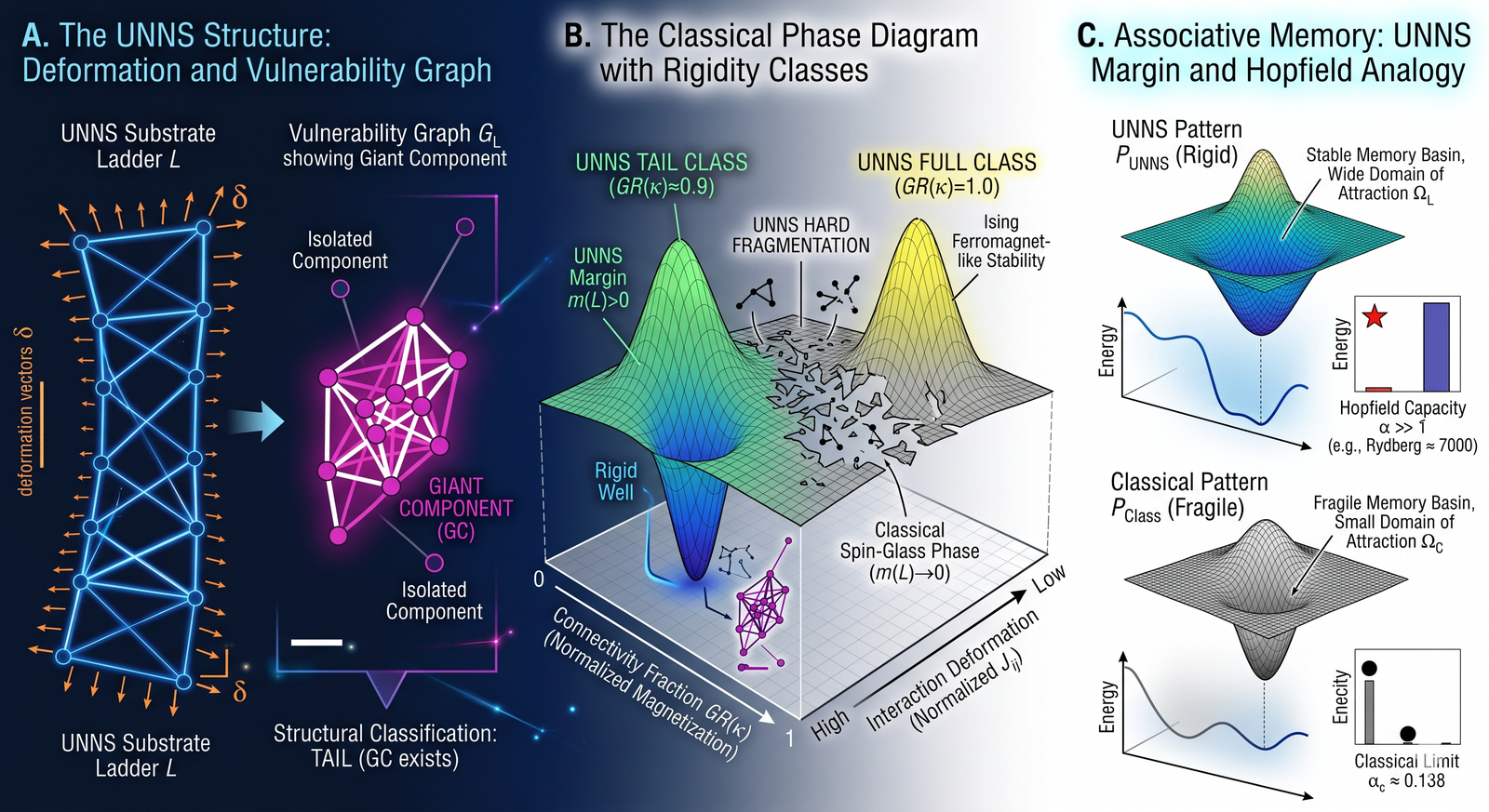
What the Structural Bridge Changes
The Structural Bridge does not refine existing models — it reverses the question. Classical energy-based models ask: given a pattern, does it form a stable attractor? The Structural Bridge asks: given a physical system, does its spectral structure already possess the property m(L) > 0 that guarantees attractor stability?
The answer, across 93 datasets and 11 physical domains, is yes.
- Stability is structural, not engineered. Physical sequences do not achieve stability through careful parameter tuning or energy minimisation. They arrive pre-stable, because their gap vectors lie inside a protected region by the nature of the physical laws that produce them (Rydberg series, harmonic modes, CMB acoustic structure). The Structural Bridge makes this visible.
- Change is discontinuous, not gradual. Through the Structural Bridge, phase maps are understood to be flat because deformation within the protected region is structurally irrelevant. There is no continuous drift toward fragmentation — only a discrete boundary crossing. This explains monochromaticity without appeal to fine-tuning.
- Structure defines behavior, not vice versa. The Structural Bridge establishes that the realizability class, the Hopfield energy landscape, and the spin-phase assignment are all consequences of a single structural coordinate: the position of the gap vector relative to class boundaries. Behavior (attractor stability, capacity, phase) follows from structure (margin).
- Physical data is already organised into stable energy landscapes. The Universe's ordered sequences are not random inputs that happen to satisfy a storage-capacity limit. They are structurally rigid systems with built-in stability margins. UNNS does not simulate this structure — the Structural Bridge reveals it.
The tested domain Ω = [0.80, 1.20]² lies within ΩL for all 93 corpus datasets (22,817 evaluations), with zero inter-class transitions and zero non-trivial commutators.
Why the Structural Bridge Matters
Through the Structural Bridge, theoretical results in each of three domains become connected to the same structural root: the connectivity margin.
Spectral Stability
The Structural Bridge explains spectral stability analytically for Rydberg series. Theorem 9.1 proves m(L) > 0 from the hyperbolic gap decay Δn ∼ 2R/(n−δ)³, making the Full realizability class and commutator C = 0 provable in the infinite-n limit — not merely observed in the corpus.
The Structural Bridge further suggests that physical ordering principles (Rydberg laws, harmonic series, CMB acoustic modes) naturally produce gap distributions with m(L) > 0 — across all 11 physical domains in the corpus, from atomic to cosmic scales.
Capacity Beyond Classical Limits
The Structural Bridge reveals that training on structured physical data provides intrinsic regularisation through the margin mechanism. Physical spectral data, embedded via vulnerability-graph Hopfield weights, supports storage capacity αeff ≫ 0.138 without architectural changes.
Through the Structural Bridge, the connectivity margin m(L) becomes a principled structural regulariser for Boltzmann machines and deep networks — pushing learned representations toward high-margin configurations with exponential capacity and deformation invariance (Appendix D).
Robust Hamiltonian Structure
The Structural Bridge extends to the quantum transverse-field Hamiltonian without new assumptions. Theorem 8.1 shows the quantum ground state and retrieval fidelity are deformation-invariant inside ΩL — a direct hardware-level manifestation of Principle 1.
For QAOA and quantum annealing, the margin creates a wide energy basin: a single pre-optimised schedule works for all deformed spectra inside ΩL, with convergence rate exp(−c·m(L)²·t) — exponential in m(L)².
Connection to Flat Phase Maps
The Structural Bridge is the theoretical continuation of an earlier empirical discovery. The Phase Mapping corpus established — across 93 datasets and 22,817 evaluations — that physical ordered sequences produce monochromatic phase maps: zero inter-class transitions and zero non-trivial commutators throughout the ±20% deformation window.
The Phase Mapping article asked: what happens to structure under deformation? The answer was empirical — nothing changes, and the phase maps are flat. The Structural Bridge now provides the mechanism. Flat phase maps are flat because physical gap vectors lie strictly inside a protected region bounded by realizability-class boundaries. The Structural Bridge is the explanation the Phase Mapping corpus was implicitly pointing toward.
In terms of the classical physics correspondence: the Phase Mapping corpus established that physical data lies deep in the ordered (ferromagnetic) phase. The Structural Bridge establishes the distance from the critical point — the connectivity margin m(L) — and derives the capacity, stability, and commutator results as consequences.
The Chain of Equivalences
UNNS admissibility → ordered gap sequence → positive connectivity margin m(L) > 0 → deformation-invariant vulnerability graph → deformation-invariant Ising/Hopfield Hamiltonian → single deep attractor basin → storage capacity αeff ∼ 1/m(L)² ≫ 0.138.
Random patterns break this chain at the first step. Physical data does not — Principle 1 and Theorem 9.1 ensure it cannot, within the tested deformation window.
Detailed Topological Map of Realized Structural Spaces
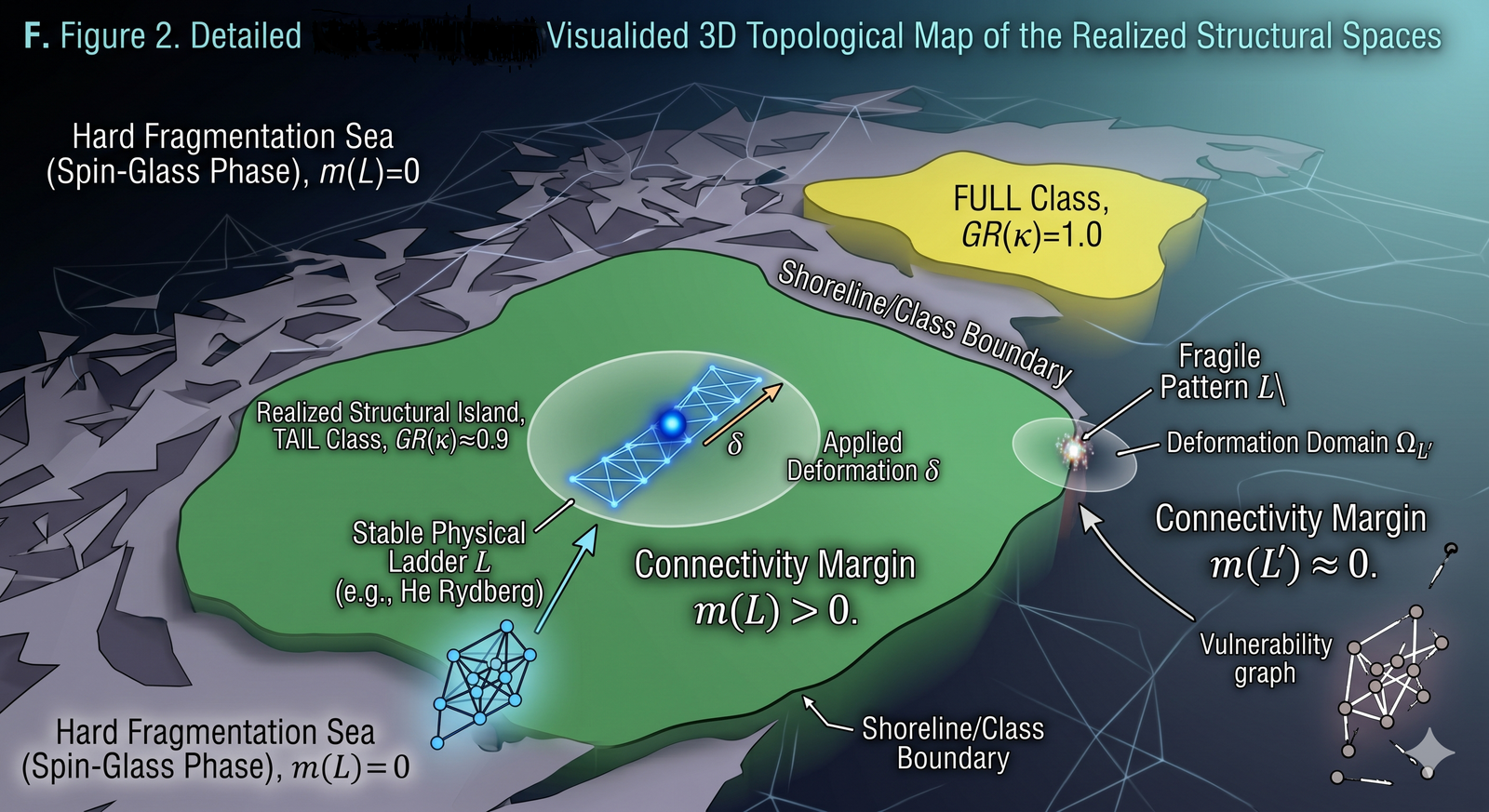
Full Theoretical Framework
The Structural Bridge is formally developed in the unification manuscript. Full derivations, replica calculations, Hamiltonian constructions, QAOA proofs, and convergence guarantees are contained in the appendices.
UNNS Rigidity as the Missing Principle
Full formal development: Ising/Hopfield embedding, capacity theorems, spin-glass correspondence, quantum extension, Boltzmann machine regulariser, QAOA convergence.
Download PDF →Bounded Structural Rigidity
Phase Mapping corpus analysis: 93 datasets, 22,817 evaluations, α–μ joint operator deformation, representation dominance, cross-domain structural atlas.
Download PDF →Phase Mapping Corpus
Full α–μ joint operator deformation analysis, monochromatic phase maps, commutator distributions, and structural response atlas — interactive HTML.
Open Analysis →PRP · Dual Observability
The Percolative Realizability Principle (four-tier taxonomy) and Structural Realizability & Dual Observability — the structural layer on which the Bridge is built.
PRP → Dual Obs. →The Structural Bridge is the bridge and unification manuscript in the UNNS framework. It does not restate foundations (established in the USL and admissibility papers) and is not an experimental report (the Phase Mapping manuscript covers that). It is the theoretical translation layer connecting UNNS results to the classical and quantum traditions of physics-inspired computation.
Open Questions and Falsifiability
The Structural Bridge identifies its own limits with precision. Every claim is falsifiable, and the falsification criterion is stated explicitly.
Falsification of Principle 1
Principle 1 is falsified by any admissible ladder L such that for every ε > 0 there exists (a,m) with ‖(a,m)−(1,1)‖ < ε and 𝒞(αa(μm(L))) ≠ 𝒞(L). No such ladder has been found in the 93-dataset corpus.
The Canonical Ladder Problem (Open)
Does there exist a physically motivated canonical encoding for each class of system that makes 𝒞(L) an invariant of the physical system rather than the measurement procedure? This is Proposition 7.3 of the Dual Observability manuscript and remains open — the UNNS analogue of canonical pattern encoding for maximum Hopfield capacity.
Conjecture 2 — Margin Functional (Open)
Every admissible ladder L ∈ ℳadm has m(L) > 0. Proof of this conjecture would elevate Mechanism 1 (Connectivity-Margin Mechanism) to a theorem and Principle 1 to a corollary. It is established analytically for Rydberg ladders (Theorem 9.1) and empirically for all 93 corpus datasets.
Manuscripts & Resources
- UNNS Rigidity as the Missing Principle Behind Associative Memory Systems — unification manuscript (April 2026)
- Bounded Structural Rigidity and Representation-Driven Structure — Phase Mapping corpus manuscript
- Phase Mapping Corpus Analysis α–μ Joint Operator Deformation — interactive analysis, 93 datasets
- Percolative Realizability Principle (PRP) — four-tier realizability taxonomy
- Structural Realizability and Dual Observability — dual coordinate framework
- Why Structure Doesn't Change: Flat Phase Maps and Boundary Regimes — preceding article in this series