
From Margin to Dimension
At a Glance
The Emergent Dimensionality manuscript proposes — and demonstrates across four independent physical domains — that the number of effective degrees of freedom in a physical system is not a geometric primitive. It is a structural observable, governed by the connectivity margin m(L) of the system's ordered spectrum. Systems with large margin access more structural modes; systems near the margin boundary collapse toward fewer. The manuscript formalises this with ten new theorems, a four-coordinate phase space, and a renormalization-like interpretation of the deformation dynamics.
A note on terminology: throughout this article, dimension does not refer to spatial axes (x, y, z). It refers to independently active structural modes — the number of independent ways a system can structurally respond to deformation. The full manuscript formalises these observations into ten theorems and a complete operator framework.
This article walks through the key ideas, the data, and what it all implies — without requiring familiarity with the formal framework.
The UNNS Phase Space
Every physical system, once encoded as an ordered sequence of values (energy levels, pairwise distances, frequency modes, cosmic web positions), can be described by four structural coordinates. Together these define a phase space — not of position and momentum, but of structural admissibility.
How gap sizes scale across the ordered spectrum. Positive α means an expanding gap structure; negative α means compression.
DeformableDistance from the nearest realizability boundary. The single most important structural parameter — governs stability, interaction class, and dimension.
ConvergentNumber of independently active structural modes. Not assumed — computed from the covariance structure of the gap sequence.
DiscreteThe asymptotic power-law growth of the level sequence itself. Independent of gap structure and invariant under all tested deformations.
InvariantThe phase space diagram below shows 35 systems from four physical domains plotted by α and m. Bubble size encodes dim_eff. The dashed band and vertical stripe mark structural attractors — regions where systems converge regardless of where they start.
Structural phase space: α (gap scaling) × m (connectivity margin). Bubble size = effective dimensionality. Dashed band = universal margin attractor. Vertical stripe = crystallographic α attractor at B=1. Interactive version: open phase space explorer →
How to read this map
- Move right (↑ α): gap structure expands — scaling becomes more expansive
- Move up (↑ m): margin increases — system is more stable, farther from any structural boundary
- Larger bubble: more active degrees of freedom — more independent structural modes accessible
- Vertical motion: stability change — the system is moving toward or away from a realizability boundary
- Horizontal motion: scaling change — the internal gap organisation is being reorganised
Systems that land in the same region behave the same — regardless of what they are made of.
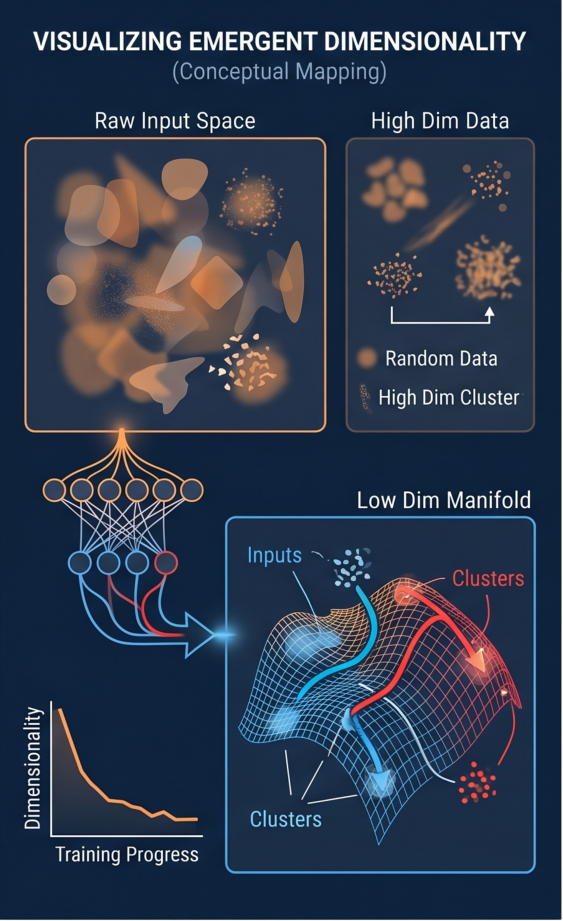
Example: One System, One Transition
Here is what a dimensional transition looks like in this framework, step by step, using gold (Au) under magnetic field activation.
At zero field, gold's Zeeman energy ladder has two independently active structural modes (dim = 2). Its margin of 0.520 places it in the structural interior but not deeply — two thresholds are satisfied, a third is not. At B = 0.01 T, the magnetic field perturbs the gap structure. The margin jumps by 0.34 in a single step, crossing the third activation threshold. A new structural mode becomes accessible. dim jumps to 3 and stays there for all remaining field steps.
What this looks like in the phase space
In the map above, gold starts as a medium-sized bubble (dim=2) in the lower-left region. At B=0.01 it jumps upward and slightly rightward — moving to a larger bubble (dim=3) at much higher margin. The dashed arrow shows this trajectory. The system does not drift gradually; it relocates discretely. This is a structural phase transition.
Four Domains, One Structure
The analysis draws on 35 systems spanning four independent physical domains, processed through a single unified pipeline. In each domain, the same four coordinates are extracted from the ordered gap sequence — no domain-specific assumptions.
Continuous Convergence
19 crystal structures begin with gap scaling exponents scattered from 0.37 to 6.01. Under deformation, every system converges to α ≈ 1.39, m ≈ 0.578, dim = 3 — independently of space group, lattice constant, or initial state.
The deformation operator erases representational differences and selects the canonical structural encoding. Different descriptions of the same physical system forget their origins and arrive at the same point.
Encoding collapse → attractorDiscrete Activation
Three atomic systems — gold, helium singlet, iron (fcc) — are structurally locked at B=0 and cross a dimensional boundary at the first non-zero field step (B=0.01 T). Gold jumps from dim=2 to dim=3. Helium singlet jumps from dim=1 to dim=3 in a single step.
These are not gradual changes. The transition is instantaneous and irreversible within the sweep. The system enters a new structural class and does not return.
Threshold crossing → dim jumpStructural Inertness
Five cosmological ladders (radial distances and redshift catalogs from 2MRS, DESI, and SDSS) show Δm/ΔB ≈ 0 and constant dim across the full deformation sweep. These structures are already in a structurally stable interior state — no deformation operator reaches their boundary.
The 2MRS radial ladder reaches m = 1.000 exactly: a perfectly uniform gap sequence, crystallised into a single structural mode.
Already at fixed pointElevated Margin
Oxide gap structures (FeO, VO, TiO₂, SnO, KSiO) occupy a distinct margin tier: m ∈ [0.66, 0.91], above both atomic and cosmological systems. Different dim values at similar margin values confirm that dim_eff is sensitive to the internal covariance structure of the gap sequence, not margin alone.
Distinct margin tierThree Ways Structure Evolves
The deformation operator does not act the same way on all systems. Across four physical domains, three qualitatively distinct operator response modes emerge — each producing a different structural outcome.
Key insight
These three modes are orthogonal to the four interaction regimes (strong, EM, weak, gravity). The operator response describes how B deforms a ladder; the interaction regime describes what structural class it occupies. A system in the strong-like regime can exhibit any of the three response modes.
How Dimensionality Is Selected
The central theoretical claim: a physical system has access only to the degrees of freedom (structural transformation axes) for which the connectivity margin exceeds a minimum activation threshold. Accessible axes define the effective dimensionality.
The effective dimensionality is the cardinality of the set of activated structural directions — those for which m(L) ≥ mmin(δ). As margin increases, more directions become accessible. As margin approaches zero, only global modes survive.
Each structural direction δ has a minimum margin threshold for activation. In this example with m(L) = 0.60, five of the nine directions are activated — these are the active degrees of freedom, and their count is dimeff. As margin increases, more thresholds are crossed and dimensionality grows. This is not a metaphor: the threshold crossing is measurable from the gap sequence covariance structure directly.
Why Everything Converges
One of the strongest empirical results is the universal margin attractor: across all four domains, admissible deformation drives systems toward m ∈ [0.55, 0.60], dim = 3. Cosmological systems are already there. Atomic systems jump in. Crystallographic systems converge smoothly from wherever they begin.
Encoding collapse
The collapse to a shared attractor is not just convergence in m — it is encoding collapse. Different representations of the same physical system (different space groups, different lattice parameterisations) start from different points in α and arrive at the same attractor. The deformation operator acts as a canonical selector, not a smoothing process. This is the dynamical content of the Maximum-Margin Principle: the attractor is the maximum-margin encoding of the system.
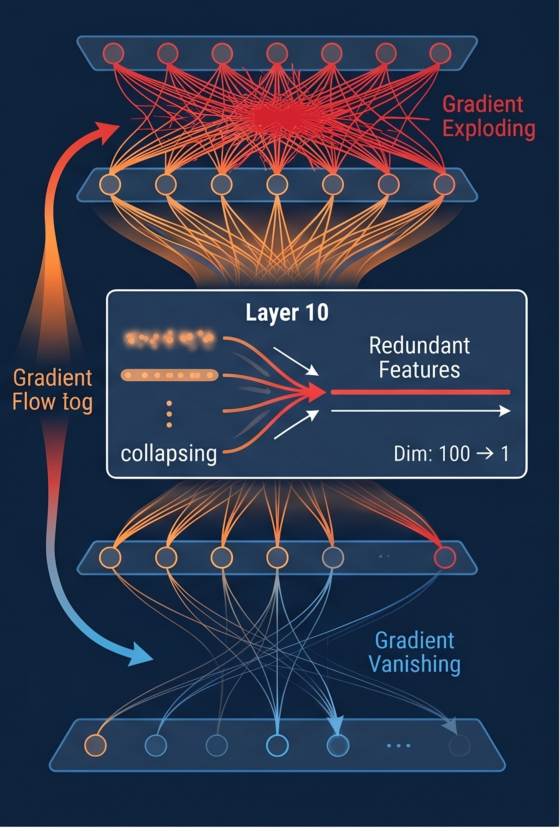
The Coordinate That Doesn't Move
While α, m, and dim all respond to structural deformation — in at least some domains — there is a fourth coordinate that is preserved throughout: the spectral growth exponent γ. Computed from the energy levels themselves (not the gaps), γ does not change under any tested deformation.
Spectral Invariance Theorem
If the deformation operator acts on gap structure without changing the level-generating law, then γ(L(B)) = γ(L(0)) for all admissible B. This is not an assumption — it is a derived consequence of the coordinate separation between level-derived and gap-derived quantities.
The empirical evidence is striking. Across 19 crystallographic systems, |Δγ| < 0.01 over the full B sweep even as α changes by factors of 4–17 and m shifts by 0.3. In the atomic corpus, helium singlet maintains γ = 0.00350 while its effective dimensionality jumps by two and its margin increases by 0.42 in a single field step.
This invariance has a structural consequence: the admissibility manifold decomposes into dynamically disconnected sectors, each labelled by its γ value. Systems in different sectors cannot reach each other under admissible deformation. Two systems may share identical α, m, and dim values and yet remain structurally distinct — separated by their spectral family.
γ-stratification
The four-coordinate phase space (α, m, dim, γ) is not a uniform space. It is stratified: γ partitions the admissibility manifold into disconnected sheets, within each of which the other three coordinates evolve under the structural flow. The invariant γ acts as a topological label for the physical system's spectral class.
A Structural Flow, Not a Scale Flow
The patterns revealed by the four-domain corpus — convergence to fixed points, discrete phase transitions, invariant exponents — admit a natural interpretation in the language of renormalization. But the UNNS structural flow is not conventional RG. The analogy is productive; the identification is not.
Conventional Renormalization Group
- Acts on scale (energy or length)
- Purely continuous flow
- No guaranteed invariant exponent
- Geometry-based (metric / field theory)
- Fixed points at critical coupling constants
UNNS Structural Flow
- Acts on gap structure (admissible sequences)
- Hybrid: continuous (α, m) + discrete (dim)
- γ invariant — by theorem
- Admissibility-based (gap covariance)
- Fixed points at domain-specific (m*, dim*)
Under the UNNS structural flow: α plays the role of running parameter (driven to α* exponentially); m plays the role of stability coordinate (driven to m*); dim plays the role of discrete phase observable (jumps at boundaries); and γ plays the role of topological invariant (preserved throughout). Dimension jumps are structural phase transitions — bifurcations in the DOF activation functional, not continuous deformations.
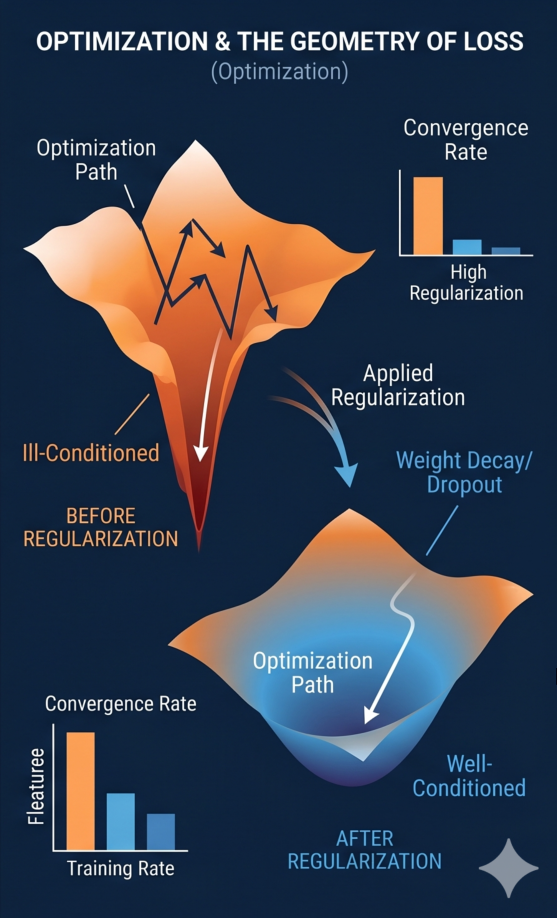
What This Replaces
The standard physical treatment of dimensionality treats it as a primitive input. Space has three dimensions (or four, or ten) and this is taken as a given. The UNNS framework reverses this: the question is not "how many dimensions does space have?" but "which structural transformation axes does the system's margin allow?"
Traditional View
- Dimension is given as a geometric primitive
- Degrees of freedom are assumed from the outset
- Extra dimensions are compactified geometrically
- Space defines physics
- Different forces are independent phenomena
UNNS View
- Dimension is selected by connectivity margin
- Degrees of freedom are activated at thresholds
- Suppressed dimensions are structurally inaccessible
- Structure defines the accessible phase space
- Forces are asymptotic regimes of a single functional Φ(m, r)
This is not a revision of the Standard Model. The UNNS framework operates below gauge theory: it provides a structural layer from which the observed interaction hierarchy, dimensional accessibility, and scaling laws can be derived, rather than postulated.
Testable Consequences
The framework makes specific, falsifiable predictions — not qualitative analogies.
Dimensional jumps are observable
When a system crosses a margin threshold, dim_eff jumps discretely. This should appear as a sudden change in the number of independent scaling exponents, a new symmetry channel becoming active, or a change of asymptotic decay family. The He singlet and Au transitions at B=0.01 T provide corpus instances.
Encoding collapse is testable
Different structural representations of the same physical system should converge to the same (α*, m*, dim*) under the deformation operator. Tested across 19 crystallographic systems and 7 chemical families. A representation that does not converge to the same attractor as others from the same system would falsify Theorem 9.8.
γ-sectors are permanent
Two systems with distinct spectral growth exponents γ cannot be connected by any admissible level-law-preserving deformation. This is directly falsifiable: a deformation experiment that moves a system from one γ value to another would break Theorem 9.7.
Margin band should exist in other regimes
The attractor band m ∈ [0.55, 0.60] is established within the strong-like interaction regime only (all 35 corpus systems land here). Analogous fixed-point bands should exist in EM-like (m ~ 10⁻²), weak-like (m ~ 10⁻³), and gravity-like (m ~ 10⁻⁴) regimes. This is the main prediction awaiting corpus expansion.
What We Do Not Yet Know
Stating limits is not a weakness — it defines the boundary of what has been established and what remains to be done.
| Open Problem | Status | Impact if resolved |
|---|---|---|
| Closed-form derivation of mmin(δ, ρ̄, ℛ) | Geometric gaps identified | Fully differential theory of dimensional emergence |
| Attractor bands in EM-like, weak-like, gravity-like regimes | Requires new corpus coverage | Cross-regime universality or family of local attractors |
| Uniqueness of structural attractor within each domain | Empirically observed, not proved | Global stability of the fixed-point map |
| Threshold universality at B=0.01 | Unexplained | Universal minimum deformation to boundary crossing |
| γ-invariance beyond level-law-preserving deformations | Current corpus cannot probe | Full conservation law status for γ |
| Monotonicity of m(L) with respect to class boundaries | Highest-priority open problem | Maximum-margin principle becomes unconditional theorem |
What This Is Not
Not this
- Not a new coordinate system for existing physics
- Not a visualization trick or data-reduction technique
- Not a reparameterisation of known results
- Not a claim that space has different dimensions than observed
- Not a replacement for the Standard Model or general relativity
This
- A structural layer beneath existing physics
- A measurable mechanism for how dimensionality is selected
- A framework that constrains and classifies interactions, not generates them
- A demonstration that what is usually assumed can instead be derived
- A falsifiable, corpus-validated, internally consistent theory
From Geometry to Structure
The number of dimensions is not a property of space. It is a consequence of how structure is allowed to exist — of which transformation axes remain accessible when a physical system is pressed against its structural boundaries.
The UNNS framework demonstrates this across atomic spectra, crystalline lattices, condensed matter gap structures, and the large-scale distribution of galaxies. In each domain, the same mechanism operates: margin governs accessibility, accessibility governs dimensionality, and deformation reveals which structural encodings are canonical.
If dimensionality is structural, then interaction strength, symmetry, and observable scaling laws may all be consequences of margin — not independent inputs. The connection to the four fundamental forces, already formalised in the companion Interaction Unification manuscript, makes this more than a possibility.
What changes is not the geometry of space, but the set of admissible structural directions. Dimensions emerge. And now, for the first time, their emergence can be measured.
Explore the full phase space
The interactive four-domain structural phase space map — 35 systems, four coordinates, live tooltips — is available at: unns.tech · UNNS Structural Phase Space →
Start by finding gold (Au) in the lower-left cluster, then follow its dashed transition arrow upward — that single jump is a dimensional phase transition, visible in a single field step.
Resources & Downloads
- Full manuscript: Emergent Dimensionality in the UNNS Substrate — Connectivity Margin as the Generator of Observable Degrees of Freedom (PDF, April 2026)
- UNNS Structural Phase Space — interactive four-domain explorer
- UNNS Dimensional Regime Synthesis Pipeline v1 — full source for unns_scaling_extractor.py, transition_generator.py, and domain-specific data
- Foundational library archive — companion manuscripts, instruments, and corpus data