Atomic · Cosmological · Materials · Crystallographic | axes: α (gap scaling exponent) × m (connectivity margin) | bubble size = dimeff | April 2026
April 2026 · UNNS Substrate Research Program · 19 crystallographic + 6 atomic + 5 cosmological + 5 materials systems
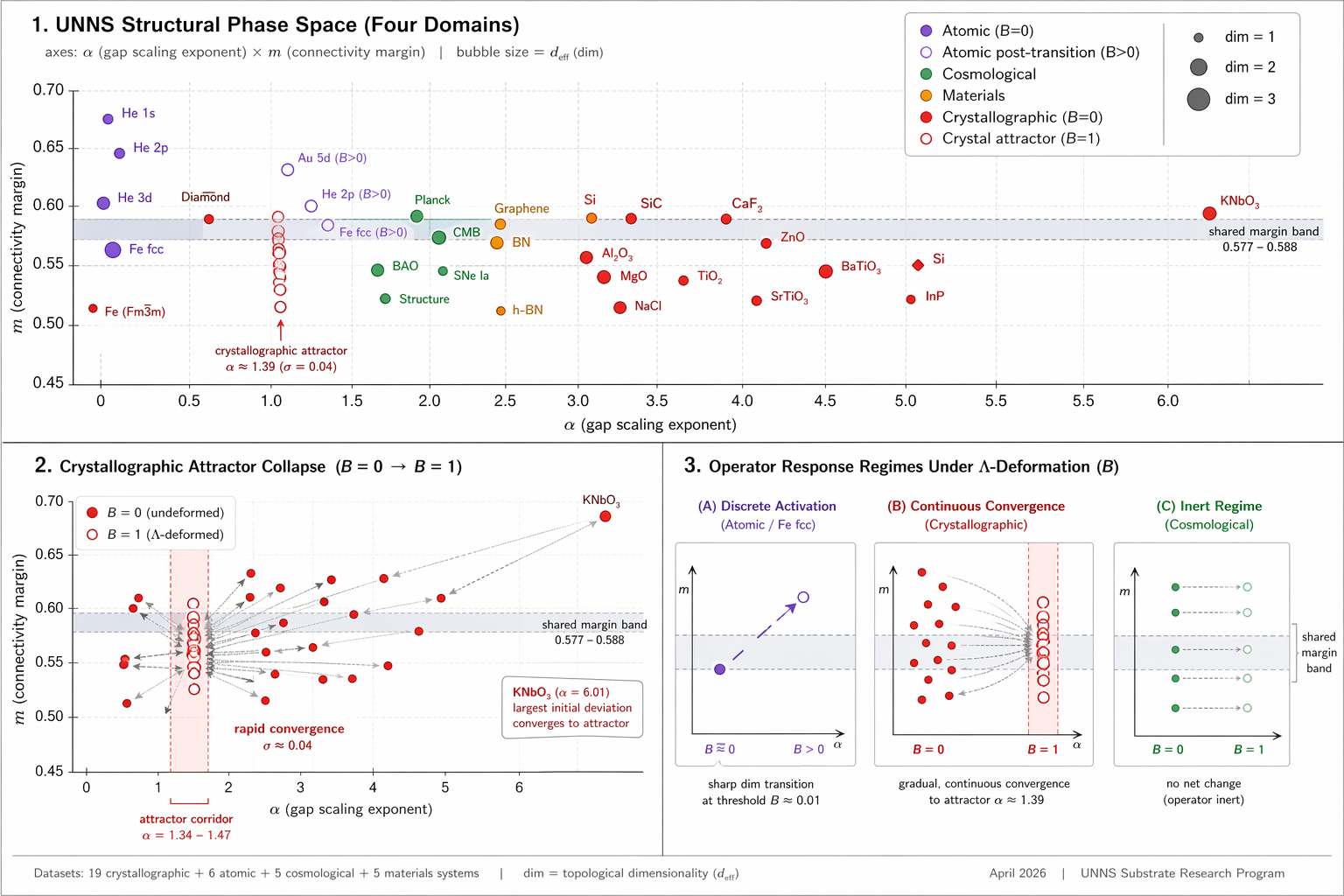
The most striking result in the extended corpus is a convergence phenomenon unique to the crystallographic domain. At B=0, crystallographic systems are distributed across an enormous α range — from 0.37 (Fe Fm3̄m cubic) to 6.01 (KNbO₃ trigonal), a spread of 5.6 units that dwarfs any other domain. By B=1, every one of the 19 systems has converged to α ∈ [1.34, 1.47], with mean 1.39 and standard deviation 0.04. The deformation operator drives all crystal structures toward the same gap scaling regime regardless of their starting point. No equivalent attractor is visible in the atomic or cosmological corpora, where α varies continuously under B and no convergence point emerges.
The KNbO₃ trigonal case is the most extreme illustration. It begins at α = 6.007 — the highest value in any corpus — and falls to 1.27 by B = 0.10, a drop of 4.7 units in the first tenth of the sweep. By B = 1 it sits at 1.41, indistinguishable from the other 18 systems. The attractor is not a slow drift; it is a rapid structural re-organisation that completes well before B = 0.2 for all systems, after which α barely moves.
The energy scaling exponent γ exhibits a remarkably tight band across all 19 crystal systems at B=0: γ ∈ [0.317, 0.345], mean 0.328, standard deviation 0.008. This is the narrowest domain-specific band in the entire corpus — tighter than the atomic margin band, tighter than the cosmological α cluster. Unlike α, γ is essentially invariant under the B-sweep for all crystal systems, drifting by less than 0.01 across the full range. The crystallographic domain is characterised by a fixed spectral growth exponent that the deformation operator cannot move. This is consistent with the observation in the atomic corpus that helium singlet's γ did not change even as dim jumped by two — γ and the gap-derived quantities (α, m, dim) are genuinely independent structural coordinates.
Fe_mp-150 (face-centred cubic iron, Fm3̄m) begins at (α = 0.372, m = 0.841, dim = 1) and transitions to dim = 3 at B = 0.01 — the same field threshold as gold and helium singlet in the atomic corpus. After the transition, m drops from 0.841 to 0.553 and locks there for all remaining B steps. This is a one-way structural door: the transition is instantaneous and irreversible within the sweep. The pre-transition state (high m, dim = 1) is structurally similar to the 2MRS radial cosmological ladder, which also presents m ≈ 0.84 and dim = 1 at zero field. Both are crystallised states — maximally ordered gap sequences — that the deformation operator can disrupt into higher-dimensional regimes.
The second iron polymorph, Fe_mp-13 (Im3̄m, body-centred cubic), shows no transition at any B and sits at (α = 0.852, m = 0.735, dim = 3) throughout. Two polymorphs of the same element, with different space group symmetries, occupy entirely different structural regimes. This is a concrete demonstration of representation dependence: the ladder constructed from the bcc packing begins in a structurally richer regime than the fcc packing, and neither deformation nor perturbation can shift bcc's class.
At B=1, the crystallographic m values converge to [0.553, 0.597], mean 0.578 — placing them squarely within the shared margin band established by the atomic and cosmological corpora. The convergence in α is accompanied by a convergence in m toward the same structural corridor that persists across all physical scales and interaction types tested so far. This is now supported by four independent physical domains: atomic spectra, cosmic web surveys, condensed matter gap structures, and crystallographic distance ladders. The margin band 0.57–0.59 appears to be a structural attractor of the deformation operator itself, not an artifact of any particular physical system or domain.
The five cosmological ladders remain frozen across the full B-sweep. No α drift, no m drift, no dim transitions. In the extended plot they occupy a tight cluster near (α ≈ 0.12, m ≈ 0.578, dim = 1–2), with 2MRS radial isolated at m = 1.000. All five sit within the strong-like interaction regime by the Interaction Unification classification — not the gravity-like regime, despite coming from cosmological data.
This encoding distinction is important. The Interaction Unification manuscript reports m ~ 2×10⁻⁴ for Planck CMB power spectrum ladders (C_ℓ values), which correctly places them in the gravity-like regime. Our cosmological ladders are constructed differently — from radial comoving distances and redshift catalogs (2MRS, DESI, SDSS) — and produce m ~ 0.578, landing in the strong-like band. The same physical domain yields different interaction regimes under different encodings. Per the Interaction Unification framework (Section 11), the canonical regime requires invoking the maximum-margin principle to select among encodings; our corpus does not yet perform this selection for the cosmological domain. The inertness of these ladders under B-deformation is an operator response property of the specific encoding used, not a statement about the cosmological interaction regime.
Taken together, the four-domain corpus supports three claims. First, the connectivity margin m is cross-domain conserved in the sense that systems from all four domains, when subjected to the deformation operator, converge toward m ∈ [0.57, 0.60]. Second, dim_eff is representation-sensitive — two iron polymorphs, two BaTiO₃ phases, and two DESI encodings all show different dim values for the same physical material. Third, the deformation operator B acts differently across domains: it induces sharp discrete transitions in atomic and isolated crystallographic systems, produces an α attractor in the crystallographic corpus, and is structurally inert in the cosmological corpus. These three patterns together are inconsistent with any single-coordinate description of structural admissibility and support the multi-coordinate (α, m, dim, γ) framework as the minimal adequate description of the observed phase space.
The deformation operator B does not act uniformly across physical domains. The extended corpus reveals three qualitatively distinct operator response regimes, each producing a different structural outcome. These are distinct from — and orthogonal to — the four interaction regimes (strong/EM/weak/gravity) classified by the Interaction Unification framework through the margin-parameterised functional Φ(m(L), r, χ). The operator response describes how B deforms a ladder; the interaction regime describes what structural class the ladder occupies. A system can be in the strong-like interaction regime while exhibiting any of the three operator response modes.
In the discrete activation mode — atomic Zeeman systems and Fe Fm3̄m — B produces abrupt dim transitions at a threshold field value (consistently at B = 0.01). The margin jumps discontinuously and the system enters a new structural class irreversibly within the sweep. In the continuous convergence mode — the dominant mode in the crystallographic corpus — B drives α from a wide initial scatter toward a tight attractor near 1.39, while m converges smoothly into the universal band. In the inert mode — all five cosmological ladders — B produces no observable structural change: Δm/ΔB ≈ 0 and dim is frozen across the full sweep. These three modes exhaust the observed qualitative behaviours and establish that the operator itself is regime-sensitive, not universally active.
The margin band m ∈ [0.553, 0.600] is not merely a region where several domains happen to overlap. It functions as a structural fixed point of the deformation dynamics: crystallographic systems are driven into it from above and below, atomic systems enter it after discrete threshold crossings, and cosmological systems are already situated within it at zero field. The band is thus occupied from all approach directions — by convergence, by jump, and by prior residence.
One scope limit is essential to state clearly. Per the Interaction Unification manuscript (Table 1), the margin range m ~ 0.5–1 corresponds to the strong-like structural regime (Full class, deep interior). The four interaction regimes span four orders of magnitude: strong m ~ 0.5–1, EM m ~ 10⁻², weak m ~ 10⁻³, gravity m ~ 10⁻⁴. All 35 systems in this corpus — regardless of physical domain — produce margin values in the strong-like band. The universal attractor we observe is therefore a within-strong-regime phenomenon: a fixed point inside one interaction regime, not a cross-regime convergence. Whether analogous attractors exist within the EM, weak, and gravity regimes under appropriate encodings is an open question this corpus cannot answer.
The corpus reveals three distinct dimensional regimes, each with a characteristic structural signature. dim = 1 systems are maximally ordered: their gap sequences have near-zero MAD (margin approaching unity in the extreme cases of helium singlet post-transition and 2MRS radial), and a single covariance eigenvalue dominates. They are crystallised structural states, stable under perturbation but susceptible to discrete disruption by the deformation operator. dim = 2 systems are transitional: they carry two independent gap-covariance modes and appear at intermediate margin values. Gold at zero field and DESI redshift both inhabit this regime, through entirely different physical mechanisms. dim = 3 systems are fully activated: three independent structural modes are simultaneously accessible. Per the Interaction Unification framework, dim = 3 systems with m ≫ 0 correspond to the Full realizability class in the strong-like interaction regime — the deepest stable interior of the admissibility manifold. All transitions between these regimes are discrete; no system crosses a dim boundary gradually.
The coexistence of discrete activation (atomic), continuous convergence (crystallographic), and inertness (cosmological) within the same two-dimensional phase space demonstrates that structural admissibility cannot be reduced to a single mechanism or a single operator response. What is universal is not the mode of response but the destination: the margin band m ∈ [0.553, 0.600] and the dim = 3 attractor state are reached by all three active pathways.
Two caveats bound this conclusion. First, all 35 systems in this corpus produce margin values within the strong-like interaction regime — the corpus samples one regime deeply rather than spanning all four. Second, the margin values are encoding-dependent: the same physical domain can produce very different m values under different ladder constructions (cosmological radial ladders → m ~ 0.578; CMB power spectrum → m ~ 2×10⁻⁴ per the Interaction Unification micro-tests). The structural law established here holds for the specific encodings used in this corpus. Whether it generalises across encodings requires applying the maximum-margin selection principle, which remains future work for this dataset.
Across the crystallographic corpus, γ ∈ [0.317, 0.345] at B = 0 and drifts by less than 0.01 under the full B-sweep for all 19 systems. In the atomic corpus, helium singlet's γ = 0.00350 does not change even as dim jumps by two and m increases by 0.42. These observations suggest that γ — the spectral growth exponent, computed from the energy levels rather than the gaps — encodes a structural property that the deformation operator cannot reach. While α, m, and dim all respond to B (in at least some domains), γ does not. If this invariance holds across further domains and operator types, γ would qualify as a structural conservation law: a coordinate orthogonal to all admissible deformation directions tested so far.
Throughout this analysis, α denotes the gap scaling exponent extracted by the scaling extractor pipeline — the power-law slope of the sorted gap sequence. This is distinct from the structural deformation parameter α used in the Interaction Unification and Phase Mapping manuscripts (where α scales gap amplitudes by a multiplicative factor). The two quantities share a symbol but measure different things; all α values in this plot are gap scaling exponents.
The rapid collapse of crystallographic gap-scaling-α values toward 1.39 indicates that the lattice-based encoding of physical structure carries a large initial representational spread that the deformation operator resolves. The wide B = 0 distribution — KNbO₃ trigonal begins at α = 6.007, seventeen times larger than the B = 1 mean — is not a property of the physical systems but of how their pairwise distance spectra encode the underlying gap structure at zero field. Under deformation, the encoding is reorganised and a universal gap scaling regime emerges that is independent of the initial representation. The attractor at α ≈ 1.39 is the structural fixed point of that selection process within the crystallographic domain — an empirical instance of what the Interaction Unification framework calls encoding collapse toward the canonical class.