
Local Geometry of
Realizability Boundaries
A new manuscript establishes that the connectivity margin — the UNNS framework's central operational invariant — is not merely a heuristic quantity, but a proven geometric distance to a class boundary. Realizability space has structure: smooth hypersurfaces, measurable trajectories, and a phase landscape confirmed across six atomic elements.
What This Paper Establishes
The UNNS Substrate framework has long operated with an invariant called the connectivity margin m(L), defined operationally as the minimum distance to the nearest class-changing structural event. It works — but until now, its geometric meaning has been unknown. Is it really a distance? To what? In what space?
This manuscript answers those questions. It introduces realizability charts — finite-dimensional local coordinate systems built from decisive structural observables — and proves that realizability-class boundaries are locally codimension-1 smooth hypersurfaces. The central result is a bi-Lipschitz equivalence between m(L) and the literal Euclidean distance to the nearest class boundary in chart coordinates. The margin is a distance.
This geometric foundation then enables a canonicalization theorem: within any regular local regime, all margin-maximizing encodings of the same physical system must lie in the same realizability class. An atomic corpus of 16 directly measured runs across six elements confirms the geometric picture empirically and reveals a five-regime structural phase landscape.
I. The Core Discovery: Margin as Geometric Distance
The deepest shift in this work is conceptual. The UNNS framework has always measured two things for each physical system: admissibility (via the Universal Structural Law) and realizability (via the Percolative Realizability Principle). Both are binary verdicts — a system either passes or fails. The connectivity margin m(L) is the analogue of a safety buffer: how far is the system from flipping?
Before this paper
The margin m(L) is operationally defined as the minimum signed distance to the nearest decisive class-changing event — a threshold crossing in giant ratio, tail dominance, or connectivity.
It works empirically across 81 corpus runs. But its geometric meaning is unknown.
- What kind of distance is it?
- Distance to what, exactly?
- In what coordinate system?
After this paper
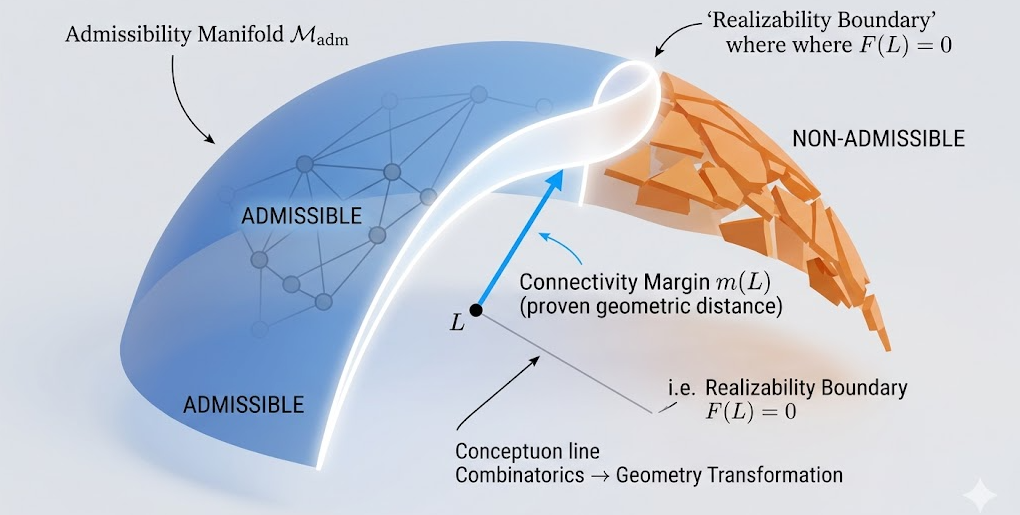
m(L) is a Lipschitz-equivalent distance to a codimension-1 C¹ hypersurface in a decisive local chart of the admissibility manifold.
The class boundary is not an algorithmic black box — it is a smooth geometric surface. The margin measures how far a system sits from that surface.
- Distance in: decisive chart coordinates
- To: the nearest local class-boundary hypersurface
- Proven: by Lipschitz equivalence theorem (Lemma 6.2)
The Category → Geometry Upgrade
The question "Does this system belong to the FULL class?" is now replaced by "How far is this system from losing the FULL class?" — a continuous, measurable, geometrically grounded answer. Combinatorial structure has a metric interpretation.
The Proof Architecture
The result is built on a clean lemma chain. The key steps are:
- Finite decisive reduction (Lemma 3.3): At most five decisive observables suffice to determine the local realizability class near any system — matching the operational structure of STRUC-PERC-I exactly.
- Threshold representation (Lemma 4.2): Each class-changing event is locally representable as a smooth function Gj(x)=0 with non-vanishing gradient — making it a regular hypersurface.
- Active branch lemma (Lemma 5.3): Locally, a single branch function Mj*(L) controls the margin — so the global minimum over decisive events reduces to a single smooth distance function.
- Bi-Lipschitz equivalence (Lemma 6.2): The active branch satisfies c₁·d∂C(L) ≤ Gj*(x) ≤ c₂·d∂C(L) for positive constants c₁, c₂ — proving the margin is equivalent to boundary distance.
II. Five Structural Phases Confirmed Empirically
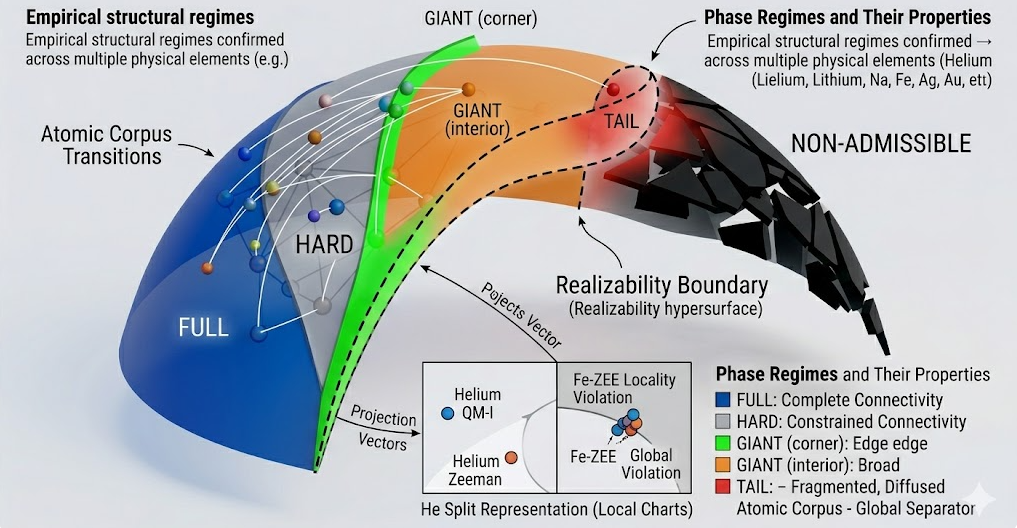
The local geometry theory makes a prediction: different physical systems, placed in the decisive coordinate chart (tailDom, GR), should cluster into structurally distinct regions. The atomic corpus — 16 direct STRUC-PERC-I runs across six elements in two representation families (QM-I energy levels and Zeeman magnetic splittings) — tests this prediction directly.
The result is a structural phase landscape: five clearly separated regimes, each with a distinct physical interpretation, each occupying a geometrically coherent region of the decisive chart.
Complete Connectivity
GR = 1.000; full percolation achieved. Largest boundary-distance; most structurally stable.
Constrained Connectivity
GR < 0.95; Theorem 1 triggered. Hydrogen QM-I only — hydrogenic n⁻³ level spacing resists percolation.
Near-Global Connectivity
GR ∈ [0.995, 0.998], tailDom > 0.999. Light atoms near chart corner (1,1). Orthogonal chart structure.
Large-But-Incomplete
GR ∈ [0.997, 0.998], tailDom lower (0.967–0.998). Dense fine-structure dilutes outlier fraction.
Fragmented / Diffuse
GR = 0.994, no percolation at any tested extension scale. Au Zeeman only — the corpus's richest open target.
The Iron Exception: Locality Confirmed
Iron Zeeman (Fe-ZEE) provides the most important single data point in the cross-system corpus. Its tail-dominance coordinate is 0.967 — far outside the narrow zone explored by helium. The helium-derived boundary separator F(x) = GR − tailDom = 0 gives F = +0.030 (the FULL side), yet Fe-ZEE is unambiguously GIANT.
Why This Is Not a Problem — It Is a Proof
The local theory predicts exactly this: the boundary function F=0 is valid only within the local chart neighbourhood in which it was fitted. Outside that neighbourhood, the active decisive branch changes, the boundary orientation changes, and a different local chart is needed. Fe-ZEE lies outside the helium chart zone — and it violates the helium separator. This is precisely the confirmation the theory requires. Realizability geometry is inherently local. A global separator does not exist. An atlas of local charts is necessary.
III. Representation Dependence and Dual Observability
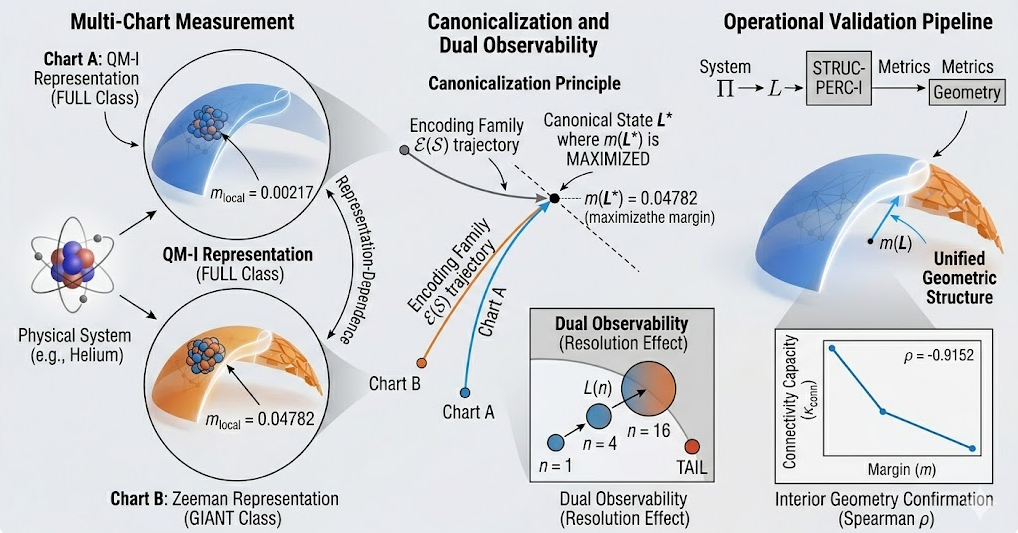
Perhaps the most surprising finding of the empirical programme is this: the same physical system can land in different realizability classes depending on how it is represented. Helium, measured as a QM-I energy-level ladder, is FULL. Helium, measured as a Zeeman magnetic-splitting ladder, is GIANT. Same atom. Different structure. Different class.
The Helium Split (7 Direct Measurements)
All three QM-I helium representations (preprocessed, gap structure, spectrum) return FULL with GR=1.000. All three Zeeman representations (full ladder, singlet, triplet) return GIANT at full instrument resolution. The decisive coordinates are completely different between the two families — QM-I is governed by the tail-dominance branch, Zeeman by the giant-ratio branch — and these branches have orthogonal gradients (∇G₁·∇G₃ = 0). This is not a continuous transition: it requires genuinely separate local charts.
The Canonicalization Principle
Given that the same system can appear in different realizability classes depending on representation, a natural question arises: is there a canonical or preferred representation? The answer, established by Theorem 7.2, is yes — locally.
Applied to helium: within the QM-I family (all FULL), the canonical encoding is Spectrum QM-I (mlocal=0.00217, κconn=271,999 — lowest tail-dominance, lowest connectivity threshold, highest boundary distance). Within the Zeeman family (all GIANT), the canonical encoding is Triplet Zeeman (mlocal=0.04782, highest giant ratio). This is the first time in the UNNS programme that a canonical representation has been identified from first principles.
Resolution Dependence: A New Dynamic
A further discovery emerges from the Zeeman runs. At low resolution (n≈2,000 levels, Phase Mapping corpus), all three Zeeman helium encodings are classified as TAIL. At full instrument resolution (n=17,000–338,000 levels), all three are GIANT. The same physical spectrum changes class as more energy levels are resolved.
What Drives the Class Change
Approximately 30–48 magnetic sub-levels are isolated (unconnected) in the Zeeman vulnerability graph. At n=2,000, these constitute ~1.5% of all levels — above the giant-ratio threshold, triggering TAIL. At n=17,000, they constitute ~0.17% — below the threshold, allowing GIANT. The physics (30 isolated transitions) is resolution-invariant; the structural class is not. This parametric class transition follows a logarithmic trajectory in the decisive chart — the first dynamic geometric result in the corpus.
| Representation | Class | tailDom | Giant Ratio | mlocal | Active Branch | Canonical? |
|---|---|---|---|---|---|---|
| QMI-spec (Spectrum QM-I) | FULL | 0.9978 | 1.0000 | 0.00217 | G₁ (tailDom) | ★ Canon. QMI |
| QMI-pre (Preprocessed) | FULL | 0.9981 | 1.0000 | 0.00192 | G₁ (tailDom) | — |
| ZEE-trip (Triplet Zeeman) | GIANT | 0.9996 | 0.9978 | 0.04782 | G₃ (GR branch) | ★ Canon. ZEE† |
| ZEE-sing (Singlet Zeeman) | GIANT | 0.9993 | 0.9978 | 0.04780 | G₃ (GR branch) | — |
IV. The Four Central Theorems
Empirical Confirmation: ²⁸Si Nuclear Corpus
Theorem 6.4 is validated directly on 10 FULL nuclear isotopes from the ENSDF corpus. Spearman ρ(mest, log κconn) = −0.9152 (p = 0.0002, n = 10). Lower margin corresponds to larger boundary distance corresponds to harder-to-percolate (higher κconn). The ordering is preserved exactly across the full FULL interior — a strong corpus-level confirmation with no exceptions.
V. What Is Genuinely New
Each of the following results is novel — not observed in prior UNNS publications, and not a consequence of existing theorems in adjacent fields (percolation theory, statistical physics, or differential geometry).
Proven locally: m(L) is bi-Lipschitz equivalent to d∂C(L). Not assumed — derived from the decisive coordinate structure and the implicit function theorem.
Class transitions are not discrete jumps in a classification algorithm — they are crossings of C¹ hypersurfaces. The boundary has local geometry.
Five geometrically distinct regimes confirmed empirically across 6 elements and 16 direct runs. A phase landscape — not a label system.
Realizability class is not invariant under protocol choice. The same system can be FULL (QM-I) or GIANT (Zeeman). Encoding families are non-trivial objects.
Zeeman helium transitions from TAIL (n≈2,000) to GIANT (n>17,000). Structural class has a parametric trajectory in realizability space — a dynamic not previously characterized.
Fe-ZEE confirms it: realizability geometry cannot be described by a single global boundary function. Madm requires an atlas of local charts — a manifold, not a fixed classifier.
The canonical representation of a physical system — the margin-maximizing encoding within its encoding family — is now identified from first principles for helium and ²⁸Si.
The ladder construction protocol specification (§2.6, Appendix D) closes the data-to-theory bridge. Any corpus run is now reproducible from raw data and protocol alone.
VI. The Computational Pipeline
This work does not only theorize. It implements. The STRUC-PERC-I instrument (v2.4.0) is the computational realization of the theory — a browser-based percolation analyzer that accepts any ordered sequence, computes realizability class, connectivity margin, and all decisive coordinates, and returns structured output for analysis.
Protocol Specification (New in This Manuscript)
Section 2.6 and Appendix D of the core manuscript formally specify four ladder construction protocol families:
(A) QM-I energy-level ladders (spectrum, preprocessed, gap-structure variants),
(B) Zeeman magnetically-split ladders (standard, singlet/triplet sub-families, approximate mode),
(C) gap-derived ladders, and (D) transform ladders.
Each canonical variant specifies the exact CSV column to extract
(energy_cm-1 for QM-I; LevelB_cm1 for Zeeman),
enabling fully reproducible corpus runs from raw data files.
VII. Relation to Existing Frameworks
| Field | Similarity | Key Difference |
|---|---|---|
| Statistical Physics | Phase transitions between ordered and disordered states | Structural phases, not thermodynamic. No temperature — structure alone. |
| Percolation Theory | Connectivity thresholds in random graphs | The margin m(L) is a continuous control parameter — not just a critical point. |
| Differential Geometry | Manifolds, charts, smooth boundaries | The space is constructed from empirical data, not assumed axomatically. |
| Information Theory | Encoding dependence of structural properties | Structure depends on representation, not just entropy. Geometric, not information-theoretic. |
| Network / Complexity Theory | Graph connectivity metrics | A unified geometric control parameter replaces ad hoc connectivity statistics. |
VIII. Open Questions and the Path Forward
The local geometry paper is deliberately scoped. It proves what can be proved now — local results — and leaves the global programme explicitly open. Three conjectures structure the next phase:
Conjecture 1 — Piecewise-Hypersurface Global Boundary
The global realizability boundary ∂C is locally piecewise C¹ in decisive charts, decomposing into finitely many smooth patches meeting along lower-dimensional strata. Evidence: the four TAIL nuclear isotopes and the Fe-ZEE locality violation both suggest multi-sheet boundary structure.
Conjecture 2 — Global Chart Atlas
A finite atlas of decisive realizability charts covers Madm such that m(L) is globally order-equivalent to the chart-local boundary distance in each chart, and the order relation is preserved across overlapping charts. This would make m(L) a genuine global distance-type functional.
Conjecture 3 — Exact Metric Equivalence
There exists a Riemannian metric g on Madm (compatible with the gap-ratio topology) such that m(L) = dg∂C(L) exactly — not merely up to bi-Lipschitz equivalence. This is the strongest possible form: the margin as a true signed distance function.
The next flagship targets are: gold Zeeman (the only TAIL Zeeman system, richest structural target), sodium (most extreme QM-I/Zeeman split in the Phase Mapping corpus), and a resolution sweep for the Zeeman helium transition to pin down ncrit precisely and map the class-change trajectory in chart coordinates.
Resources & Further Reading
- Core Manuscript: Local Geometry of Realizability Boundaries in the UNNS Substrate — 28-page working manuscript with proofs, protocol specifications, and empirical corpus.
- Interactive Research Dashboard — Full corpus, validation suite, and STRUC-PERC-I engine access in one interface.
- STRUC-PERC-I v2.4.0 — Browser-based PRP percolation analyzer. All empirical results produced using this instrument.
- Helium Multi-Chart Validation (v3) — 7-representation study: QM-I vs. Zeeman, dual-family canonicalization, corner structure, resolution dependence.
- ²⁸Si Local Geometry Validation — Nuclear corpus monotonicity test: Spearman ρ=−0.915 (p=0.0002) confirming Theorem 6.4.
- Atomic Structural Phase Landscape — 8-page cross-system addendum: 16 runs, 6 elements, 5 regimes, Fe-ZEE locality confirmation.
- Foundational Library Archive — ZIP of prior manuscripts (USL, PRP, Dual Observability, Structural Response, Interaction Unification) and corpus analysis instruments.