
The Hidden Boundaries
of Complex Numbers
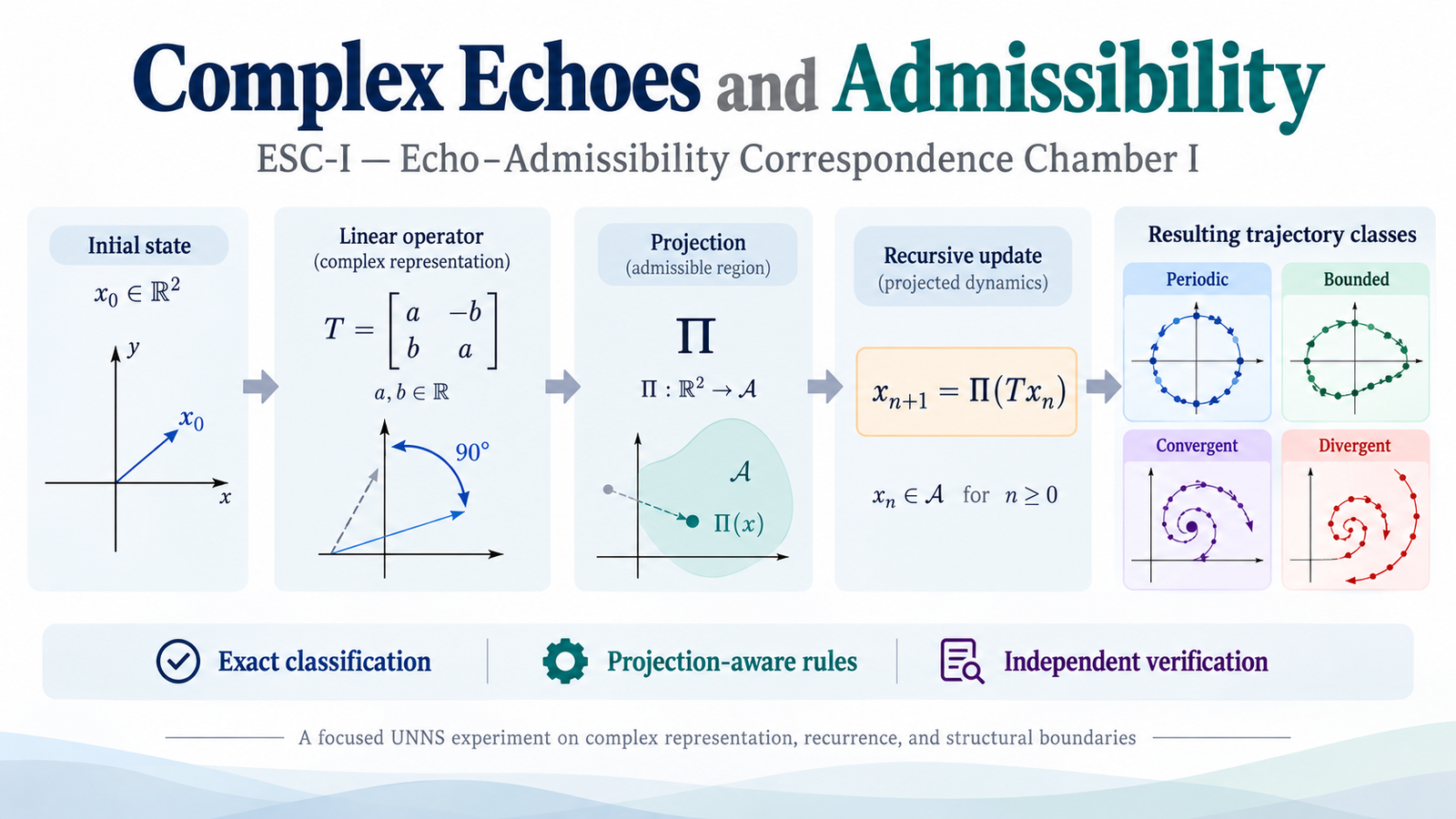
An unlikely paradox
There is something wonderfully paradoxical about imaginary numbers.
They are called imaginary, yet they help describe some of the most tangible phenomena in our world: electrical currents, electromagnetic waves, oscillating systems, quantum mechanics, and the mathematics of rotation.
The familiar symbol i, defined by i2 = −1, seems to introduce a new kind of number that cannot be found anywhere on the ordinary real-number line.
But what if we look at it differently? Instead of asking what an imaginary number is, suppose we ask what it does.
Multiplication by i rotates a vector through 90 degrees. Repeat the operation, and the vector makes four quarter-turns before returning to its starting point. Nothing mysterious needs to happen to the coordinates. The entire operation can be performed with real numbers.
This simple observation motivated an earlier UNNS investigation into the relationship between complex numbers, recursive operations, and mathematical structure. What began as an exploration of imaginary numbers eventually raised a more consequential question:
Our latest investigation suggests that the answer is more subtle than it first appears.

When an imaginary number becomes a real rotation
Apply it to the real vector (1, 0), and the result is (0, 1). Apply it again, and we obtain (−1, 0). Two more applications complete the circle. In particular,
The familiar algebraic property of i has appeared as a property of a real transformation.
This does not make complex numbers mathematically invalid or unnecessary. Their algebra is exceptionally useful, and this correspondence has long been established in classical mathematics. But it opens an interesting perspective: complex multiplication can be understood as a structured operation on real states. That was the starting point of the original UNNS complex-number research.
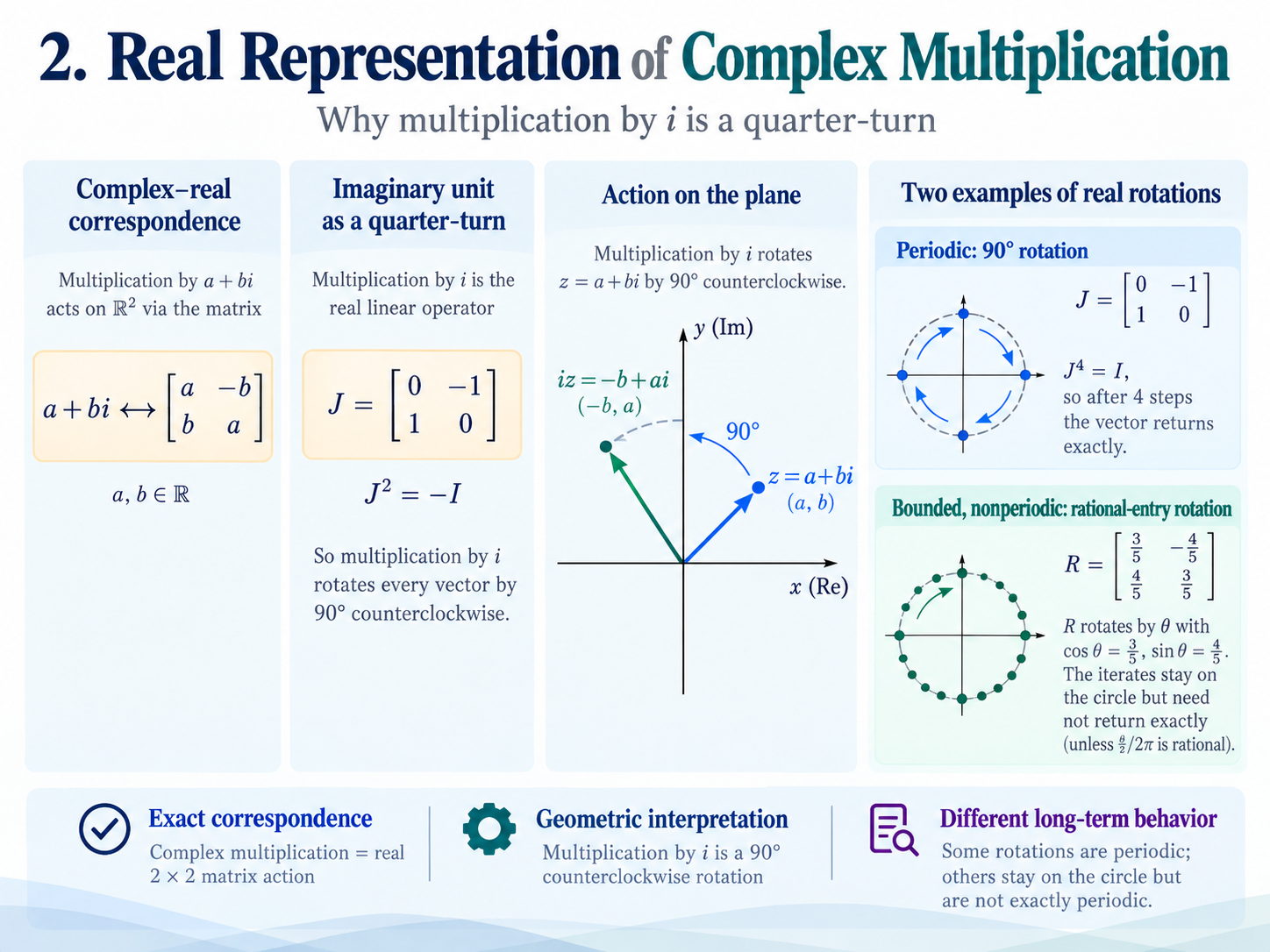
The next surprise appears when we abandon the familiar quarter-turn. Take a rotation whose cosine is 3/5 and whose sine is 4/5. Its matrix contains only rational numbers, and every iteration remains on the same circle. Yet the trajectory never returns exactly to its starting position.
A single mathematical rule can have different futures
Once we start examining recursive trajectories, a remarkable variety of behavior appears. Some trajectories rotate forever. Others spiral inward until they approach the origin. Others grow without bound. Still others appear perfectly stable until a small change in their initial state sends them in a different direction.
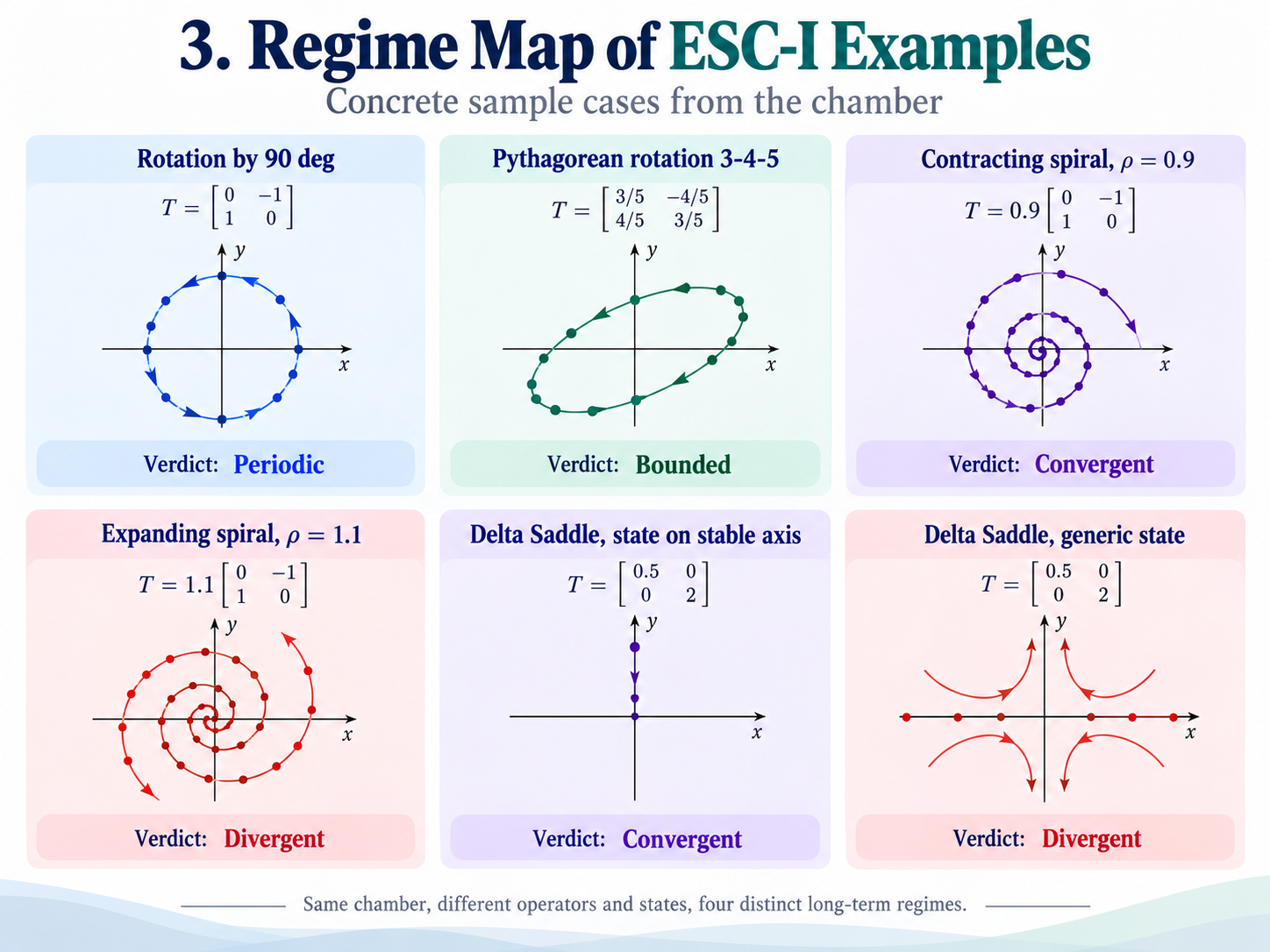
The ESC-I chamber was built to investigate these distinctions. ESC-I stands for Echo–Admissibility Correspondence Chamber I. It combines exact rational-arithmetic classification with finite-horizon observation, deliberately difficult test cases, and separately implemented verification.
Before examining those traps, however, we should look at an even simpler example. Imagine a system with two directions. Along one direction, distances double with each step. Along the other, they are halved. Surely such a system must be unstable? Not necessarily for every initial state.
Same matrix. Different fate.
The first coordinate doubles at every iteration. The second is repeatedly halved. If the initial state lies exactly along the second coordinate axis, the trajectory converges toward zero. Move the initial state even slightly away from that axis, giving it a nonzero first coordinate, and eventually the expanding component dominates.
The matrix has not changed. Its eigenvalues have not changed. Only the initial state has changed.
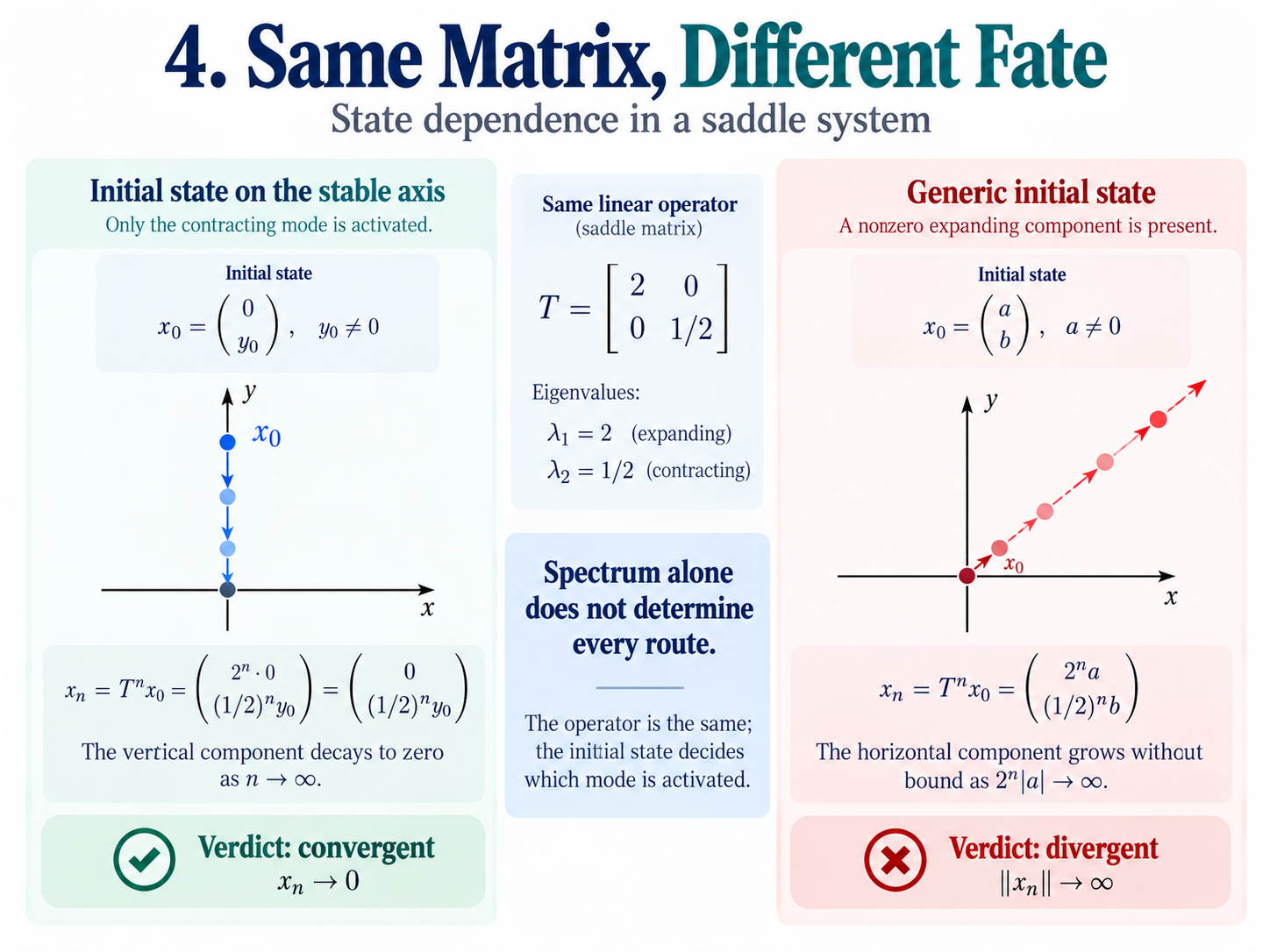
This is a classical result in dynamical systems, but it illustrates something central to the UNNS interpretation. The generating operator describes the available dynamics. The initial state determines which of those dynamics actually participate in the trajectory.
For UNNS, this is a useful distinction between the possibilities contained in a generative rule and the particular route realized by a state. And it leads to an even more intriguing problem: what happens when our ability to observe a trajectory is limited?
When mathematics deceives the observer
Imagine watching a clock whose hand moves almost — but not quite — through a complete revolution with each step. After several observations, it seems to be returning to the same positions. Increase the precision of your measurements, however, and you discover that each apparent return misses the previous position by a tiny amount. The clock never truly repeats.
Now imagine another system that expands so slowly that, over two thousand observations, its growth is almost imperceptible. An observer might classify it as bounded. Yet its exact mathematical description establishes that it will eventually grow without limit.
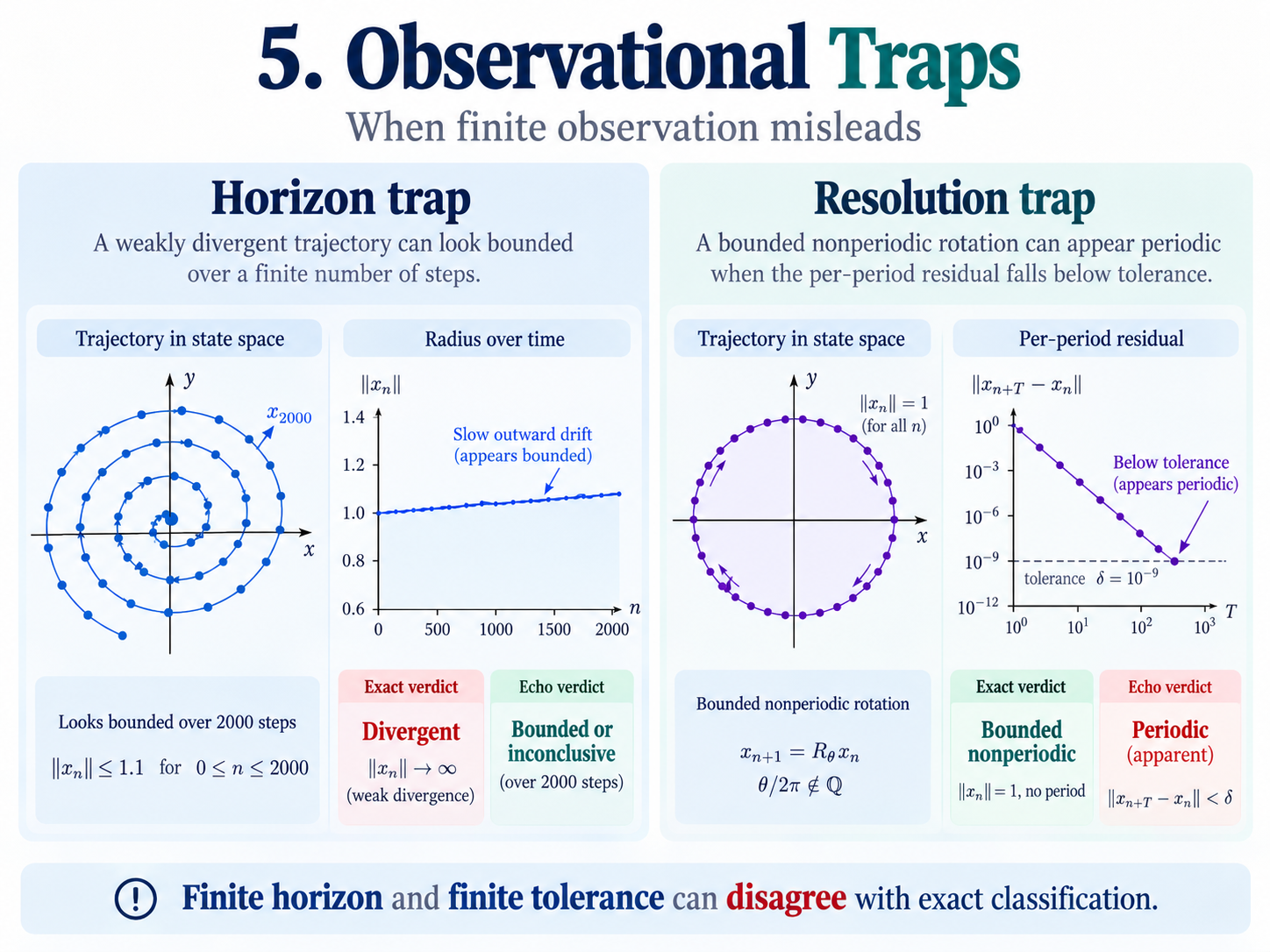
ESC-I deliberately constructed both situations. The first is the resolution trap: a nonperiodic system appears periodic because the difference between successive near-returns falls below the chosen numerical tolerance. The second is the horizon trap: genuine divergence remains effectively invisible during a finite observation window.
Neither is a failure of mathematics. Both are examples of a mismatch between the system's actual behavior and what a limited observer can establish. This matters whenever computer simulations are used to infer the long-term behavior of recursive systems. A thousand steps, a million steps, or even a billion steps cannot, by themselves, establish an infinite-time mathematical property.
The distinction is especially important for UNNS, where persistence and recurrence are often central to the interpretation of generated structures. This recognition motivated the next stage of our experiment: instead of merely watching what trajectories do, could we determine some of their possible outcomes from mathematical conditions alone?
The invisible intervention that changes a trajectory
Consider an expanding trajectory. Left alone, it grows without bound. But suppose that after every step we apply an additional operation. Perhaps values beyond a threshold are clipped. Perhaps small values are rounded to zero. Perhaps every state must be placed on a discrete lattice. Or perhaps a gate eliminates particular coordinates when a condition is satisfied. The trajectory is no longer governed by the original matrix alone. Its evolution becomes
where T generates the linear transformation and Π applies the specified projection. The projection might seem like a minor technical detail. It is not.
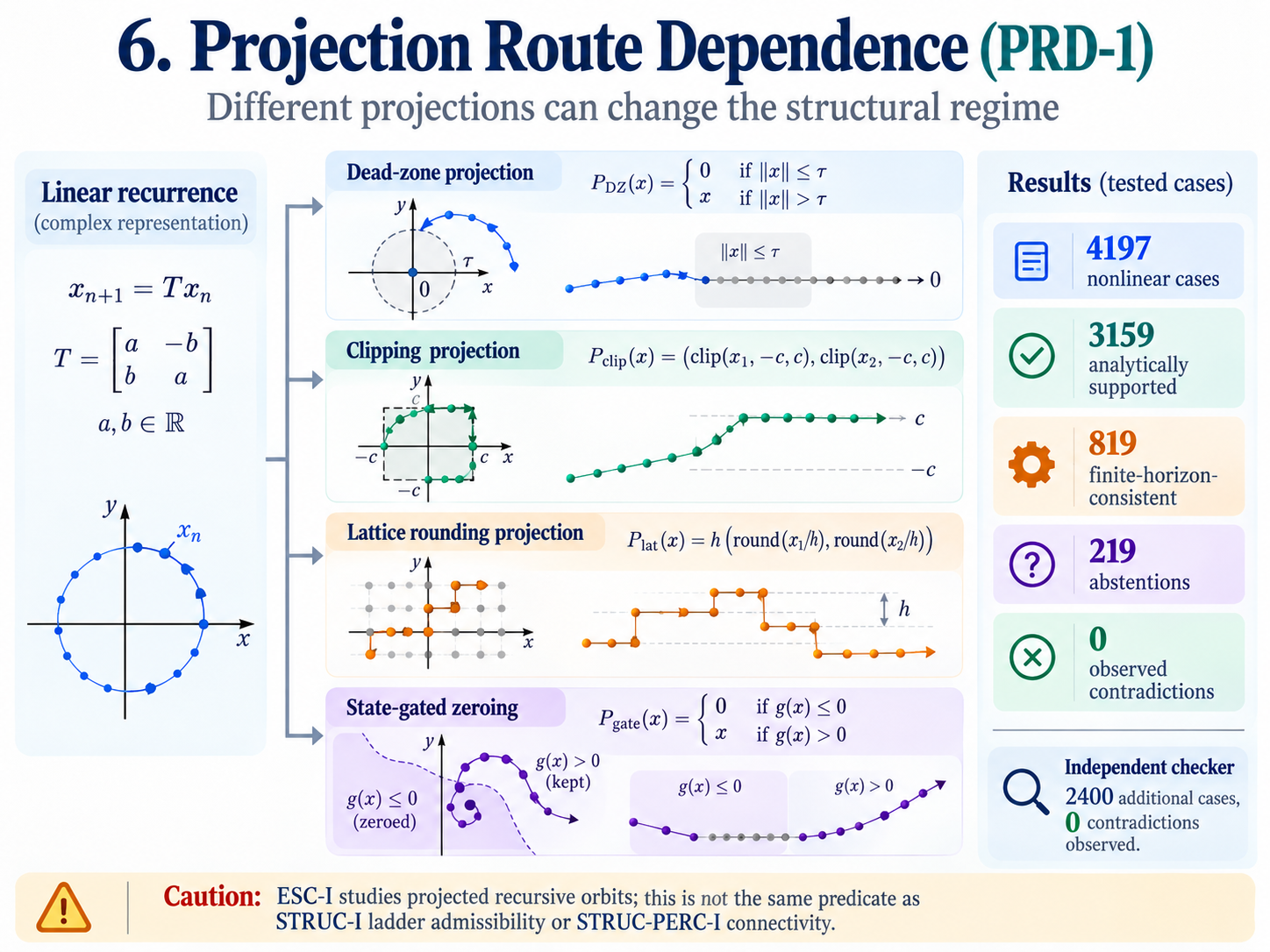
A dead zone can eliminate a route. Clipping can prevent unbounded growth. Rounding can produce discrete cycles or absorbing states. Gating can change which directions remain available. These effects belong to established mathematics, including nonlinear dynamics, control theory, and quantized systems. ESC-I investigated them systematically through the UNNS language of structural routes and boundaries.
A boundary you can compute
Take T = diag(2, ½) again, start at (1, 1), and let a dead zone erase the first coordinate whenever its magnitude falls below a threshold θ. After one step the first coordinate is 2. If θ ≤ 2 it survives and keeps doubling; if θ > 2 it is erased at the first step, and only the shrinking second coordinate remains.
The resulting experiment, called PRD-1 (Projection Route Dependence), examined several nonlinear projection families under controlled conditions. Its central question was straightforward:
What the experiments established
A separate implementation checked another 2,400 cases, including nonlinear predictions and linear controls, without detecting contradictions.
The value of preserving failure
One particularly valuable part of the study was its willingness to preserve failure. An earlier quantization rule produced 92 disagreements. Rather than discard them, the investigation retained the original record, corrected the mathematical condition, froze the correction before generating new data, and tested it on 3,600 fresh cases. The corrected conversion produced zero disagreements within its stated domain; it also abstained on 1,452 cases where it offered no certificate.
This sequence — hypothesis, falsification, correction, and independent corroboration — is as important as the final numerical agreement.
An essential distinction
The PRD-1 rules use information about the projections themselves. A classical mathematical method using the same information could derive similar certificates. ESC-I has not established an advantage over all classical approaches. Its demonstrated achievement is more specific: within the tested families, many outcomes could be predicted from explicit conditions without orbit-by-orbit simulation.
What does this tell us about complex numbers?
We began with the imaginary unit and discovered that complex multiplication has an exact real-matrix representation. We then found that real rotations can be periodic or nonperiodic, that the same matrix can admit convergent and divergent trajectories, and that observations of recurrence can be misleading. Finally, we examined how nonlinear projection changes the behavior of a generated orbit.
What connects these discoveries? The distinction between mathematical representation and structural evolution.
A complex number tells us how a particular algebraic operation can be expressed. A recursive system tells us how states evolve under repeated transformations. A projection changes the rules governing that evolution.
This provides a precise relationship between complex-compatible algebra and rotational invariance. It does not prove that complex numbers uniquely emerge from UNNS admissibility. The rotational structure is already part of the mathematical setting. But it sharpens the foundational question considerably:
That is a much more precise question than asking whether imaginary numbers are real.
The larger picture: where ESC-I belongs in UNNS
ESC-I did not emerge in isolation. The UNNS Substrate has developed a broader research program examining recursive generation, structural admissibility, persistence, refinement, route closure, and exclusion. Its canonical instruments address different mathematical questions. STRUC-I evaluates admissibility of perturbed numerical ladders through ordering and vulnerability conditions. STRUC-PERC-I analyzes connectivity and fragmentation in full pairwise vulnerability graphs. ESC-I investigates something different: the behavior of recursive trajectories under specified operators and projections.
Their conceptual relationship is nevertheless important. Each asks how structure behaves when generation is subject to constraints. Each provides a way of studying whether certain configurations or transitions remain possible under a precisely defined mathematical rule. ESC-I adds a particularly transparent setting because many of its examples can be classified exactly and their observed behavior compared against mathematical ground truth. In this respect, the complex-number investigation has become a useful bridge between elementary algebra and the wider UNNS research program.
Why these findings matter beyond the chamber
The implications extend into several established branches of mathematics.
Dynamical systems
Invariant directions and nonlinear interventions determine trajectories.
Numerical analysis
Finite-horizon simulation and tolerance-based recurrence tests require careful interpretation.
Control theory
Clipping, thresholding, and gating are familiar mechanisms that change what a system can do.
Formal verification
Sufficient conditions allow some long-term behavior to be certified without enumerating every future step.
And within UNNS, ESC-I adds a mathematically explicit example of how generation, structural boundaries, and persistence can be studied together. These relationships do not require us to claim a new universal law. They show how a conceptual research framework can be translated into precise statements that can be challenged and reproduced. That translation is a meaningful achievement.
The question that remains
The original UNNS research asked whether complex numbers should be considered foundational objects or convenient representations of deeper recursive operations. ESC-I has not settled that philosophical and mathematical question. It has, however, changed how precisely we can approach it.
We know that complex multiplication admits an exact real representation. We know that phase invariance characterizes particular operator families. We know that recursive dynamics can be modified by projections and that some resulting behaviors admit analytical certificates. The next challenge is more ambitious.
That would demand a new theorem and a new experimental design. It cannot be obtained merely by running more of the same simulations. But it is now a well-defined direction for further research.
What ESC-I has demonstrated
- Exact real representation and classification of 2×2 recursions, with the observational gap quantified.
- Corrected, proved conditions replacing two unrestricted claims of the original manuscript.
- Frozen, falsifiable rules — one falsified, refined and re-confirmed.
- A projection-aware rule with no observed contradiction in its tested domain.
What it has not
- That complex algebra emerges uniquely from UNNS admissibility.
- That its rules exceed classical dynamical-systems theory.
- That finite-horizon verdicts are asymptotic theorems.
- Any equivalence with STRUC-I or STRUC-PERC-I, or independent formal proof checking.
From imaginary numbers to real boundaries
There is a pleasing symmetry in how this investigation developed. We began with a mathematical object called imaginary and found an exact geometric operation performed using real coordinates. We then followed those operations through recursive systems and discovered that identical rules need not produce identical outcomes. Some trajectories repeat. Some persist without repeating. Some converge, some diverge, and some change their behavior when structural constraints are applied.
The most important lesson is not that complex numbers are unnecessary. It is that the representation of a mathematical operation and the fate of a generated trajectory are different questions. Complex numbers provide an elegant language for algebra and rotation. ESC-I provides a controlled setting for investigating how recursive behavior responds to starting conditions, observation limits, and projection boundaries. And the UNNS Substrate offers a broader research perspective in which those questions can be connected to generation, admissibility, and persistence.
That distinction is where the original question becomes a new research program.
Research & Reproducibility
The ESC-I project includes its mathematical synthesis, source code, experimental reports, challenge cases, and independent verification records.
- Synthesis manuscript (PDF):
Recursive Projection and Structural Admissibility: From Complex Echoes to Predictive Boundaries
UNNS Research Collective · 25 pages · six figures · proofs, counterexamples and reproducibility record. - ESC-I Dashboard (interactive):
ESC_I_Structural_Admissibility_Dashboard.html - Main research repository:
github.com/ukbbi/UNNS — projects/complex_echoes_and_admissibility
Source code, reports, rule records, independent checkers and thesynthesis/directory. - Original UNNS investigation:
Complex Numbers in the UNNS Substrate - Original UNNS investigation:
Quadratic Roots Without Complex Numbers via UNNS Echo Cycles - Foundational Library (ZIP):
FounDational_ScoPe.zip