
Does Structure Know Its Boundaries?
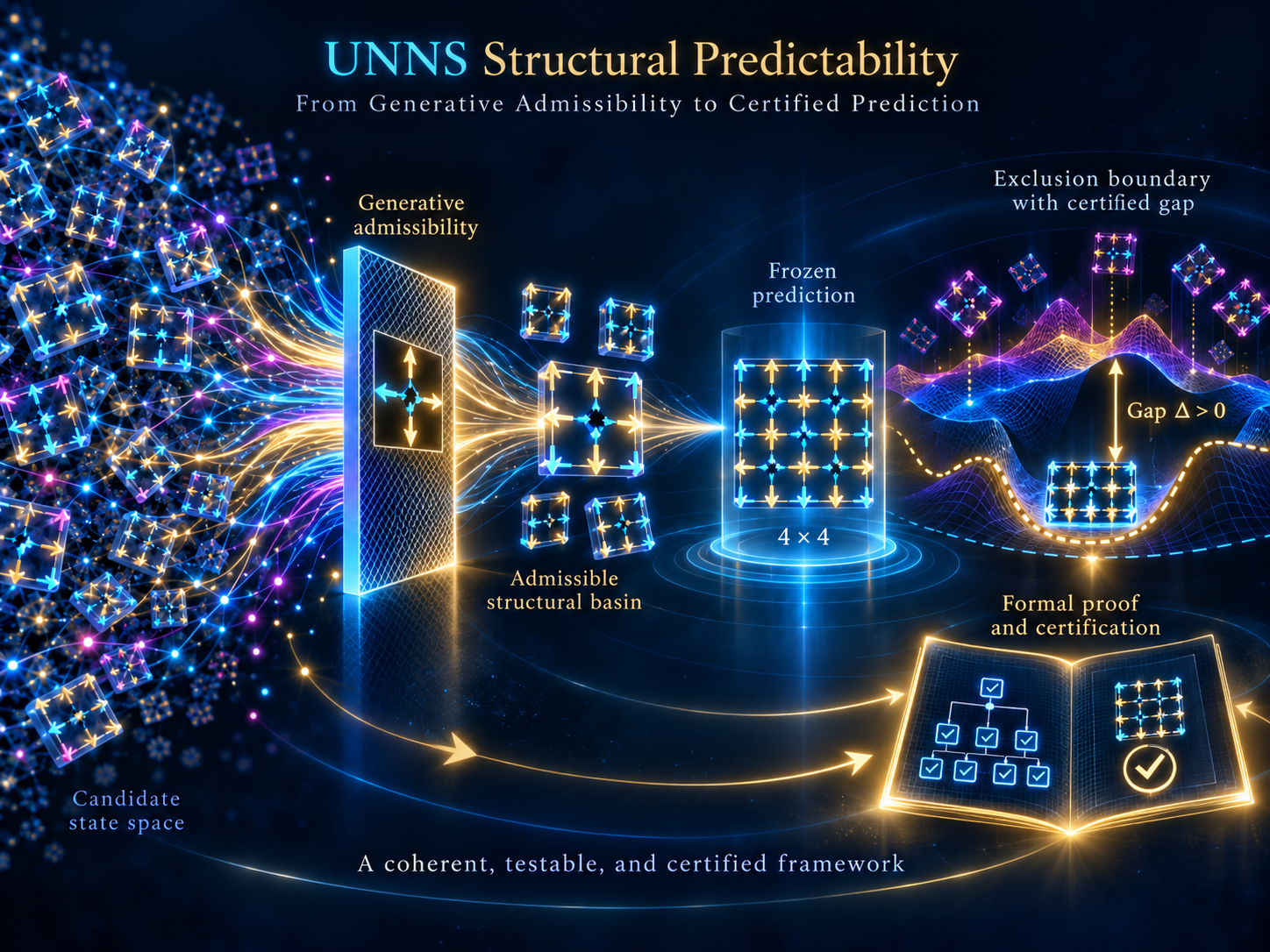
What if the structure of a system could tell us something about its physical possibilities before those possibilities had been exhaustively examined?
This question lies near the heart of the UNNS (Unbounded Nested Number Sequences) Substrate. In its developing architecture, structure is not merely a collection of objects obeying externally imposed rules. Structure emerges through generation, acquires admissibility conditions, occupies realizability regimes, and follows routes whose boundaries influence what can persist or change.
But can this architecture do more than describe?
Can it predict?
The Structural Complexity Reduction (SCR) program was designed to confront that question directly. Could a generative structural description restrict an enormous nominal configuration space? Would that restriction remain physically meaningful? And could the boundary of its validity be predicted before the corresponding larger physical system was evaluated?
The investigation has now reached a decisive milestone. In a finite model of forty binary degrees of freedom — more than a trillion nominal configurations — a quantitative prediction about the boundary of generative admissibility was registered in advance, then verified by exact arithmetic and machine-checked proof.
Along the way the experiment uncovered something equally consequential: an extraordinarily restrictive grammar can fail to preserve physically relevant states — and that failure has a definite, measurable boundary.
IThe difference between possible and generable
Mathematics is generous with possibility. Forty two-state spins can be arranged in 2⁴⁰ ways — over a trillion nominal configurations. But a generative grammar is not generous. It is a rule for how structure may be built, and it admits only what the rule can produce.
The UNNS proposition is that these two sets — the nominally possible and the generatively admissible — need not coincide, and that the gap between them is itself a structural fact. In the test system, a free-boundary square spin-ice lattice, the grammar is the local vertex condition known as the ice rule. Imposed on a 4×4 patch, it admits 193,662 configurations out of 2⁴⁰: a contraction of 99.99998 %.

Contraction on this scale is remarkable. But contraction alone proves nothing about physics. Whether a small family of generated structures is the right family depends on what you are trying to represent — and that is where the investigation turned.
IIThe unexpected lesson: structural selection is not physical preservation
The natural hope was that the ice rule — a rule the low-energy physics of this material is famous for obeying — would keep exactly the states that matter. A preregistered test on the 3×3 patch (24 spins) put that hope to work. The grammar admitted only 2,604 of 16,777,216 configurations. The physical target was defined independently of the grammar: every state within one thermal energy unit (1 kBT) of the ground level.
That window contains 26 states. The grammar kept 10. It excluded 16.
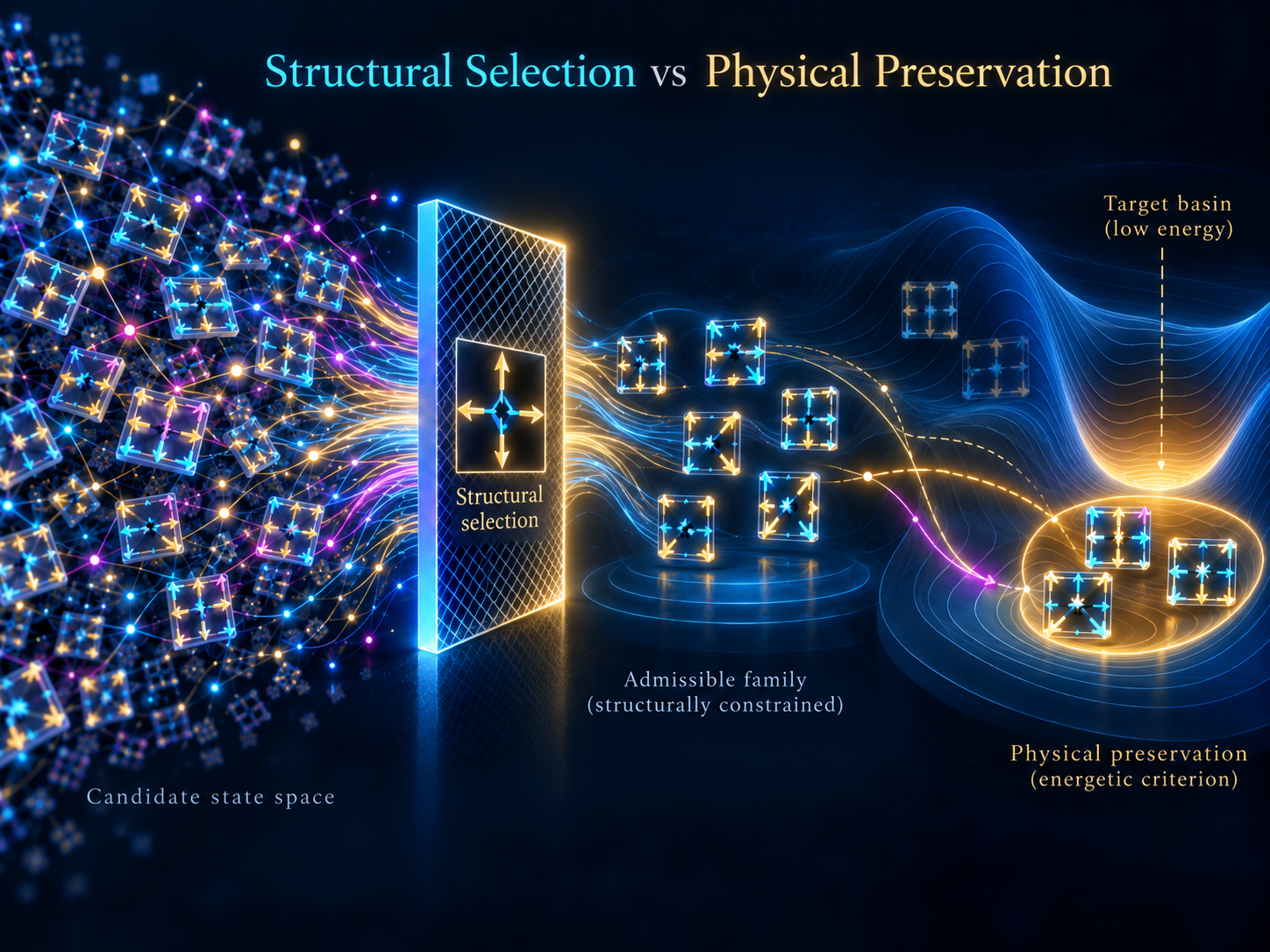
Generative boundary
What the grammar can produce. It is defined by the rule alone, before any energy is computed.
Physical relevance
What the target contains. It is defined independently, by an energy window, and does not consult the grammar.
This is a negative result for the simple hypothesis — and the most instructive moment in the program. A grammar can be extremely restrictive and physically insufficient. The two properties are distinct, and a structural description must always be evaluated against a target it did not choose.
IIIDiscovery of the exclusion boundary
The failure was not random. The excluded states were not scattered through the window; the very first one entered at a precise energy. Call it the exclusion gap, Δ: the distance in energy from the ground state to the lowest-lying configuration the grammar cannot generate.
A grammar may then represent a low-energy window completely, provided the window is narrower than Δ — and become insufficient the moment the window widens past it. The boundary of physical sufficiency stops being a vague judgement and becomes a number.

An exact criterion, not a shortcut
The equivalence tells us what it means for a grammar to be sufficient. It does not by itself tell us the value of Δ for a system we have not yet solved. That is the next step: can Δ be foreseen?
IVThe decisive step: predicting before calculating
The gap had been measured for the 1×1, 2×2 and 3×3 patches. Those values — 0.871, 0.952 and 0.943 in units of kBT — formed the evidence base. From them a prediction for the 4×4 patch was frozen and registered before the 4×4 system was evaluated. It had two parts:
- Direction: the 4×4 normalized gap δ₄ lies below 1 — so a 1 kBT window must already breach the grammar.
- Range: δ₄ lies in the interval [0.7904, 1.0334], derived from the smaller patches.
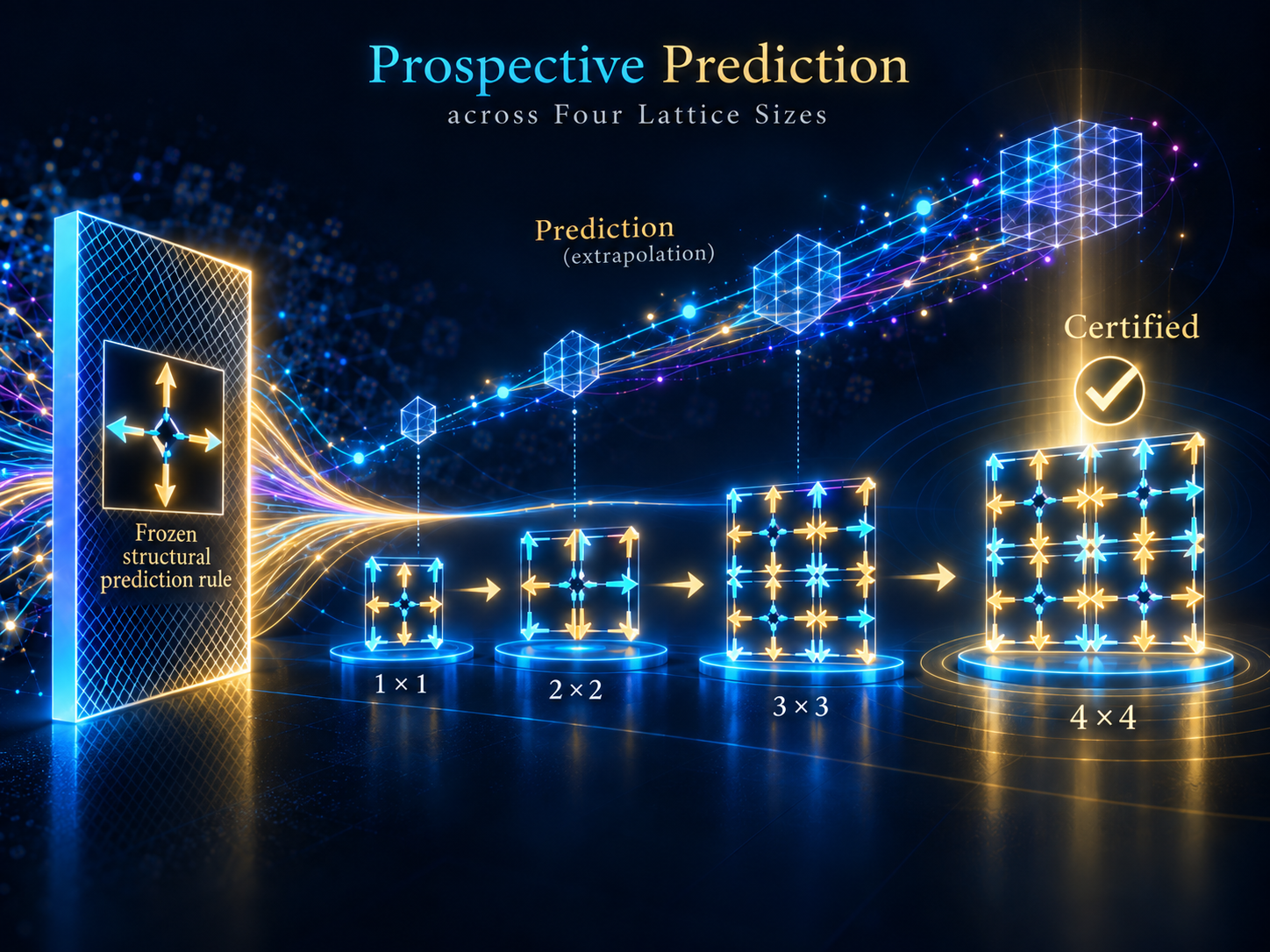
The result: δ₄ = 0.945917. It satisfied both parts.
Why does that change the evidentiary standing of the study? An explanation fitted after the fact can always be made to work. A prediction fixed in advance, from smaller systems, can fail — and the 4×4 result could have landed outside the interval or above 1. It did neither.
What this does — and does not — show
The registered interval is broad, and the directional prediction (δ₄ < 1) is a modest one. The planned feasibility campaign was not completed, and an earlier exploratory verdict was inconclusive. The claim is therefore calibrated: structural predictability is demonstrated for this finite model, with a wide interval — not a precision forecast, and not yet a general law.
VWhen computation became mathematical certainty
A number from an optimizer is only as trustworthy as the optimizer. So the program went one step further. Using exact arithmetic — the 780 couplings of the model encoded as dyadic rationals — a branch-and-bound search was reformulated so that every pruning step could be checked by a proof assistant. The proof was assembled in Lean 4 from 1,148 independently kernel-checked proof-tree batches: 344 for the ground state and 804 for the lowest grammar-excluded state.

The certificates establish both global minima, a strictly positive gap between them, and both registered inequalities — for the whole encoded 40-spin model, independently of the numerical search.
A correction that changed nothing — and showed the method working
The certification also revealed that the lowest grammar-excluded energy originally reported sat 928/2⁷⁰ A (about 7.9 × 10⁻¹⁹ A) above the true minimum. The proof replaced the minimizer, moved δ₄ by less than 10⁻¹⁵, and altered no verdict. The original record was left untouched; the correction was added beside it. Verification is not ornamental — it can find what a solver, working at its own resolution, could not distinguish.
Explore the Evidence: The Structural Predictability Dashboard
The investigation is accompanied by an interactive research dashboard bringing together generative contraction, physical preservation, exclusion-gap prediction, exact certification, Hamiltonian sensitivity, and the underlying archival evidence. Readers can explore how the physical energy window changes the sufficiency of a structural grammar and trace the results to the frozen manuscript and research records.
The six images explain the scientific ideas visually. The dashboard lets readers examine the findings and their provenance.
Together with the manuscript PDF and fixed GitHub commits, the dashboard completes the presentation of the Structural Predictability investigation.
VIWhat this reveals about the UNNS Substrate
Strip away the lattice, and what remains is a statement about the substrate itself. UNNS describes structure as something that is generated, that must be admissible to be realized, that follows routes, and that has boundaries beyond which it does not persist. SCR asks whether one of those boundaries can be turned into a measurable, forecastable quantity. In this finite model, it can. Five insights follow.
Generation and physical realization are distinguishable
The possibilities produced by a grammar are not automatically identical to the configurations relevant to a physical system. 16 of 26 target states lay outside.
DemonstratedAdmissibility has quantitatively testable boundaries
A generative description may be sufficient over one domain and insufficient beyond a definite threshold: W < Δ.
DemonstratedBoundaries can become predictive variables
Rather than predicting only physical states, we can investigate when a structural description will cease to encompass a designated target.
Demonstrated in the finite modelStructural properties can be related through margins
The exclusion gap is an energetic margin that may be studied alongside connectivity margins, rigidity regions and boundary-routing behaviour.
Opens research — not establishedPrediction can be certified
Formal verification establishes boundary claims as exact finite-model statements, independent of the numerical optimizer.
DemonstratedThe last two insights deserve care. That the gap is a margin that could sit beside the UNNS connectivity margins is a research direction, not a finding: no relation between these quantities has yet been shown. What has been shown is narrower and firmer — that this kind of boundary can be defined, forecast from smaller systems, and proved.
The significance is not confined to the particular lattice used as the test environment. It concerns the developing predictive character of structural admissibility itself.
VIIThe next frontier: predicting across domains
Honest accounting separates three levels of achievement:
Structural predictability
A boundary forecast from smaller systems, in a finite model.
DemonstratedPredictive verification
The forecast confirmed independently of the search, by Lean, for the encoded model.
AchievedCross-domain predictability
The same procedure transferring to systems with no spin-ice in them.
Not established — the next testThe spin-ice model supplied the experiment. The question it leaves is about the substrate: whether connectivity margins, rigidity, canonicality and structural routes can help predict sufficiency boundaries in other systems. A fair test would require five things: a grammar frozen blind to the target; an independently defined target; a measurable exclusion quantity; a prediction frozen from smaller instances, with an interval narrower than the spread of what it was built from; and verification independent of the search.
That is a proposal, not a result. It is also the shape of a falsifiable program.
Beyond the experiment: toward the predictive geometry of the UNNS Substrate
The Structural Predictability investigation has given the UNNS Substrate a new kind of measurable object: a boundary separating the domain in which a generative description remains physically sufficient from the domain in which it does not. This result joins a growing body of UNNS research into admissibility, realizability, connectivity, rigidity, canonical structures and structural motion.
Together, these investigations suggest an increasingly precise question about the substrate. Are its different structural boundaries — those governing generation, connectivity, persistence, rigidity and physical sufficiency — related through a deeper organization that can itself be predicted?
Structural Complexity Reduction has not answered that entire question. It has established a rigorous route by which one part of it can be investigated.
A generative rule was frozen. A physical target was defined separately. A boundary prediction was registered before evaluation. The resulting finite-model boundary was established through formal mathematical proof.
Structural admissibility has become an experimentally testable source of quantitative predictions. The next challenge is to discover how far that capability extends — and whether the substrate's different forms of structural organization reveal common principles governing the emergence, persistence and transformation of physical structure.
The investigation began by asking what structure excludes. It has brought us to a more fundamental question: what can structure predict?
Manuscript & evidence links
- Manuscript (PDF):
Structural Predictability in the UNNS Substrate: Generative Admissibility, Exclusion Gaps, and Formal Certification - SCR project (fixed GitHub commit):
github.com/ukbbi/UNNS — structural_complexity_reduction @ 7a6ecc55 - Additive manuscript evidence (commit 7610fe5d):
scr_iii_b/manuscript_evidence @ 7610fe5d — verified supplementary records. - Original SCR research and Lean certification: commit 4e759d38 (4e759d381875c7341e2f26cb72319b44d87aed15).
- Foundational Library (ZIP):
FounDational_ScoPe.zip - Interactive dashboard:
SCR Structural Predictability Dashboard