
Beyond Recursion:
How the UNNS Substrate Makes Structure Predictable
In brief
The number 72 appears ordinary. Yet within the UNNS generative framework it has three distinct incoming routes and four complete histories. The number is the same; the structures that produce it are not. From that seemingly simple distinction, a mathematical theory emerges — one that leads from arithmetic multiplicity to exact scaling, structural rigidity, and finite prediction.
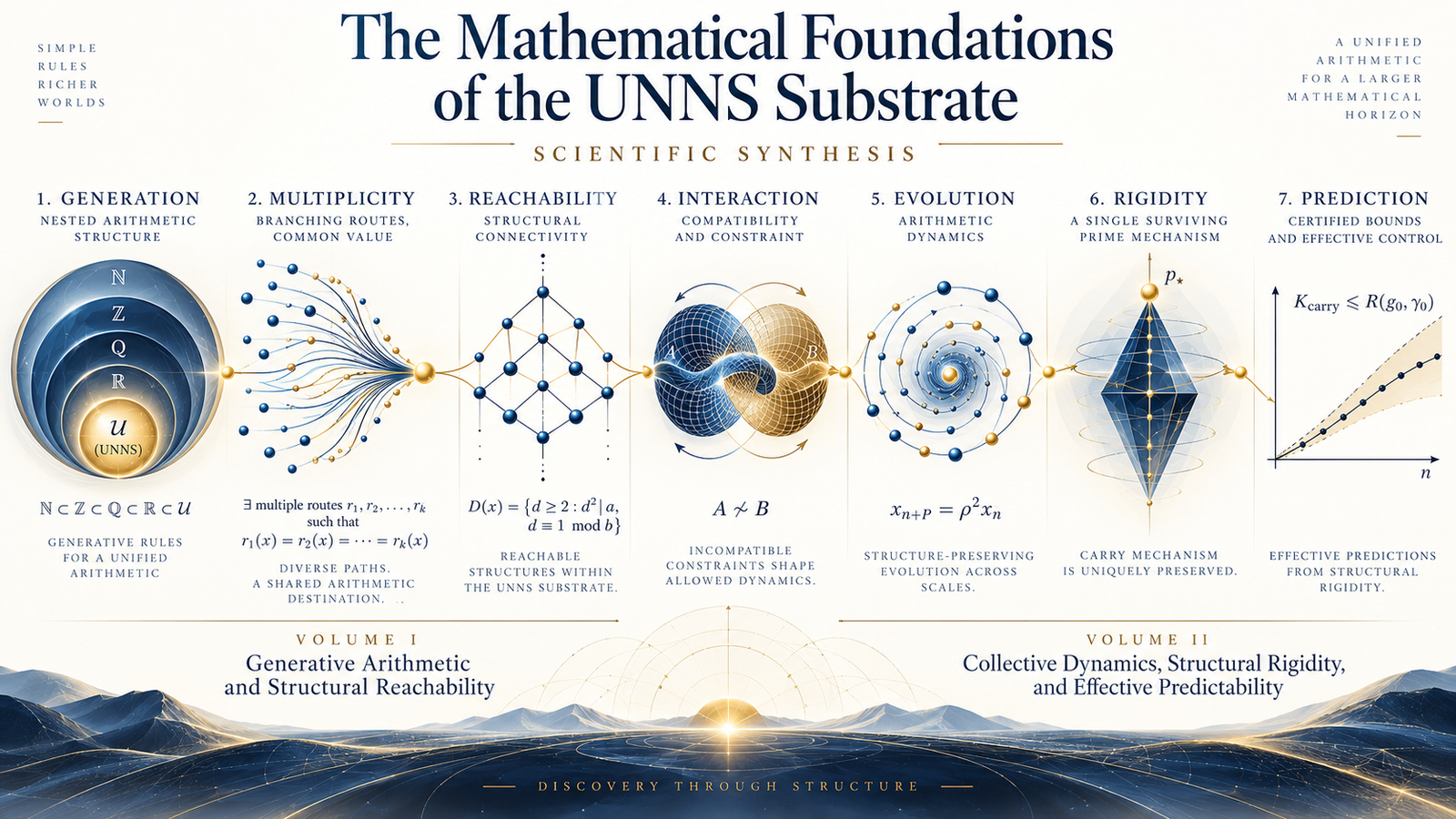
Two completed volumes now set this out in full. Volume I establishes what generative multiplicity is: an exact arithmetic structure with an internal geometry, a reachability order that is not graded, and an interaction problem that cannot be settled by assumption. Volume II adopts one explicit interaction grammar and proves what follows: collective orbits grow without bound, yet eventually repeat their arithmetic organisation up to an exact scale factor; that factor is a prime power, because a single prime carry survives; and the length of the transient before this happens can be bounded by computable, certified numbers.
In this article
The programme in seven stages
Each stage is anchored by a registered result: the Rational-Fibre Theorem (T1), the common-future theorem (T6), the Hasse structure of the reachability graph (S2.10), the incompatibility theorem (T15), exact scaling (T51), single-prime dominance (T60) and the effective bounds (T69–T72).
1When a number has more than one history
The number 72 appears ordinary. Yet within the UNNS generative framework it has three distinct incoming routes and four complete histories. The number is the same; the structures that produce it are not.
The rule that generates these structures is deliberately small. Take a number m and a nest size N that divides it. The nest rule sends m to m(N+1)²/N. Every integer therefore has as many successors as it has divisors, and the whole system is a single directed graph on the positive integers.
Ask which numbers lead to 72, and the answer is a surprise. The number 18 reaches it with N = 1, the number 16 with N = 2, and the number 10 with N = 5. Three different generating steps produce one and the same value. Follow each of them back to where it began and there are four complete histories, because 16 can itself be reached in two ways.
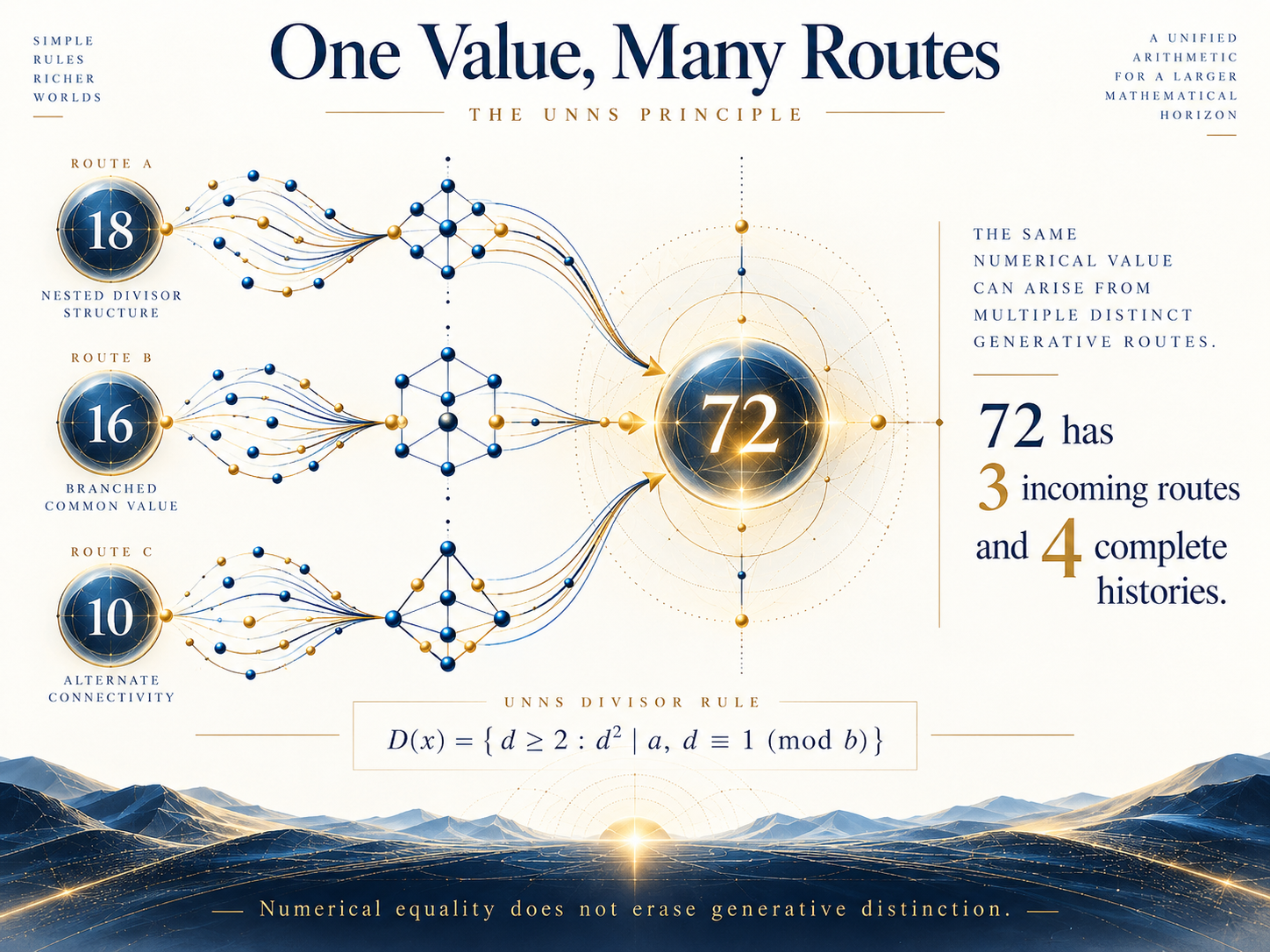
The diagram below is not an illustration drawn by hand: it is computed from the rule. Every edge is a genuine step of the nest rule, and the four histories are read off the graph.
That is the opening discovery, and the rest of the programme follows from taking it seriously: UNNS distinguishes numerical equality from generative identity. The question is no longer only what value a process produces, but by which structures — and what those structures force about the future.
2From a generative framework to two mathematical volumes
The idea has now been developed into a complete two-volume treatise, The Mathematical Foundations of the UNNS Substrate. Each volume has seven chapters, and every statement in both is a registered record: it carries an identifier, a scope, a standing, and the list of earlier records it depends on. Altogether the registry holds 128 records, 60 in Volume I and 68 in Volume II.
Two features make the treatise unusually checkable. First, a proof audit: for each Volume II record, the manuscript states whether the result is a full proof, an exact computation, a definition, a scope statement, a registered correction or an open problem — and where in the text it can be found. Second, reproducible verification: the numerical claims of Volume II are backed by 49 scripted checks, and all 49 pass.
The registry also records scope. Some results concern pure rule arithmetic and make no choice about interaction at all; others hold only inside a named interaction grammar. Where an early statement was too broad, the registry records a correction as a precise mathematical scope statement, so that every claim in the volumes says exactly what it covers.
3Generative multiplicity has an exact arithmetic structure
Volume I starts by making “more than one route to the same value” precise. For a rational value x = a/b in lowest terms, the occurrence fibre is the set of generating steps that produce it. The Rational-Fibre Theorem says this set is exactly D(x) = { d ≥ 2 : d² divides a, and d ≡ 1 (mod b) }, with nest size N = d − 1.
For integers the count has a closed form. If 72 = 2³·3², the number of routes is (⌊3/2⌋+1)(⌊2/2⌋+1) − 1 = 3: the square divisors 2, 3 and 6. The sources of the graph, the numbers with no incoming route, are exactly the squarefree integers. Writing a = s²t with t squarefree reduces every fibre to its square-root part s, so a whole value is governed by a much smaller object.
The arithmetic is also honest about where it is not tidy. For an integer value, the set of routes is closed under least common multiples. For a proper fraction it need not be. The value x = 400/3 has routes d = 4 and d = 10, but their lcm 20 is not a route, because gcd(4, 10) = 2 is not congruent to 1 mod 3. The theorem that survives is exact: an lcm of routes is again a route precisely when their gcd is ≡ 1 mod b. Volume I states the integer case and the fraction case separately.
Why this matters
Multiplicity is not a vague notion of “many ways”. It is an exact, computable object, and its exact form — squares in a, residues mod b — is what every later result is built from.
4The hidden geometry of generative routes
Distinct occurrences of one value do not drift apart. They share common futures, and those futures form a lattice. For two routes d and d′ with nest sizes N and N′, put L = lcm(d, d′) and g = gcd(N, N′). The values that both routes can reach, at or after x, are exactly x + jΔ for j ≥ 0, where Δ = L²/g.
Take 72 again. Its routes d = 2 and d = 3 have L = 6 and g = gcd(1, 2) = 1, so Δ = 36 and the two routes keep meeting at 72, 108, 144, and onward. The meeting index x/Δ is always a positive integer, and every positive integer occurs as such an index.
Taking all routes of a fibre together gives a collective rendezvous step Δcoll = lcm(di²)/gcd(Ni), and a coherence integer γ(x) = x/Δcoll, which equals the gcd of the pairwise meeting indices. This integer γ will return in Volume II as the coordinate in which the dynamics becomes simple.
Three routes: a complete classification
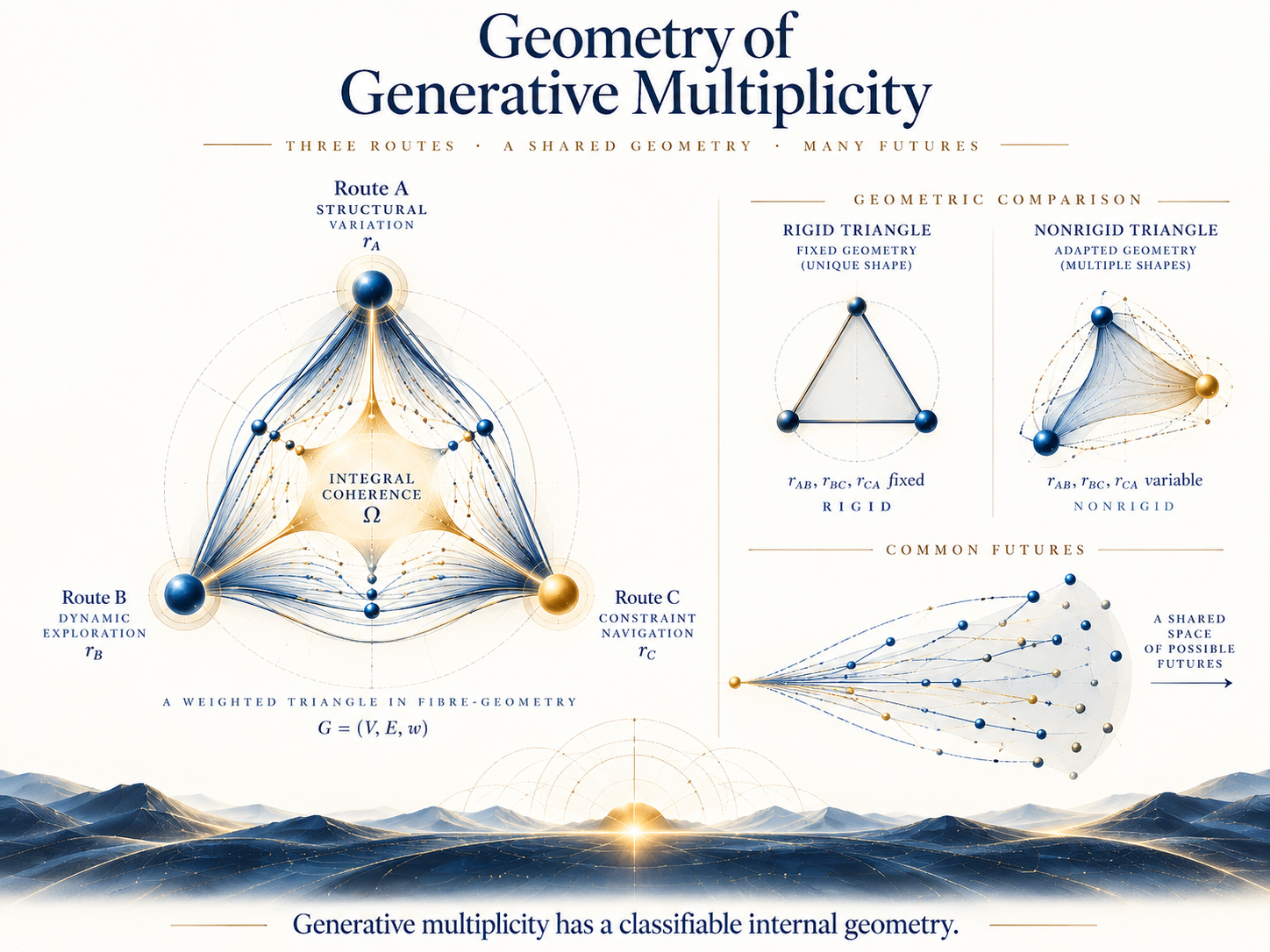
With three routes the geometry is a weighted triangle, and Volume I classifies every case. A shape theorem shows that a three-route fibre is exactly one of a short list: a chain, a product configuration, a single comparable pair, or an antichain. Integer fibres with three routes are always non-rigid — the routes are {p, q, pq} or {p, p², p³}, and the triangle has a non-trivial symmetry. Rational fibres can be rigid: for x = 20736/5 the routes are {6, 16, 36} with pair indices {1, 9, 16}, and the triangle has no symmetry at all.
A signature criterion turns this into a test: a three-route fibre is rigid exactly when its three pair signatures are pairwise distinct. And rigidity is not an isolated accident. Volume I constructs infinite rigid families, including scaled copies of any rigid primitive and a family indexed by primes in an arithmetic progression.
Why this matters
Counting representations throws information away. The weights between routes — how they re-meet, and whether they can be told apart — carry structure that the count never sees. Multiplicity has a classifiable internal geometry.
5Reachability is not the same as numerical equality
Volume I examines the way routes might be combined from two directions. In the first, an anchor-route model, a joint operation on routes is proved to be the same thing as a reachability order: choosing how routes combine is choosing an order. Requiring the combination to be minimal and to absorb the generative moves singles out one operation, but the volume is careful to record that this is an additional rule, not a consequence of nesting alone.
In the second, the graph is declared first and its structure is read off. This is the arithmetic graph of Section 1, and its properties are exact. Each integer m has exactly τ(m) successors, and every step at least quadruples the value, so the graph is acyclic. The in-degree of t equals its nest multiplicity. Every integer has a squarefree ancestor, and ancestor chains are no longer than log4 t.
No universal join
One might hope any two numbers have a least common future. They do not. The numbers 1 and 2 have exactly two common futures up to 100, namely 81 and 100, and 81 does not reach 100. So there is no least common future, and the reachability order is not a join-semilattice. Volume I records the counts as data: among the pairs 1 ≤ a < b ≤ 40, most have at least two minimal common futures, and none of those has a join.
A Hasse diagram that is not graded
Every edge of the graph is a cover relation: no edge can be shortcut by a longer path. The graph is therefore the Hasse diagram of its own reachability order, and the predecessors of any value form an antichain. Yet it is not graded. From 6 to 784 there are paths of different lengths, so path length cannot serve as a rank.
Finally, histories. The history count H(t) is at least the route count R(t), and for 72 it is strictly more: H(72) = 4 against R(72) = 3. A Markov no-go explains why this information stays hidden: the continuation of a history depends only on its endpoint, so anything that looks only forward cannot see how a value was reached. The route and history structure is retrospective — and a history-sensitive operation has to be defined by reading backwards.
Why this matters
Reaching a value, and knowing how it was reached, are different things. The arithmetic graph is a partial order without universal joins or meets, it is not graded, and its histories carry information that endpoints do not.
6Why interaction cannot simply be assumed
Suppose two routes into the same value are allowed to interact, and the result must be a new value. Which one? Volume I answers with a theorem of nonselection. If an interaction of two routes is required to produce a value in their common future, and to satisfy the basic admissibility conditions, then it must have the form x + j(r, s)Δ, where j is any positive integer the operation chooses. The arithmetic permits the whole family; it does not pick a member. Asking for minimality selects j = 1, but that is a choice added from outside.
Natural requirements then collide. Three are especially natural: that interactions land in common futures (common-future admissibility), that the law is unchanged under shifting both routes together (stationarity), and partner independence, in its weak form: the outcome must not be tied to the labels of the particular routes that are paired. The incompatibility theorem proves that no value-valued interaction defined on the full occurrence-pair domain can satisfy all three at once.
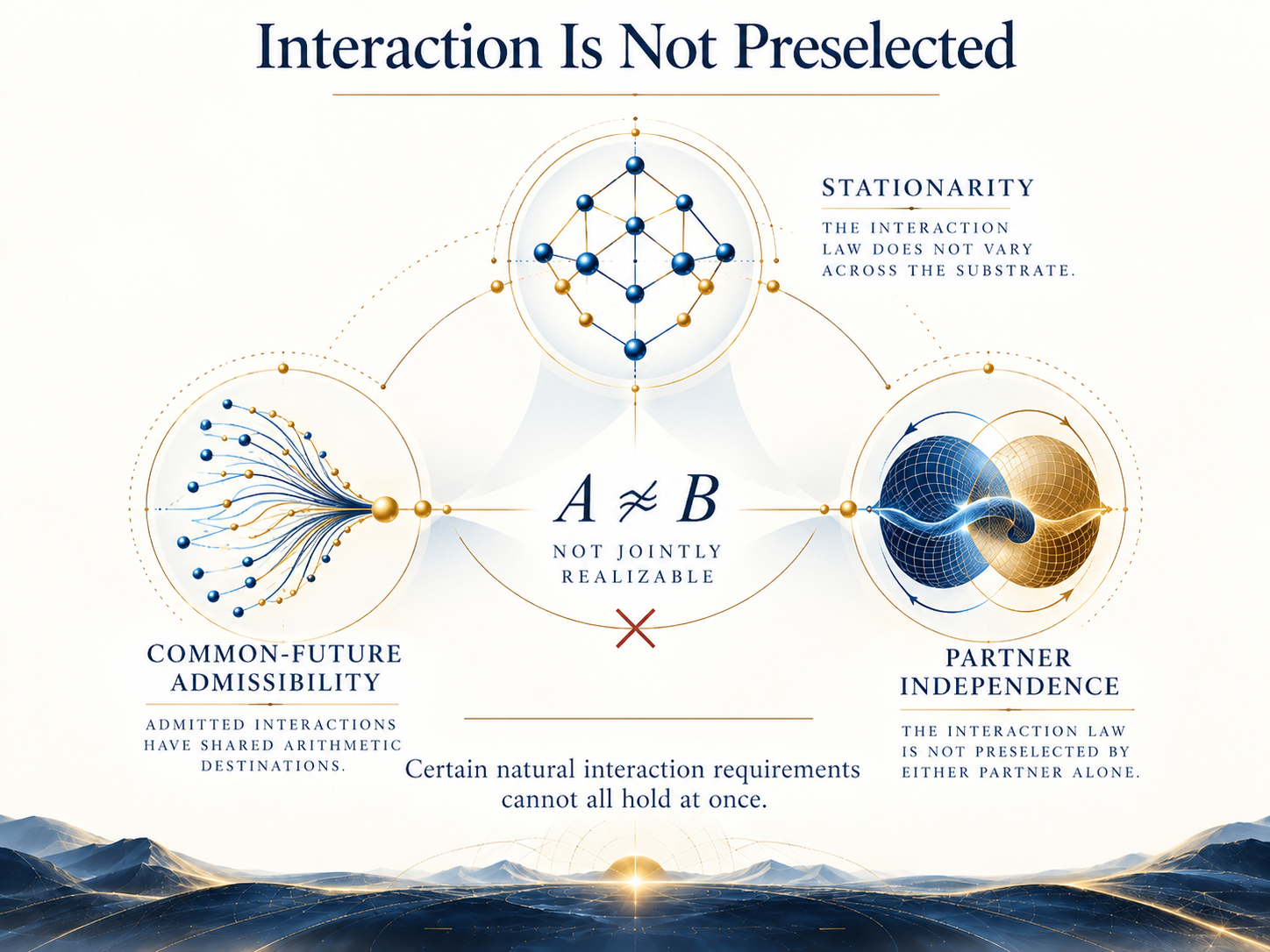
Two consequences are worth stating plainly. Operations that ignore route labels are necessarily collective: they depend only on the value and its fibre. And the two natural families split along the incompatibility. A route-aware interaction can be stationary but uses labels; a collective interaction is label-blind but non-stationary. Neither is forced. A grammar has to be chosen, and the choice has to be stated.
Why this matters
Interaction in this system is not a free by-product of the arithmetic. It is a specification, with exactly known constraints. That is what makes the next step honest: Volume II selects one grammar explicitly, and everything it proves is a statement about that grammar.
7The transition from generative structure to collective dynamics
Volume II adopts the collective map. Given a value x with fibre routes d1, …, dk, let L be their least common multiple and G the gcd of the nest sizes di − 1. Then
What changes with an explicit grammar is that questions about the future become questions with answers. The coherence integer γ = Gx/L² is a positive integer that tracks the orbit, and a plateau law says that while the fibre stays unchanged, γ simply rises by one at each step. Fibres can only grow along an orbit, and G can only shrink to a divisor of itself.
The orbit of 72 shows the machinery working. Its fibre is {2, 3, 6}, with L = 6, G = 1 and Δ = 36, so C(72) = 108. The table lists the first states.
| n | xn | routes R(xn) | G | γ |
|---|---|---|---|---|
| 0 | 72 | 3 | 1 | 2 |
| 1 | 108 | 3 | 1 | 3 |
| 2 | 144 | 5 | 1 | 1 |
| 3 | 288 | 5 | 1 | 2 |
| 4 | 432 | 5 | 1 | 3 |
| 5 | 576 | 7 | 1 | 1 |
| 6 | 1,152 | 7 | 1 | 2 |
| 7 | 1,728 | 7 | 1 | 3 |
| 8 | 2,304 | 9 | 1 | 1 |
| 9 | 4,608 | 9 | 1 | 2 |
This is the simplest regime, where G = 1, and it can be solved completely. The values run through the cycle γ = 2, 3, 1 forever, the number of routes climbs by two every three steps, and from the start xn+3 = 4xn — an exact scaling law, visible in the table (72 → 288, 108 → 432, 144 → 576). Everything that follows asks what survives of this picture when G is larger and the dynamics are richer.
8Infinite growth, yet restricted possibilities
This is genuine unbounded growth, and one might expect it to bring chaos. It does not. Volume II proves a pair of restrictions that sit alongside the growth.
Reachability is sparse. In the regime G = 1 the number of values an orbit family can reach below a bound X is given exactly, and the set has density zero. In the persistent regimes treated later the counting function is only of order log X while the route count grows linearly. The orbit explores a vanishingly thin part of the integers.
Collapse is not universal. A natural conjecture would be that G always falls to 1. For small values it does: G = 2 collapses within 7 steps, G = 3 within 2 and G = 6 within 29, so a permanently stabilised G cannot be 2, 3 or 6. But the conjecture is false in general. For every g ≥ 5 coprime to 6 there are persistent regimes, collective orbits whose G equals g at every step and never reaches 1. A later theorem extends persistence beyond the coprime case, while showing that a permanently stabilised G greater than 1 can never divide 24.
The persistent orbits are also confined: after a finite time their γ-coordinate stays inside a fixed window of size at most twice a modulus determined by g. Unbounded numbers, bounded coordinate.
Why this matters
Growth without bound and organisation are compatible. The dynamics cannot be reduced to the trivial regime, and it is also far from arbitrary: its reach is sparse and its coordinate is trapped in a window.
9Exact scaling: order within unbounded evolution
The γ-coordinate gives a one-step law for persistent orbits. From γ the next state is computed from a single integer: the next fibre, whether the orbit persists, and the next γ are all determined by γ + 1 and a few arithmetic invariants. Applied to a concrete case, g = 11, it gives the eight-step theorem: from a specific starting value the orbit satisfies xn+8 = 9xn, with γ running through the cycle 1, …, 8 and one 3-carry per eight steps.
The general statement is a closure theorem. The state that matters — the class of the orbit — can take only finitely many values, so every persistent orbit is eventually periodic in its class. Periodic classes force an exact numerical law.
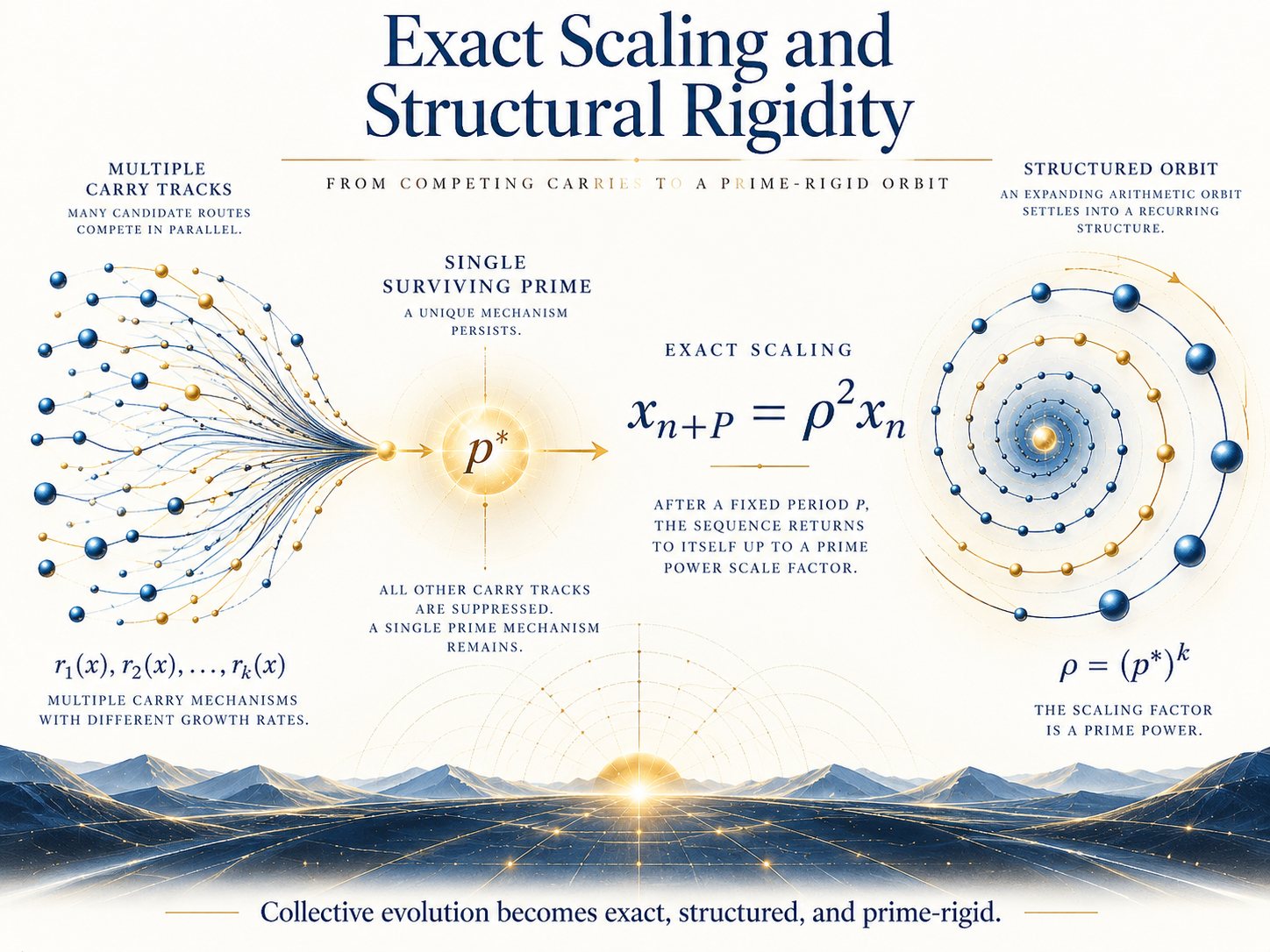
It is worth pausing on how strong this is. The orbit never stops growing. Yet its growth is not merely “geometric-like”: after the transient it multiplies by a fixed integer ratio ρ² exactly, every P steps, forever. Unbounded numerical evolution is compatible with precisely organised structural recurrence.
Why this matters
A statement about an infinite orbit has been reduced to a finite one. Whatever happens in the unbounded growth, the exact law that governs it lives in a finite state space — and that is what opens the door to prediction.
10Structural rigidity: why one prime survives
The scaling factor ρ is not arbitrary. To see why, Volume II looks inside the dynamics at its carries: the events at which the fibre acquires a new route and γ resets. Which carries occur is itself an arithmetic question, and the answers are rigid.
- Carries are eventually complete, and each one has a definite length, one less than the square of its size.
- Eventual carries are prime powers. Every carry in the eventual regime has the form pj.
- The decoupled odometer law. Each active prime behaves as an independent counter; at γ = 1 the next carry is the smallest pending prime power.
- A carry scheduler. At every reset state the next carry is the prime with the smallest pending carry, ties are impossible, and the orbit stays persistent exactly while that carry stays inside the window set by g.
Put the pieces together and the competition between primes has a winner, and only one.
Take g = 31. Its single active prime is 2. One period of the orbit consists of three carries, 2², 2² and 2¹, which occupy 15, 15 and 3 steps, so P = 33. The exponent of 2 rises by 2 + 2 + 1 = 5 per period, so ρ = 2⁵ = 32 and the orbit satisfies xn+33 = 1024 xn for every n in the eventual regime.
Further results make the picture robust. For an odd prime g, two saturated clocks always have coprime periods, so the primes cannot lock into a common rhythm. A general q-carry theorem handles other primes, for example a 3-carry at g = 11 with an eight-step cycle and a 7-carry at g = 367 with a forty-eight-step cycle.
Why this matters
Why is ρ a prime power? Because competition among carries has a unique survivor. The rigidity is not a numerical coincidence; it is forced by the arithmetic scheduler.
11From eventual behaviour to certified prediction
“Eventually” is a weak word for a predictor. Volume II closes the gap in three steps: it identifies the survivor, certifies the identification from finite data, and bounds the time it takes.
Survivor selection and static certification
A minimax selection theorem shows that for a fixed set of independent odometers the survivor is the prime p that minimises pd, where d is the largest cyclic gap in that prime’s pattern of availability — independent of the phases. A quotient-residue formula computes that pattern. An exact carry-level predictor then gives, from any reset state, the next carry and the next state.
A static survivor certificate (T66, proved for prime g) turns this into a finite test. If three explicit conditions S3–S5 hold at a reset state, then only the certified prime carries forever and the scaling law holds for all later steps. The certificate depends only on finite data at one state.
Effective transient bounds
How long can the transient last? Volume II gives four answers, T69–T72, each stronger in a different direction.
- T69, reset descent. In a constant-G segment starting at γ₀, the first reset occurs after at most κ(γ₀) carries, where κ(a) is the least k with 4k > (3a − 4)/2. This bound is sharp: it is attained for every κ from 1 to 11. For g = 103 and γ₀ = 1,345,610, the orbit needs exactly 11 carries.
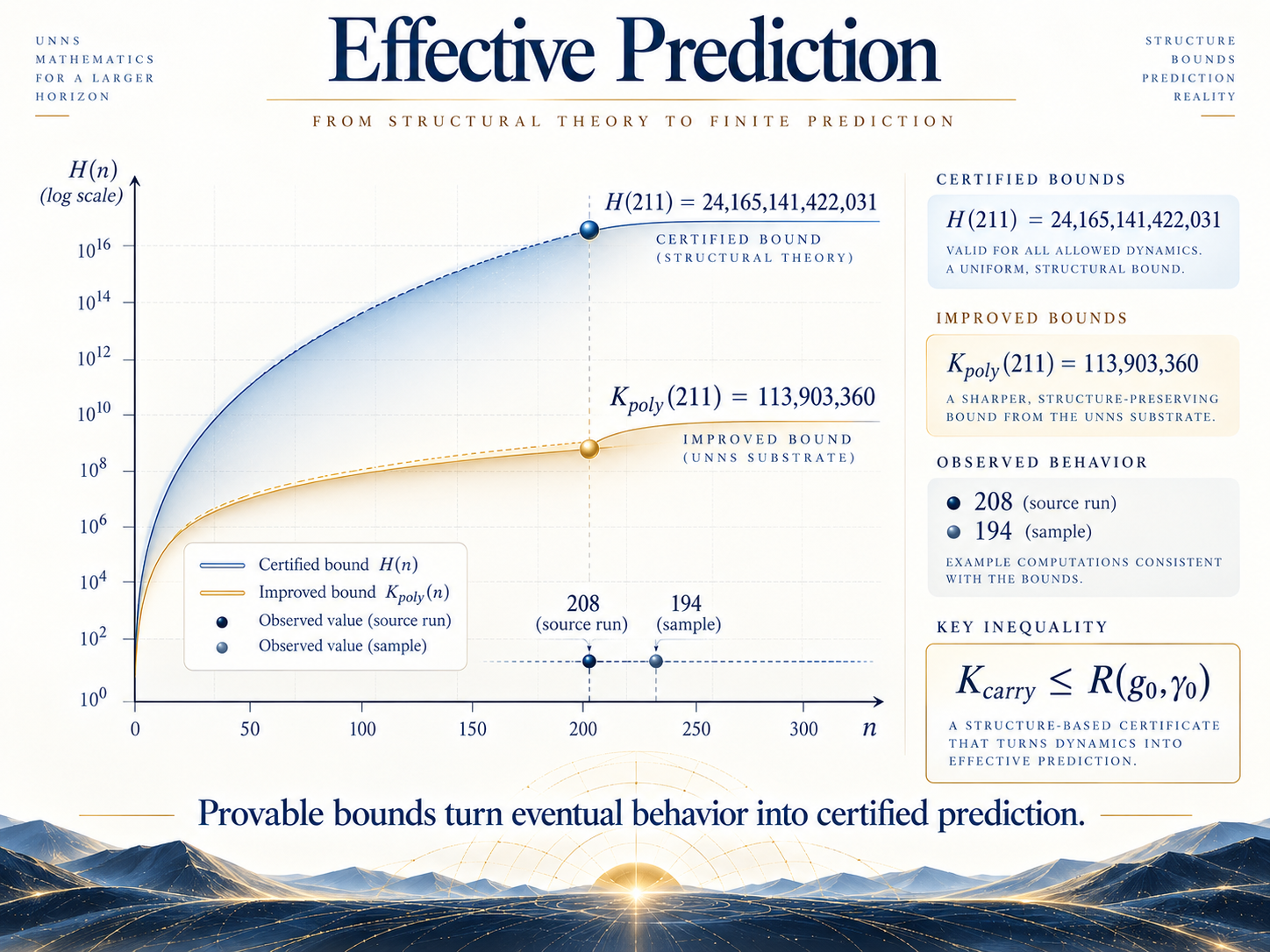
- T70, class counting. After the first reset the class sequence repeats within H(g) steps, where H(g) = ∏(2op − 1) over primes with p² < g.
- T71, polynomial bound. The entry index is at most Kpoly(g), a bound that is cubic in the multiplicative orders instead of exponential.
- T72, dynamic G. From any state, the chain of segments with changing G has at most Ω(g0) segments with G > 1, and the total gives an explicit bound R(g0, γ₀).
For concrete numbers take g = 211. The class-counting bound is H(211) = 24,165,141,422,031 and the polynomial bound is Kpoly(211) = 113,903,360. Recorded entry indices are much smaller: 208 in the recorded run at g = 211, and a sample maximum of 194 at g = 197 among 150 sampled orbits.
What is proved, and exactly where
Counting convention. The principal bound of T72 counts carry events along the chain of constant-G segments; it bounds carries, not elapsed steps.
Static certification. The certificate is proved for prime g. The six cycles g = 15, 39, 51, 57, 68 and 87 fail the condition S5, and the composite and even case is recorded as open.
Certified, not sharp. T70 and T71 are valid and computable, but far above anything observed. An exact transient time, or a bound within a small factor of the observed entry index, is an open problem of Volume II.
12Seven revelations about generative mathematics
Taken together, the two volumes support seven short discoveries. Each is stated once, with the reason it matters.
Equal numbers can possess distinct generative histories.
Why it matters: a value does not determine how it arose, so structure must be tracked beyond the number.
Generative multiplicity carries a classifiable internal geometry.
Why it matters: routes have weights and symmetries; three-route fibres can be classified exactly, rigid and non-rigid.
Arithmetic reachability does not imply universal joins or meets.
Why it matters: the order is a Hasse diagram that is not graded; “the next common value” is not always defined.
Interaction requires specification, and some natural requirements are incompatible.
Why it matters: a dynamics built on this arithmetic must declare its grammar, and its theorems then speak for that grammar.
Unbounded growth can coexist with sparse reachability.
Why it matters: growth does not mean disorder; the reachable set is thin and the coordinate stays in a window.
Expanding arithmetic dynamics can become exactly self-similar and prime-rigid.
Why it matters: an infinite orbit obeys a single exact scaling law whose ratio is a prime power.
Long-term organisation can be predicted within finite, mathematically certified bounds.
Why it matters: “eventually” becomes a number, and the survivor can be certified from finite data.
13How UNNS relates to established mathematics
None of this stands outside mathematics. The volumes lean throughout on established tools — divisibility and congruences, orbits and recurrence, partial orders, finite-state periodicity, scheduling arguments and exact checking — and the programme is best read as a development that connects them around a specific generative system. The table lists the shared concepts and what is specific to the UNNS treatment.
| Mathematical field | Shared concepts | UNNS-specific contribution |
|---|---|---|
| Classical number theory | Divisibility, congruences, square divisors | Generative fibres and common-future arithmetic |
| Arithmetic dynamics | Orbits, recurrence, eventual behaviour | Exact scaling of the specified collective map |
| Order theory | Partial orders, joins and Hasse diagrams | Reachability structures and nonselection |
| Graph theory | Directed paths, predecessors, histories | The arithmetic self-substitution graph |
| Finite-state dynamics | Periodicity and eventual cycles | Arithmetic-state recurrence beneath unbounded growth |
| Scheduling theory | Competing clocks and event selection | Single-prime carry dominance |
| Formal verification | Certificates, bounds, finite checking | Certified prediction of UNNS arithmetic dynamics |
The aim is to show how UNNS builds on these fields while naming the specific results and structures that the treatise develops. It does not replace any of them, and the use of classical techniques inside the proofs is part of what makes the results checkable. Two standard references frame the comparison: the integer sequence of square-divisor counts, OEIS A046951, which is the classical multiplicity formula underlying the fibre counts, and Silverman's The Arithmetic of Dynamical Systems for the established arithmetic-dynamical context.
14Toward practical predictive computation
The most direct computational use of this mathematics is a UNNS Certified Dynamics Analyzer. It would accept an initial rational state, calculate its structural invariants — the fibre, L, G and γ — apply the proved carry and scaling theorems, and return a mathematical certificate of eventual behaviour where the hypotheses permit: the surviving prime, the period, the scale factor ρ², and an explicit bound on the transient.
That is a pathway from pure mathematical theory to usable software, and the dashboard embedded above is a first step in that direction: it already exposes the registry, the machine checks and the bound computations in one inspectable place.
The wider objective
Behind the analyzer sits a broader question, the programme of Structural Complexity Reduction: whether structural constraints of this kind can reduce search spaces in independently defined computational problems. The status of this question should be stated precisely. The mathematics establishes certification within the selected UNNS system. Measurable computational advantage, and transfer to systems defined independently of UNNS, remain research questions — now with a rigorous base to be tested against.
15What has been established
The mathematical foundations of the UNNS Substrate now form a coherent development from generative arithmetic to structural reachability, interaction constraints, collective dynamics, exact recurrence, prime rigidity, and finite prediction.
The significance of this progression is that structure is no longer merely described. Within explicitly defined generative systems, its organisation can be derived, its restrictions proved, its eventual behaviour characterised, and aspects of its future certified.
The next challenge is to determine how far these mathematical principles extend beyond the systems in which they have been established.
The programme remains open to further grammar development, independent evaluation and practical investigation. The volumes, the registry and the checks are public precisely so that all three can proceed.
Resources & references
- UNNS Math Foundations, Volume I (PDF):
UNNS_Math_Foundations_Vol_I.pdf
Generative arithmetic and structural reachability: rational fibres, common futures, three-route classification, reachability, nonselection and incompatibility. - UNNS Math Foundations, Volume II (PDF):
UNNS_Math_Foundations_Vol_II.pdf
Collective dynamics, structural rigidity and effective predictability: exact scaling, single-prime dominance, static certification and the transient bounds. - UNNS Math Foundations Dashboard (interactive HTML):
UNNS_Math_Foundations_Dashboard.html
Registry explorer, machine-check grid, κ staircase and entry-bound charts. - UNNS_MATH_FOUNDATIONS repository (GitHub):
github.com/ukbbi/UNNS/…/projects/UNNS_MATH_FOUNDATIONS
The preserved mathematical source collection with its maintenance and verification documentation, pinned to commit e050580, the documentation and verification revision of the frozen reference baseline (bb8b12d). - OEIS A046951 — Number of square divisors of n:
oeis.org/A046951
The classical integer multiplicity formula for square divisors. - Joseph H. Silverman, The Arithmetic of Dynamical Systems (Springer, GTM 241):
link.springer.com/book/10.1007/978-0-387-69904-2
Established context for arithmetic dynamics.