
The Geometry
That Refuses to Break: Mapping the Regimes of Structure
We investigated how the realizability classification of ordered physical sequences responds when their defining parameters are continuously deformed. Using a fully automated field generator pipeline and the STRUC-PERC-I percolative chamber, we subjected 93 ladder datasets to a joint (α, μ) deformation grid spanning ±20% around physical values.
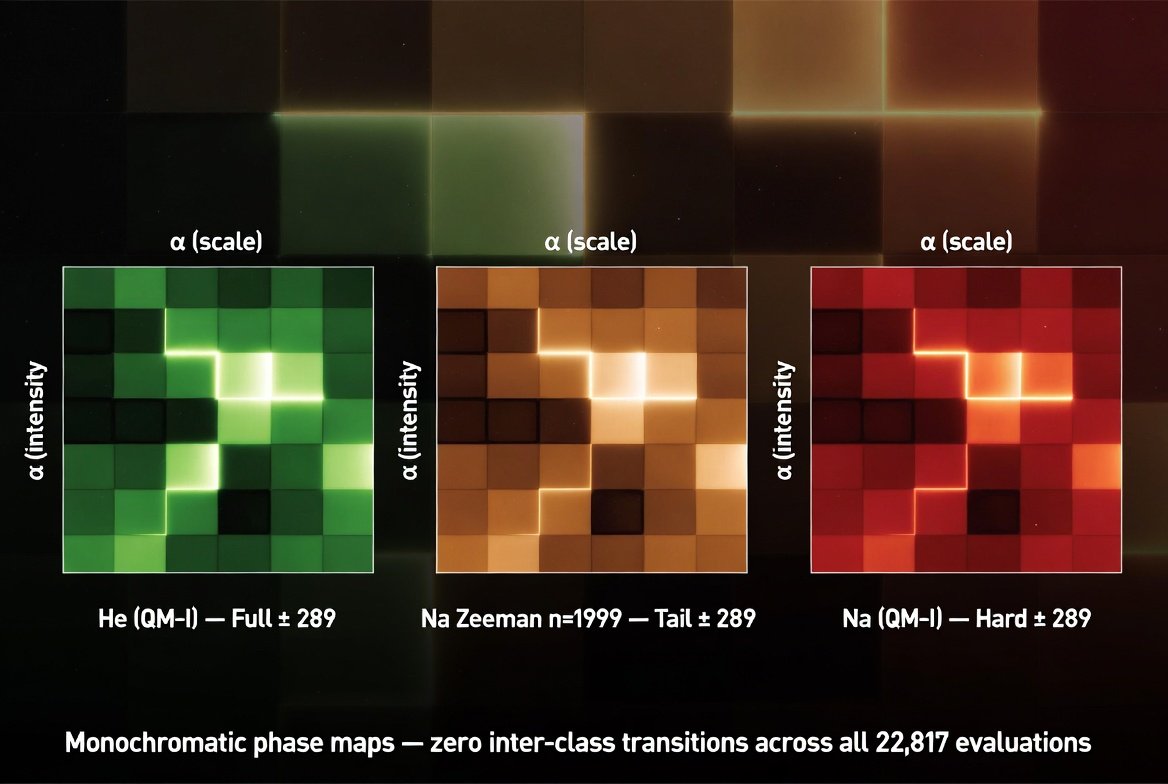
The outcome is unambiguous. Across all 22,817 evaluated grid points, zero inter-class transitions were observed. Every tested ladder stayed in a single realizability class — Full, Tail, or Hard — across the entire parameter space. The structural commutator was identically zero at every point. Phase maps were monochromatic throughout.
"Realizability in the UNNS Substrate is a locally rigid, boundary-governed structural observable — governed not by continuous response but by discrete boundary conditions in gap space."
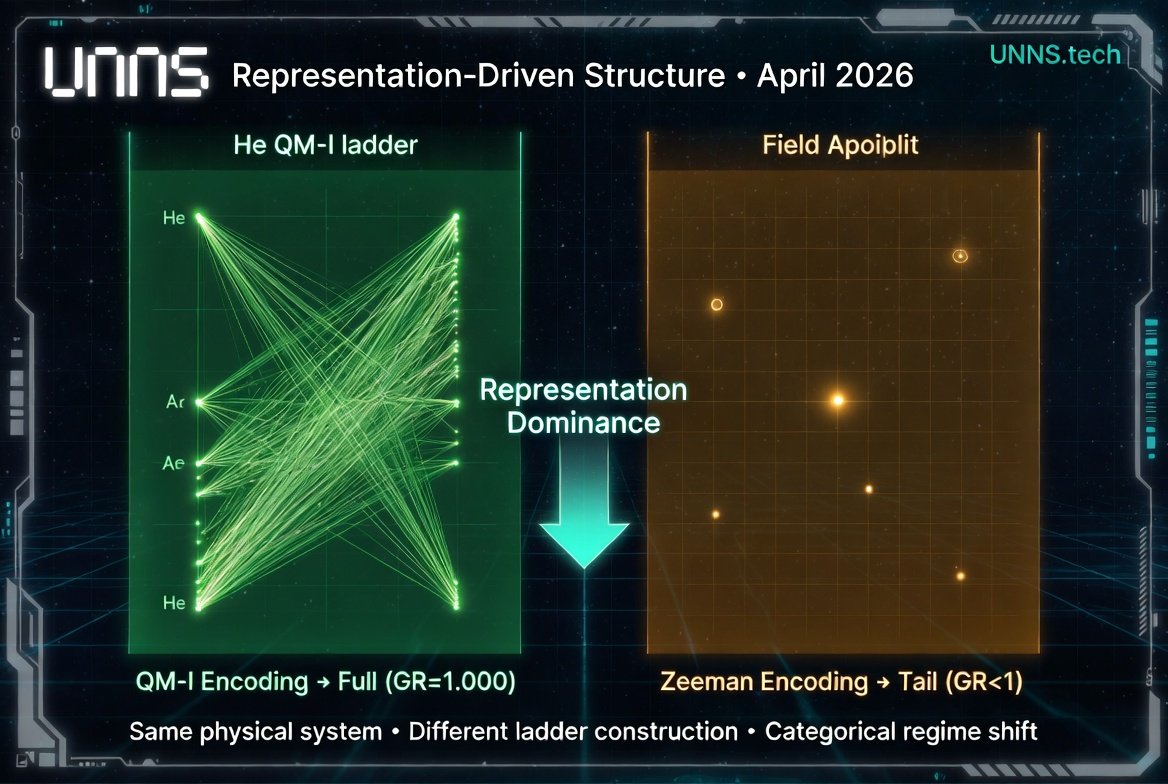
Simultaneously, the same corpus reveals that representation — not deformation — is the primary structural variable. The same physical system encoded differently can yield a categorically different realizability class, while bounded deformation of any single encoding never does.
Principle 1 — Bounded Structural Rigidity of Realizability
The central result of this work is not simply a null observation — it is the identification of a structural principle. The realizability coordinate ℛ(L) of an admissible ladder is not continuously sensitive to parameter variation. It exhibits piecewise-invariant behaviour: deformation space is partitioned into regions within which ℛ(L) is constant, separated by boundaries where discrete class changes may occur.
(i) The realizability class 𝒞(L) is invariant over ΩL.
(ii) The connectivity structure Gκ(L) — in particular GR and κconn — is invariant over ΩL.
The tested domain Ω = [0.80, 1.20]² lies within ΩL for all 93 corpus datasets, with zero inter-class transitions across 22,817 evaluations. This is a bounded, local property of the realizability coordinate; it is not a universal structural invariant.
Three Non-Negotiable Constraints
Locality
The stability domain is finite: ΩL ⊊ ℝ². No claim is made that 𝒞(L) is globally invariant under all deformations. Breakdown scans at α ∈ [1.0, 4.0] (a separate protocol) confirm that rigidity does not extend to all scales.
Ladder-dependence
ΩL depends on L. Different physical systems and different encodings of the same system have different stability radii. No universal Ω is asserted — each ladder carries its own stability region.
Coordinate restriction
Principle 1 applies only to the realizability coordinate ℛ(L). It makes no claim about the admissibility coordinate ρ̄(L) or the full two-coordinate state 𝒮(L) = (ρ̄(L), ℛ(L)). Both coordinates are needed for a complete structural description.
The Geometry: Stratified, Not Smooth
The (α, μ)-plane does not support a smooth response manifold for realizability. Instead it is partitioned into rigidity domains and transition loci. The phase maps observed in this corpus correspond to a single rigidity domain containing the tested region Ω.
Derived Corollaries
Three corollaries follow directly from Principle 1 and are attested across the full corpus:
Corollary 1 — Degenerate Local Phase Space
Within ΩL, the phase map ΦL(α, μ) = 𝒞(L) is constant. No phase structure — no transitions, no boundaries — is accessible within the tested region. Every phase map in this corpus is monochromatic.
Corollary 2 — Emergent Commutativity
Within ΩL, C(α, μ; L) = 0. Operator commutativity is a consequence of realizability invariance, not a fundamental property of α and μ. It is emergent, not primitive. Outside ΩL, the same operators may produce non-trivial asymmetric structural responses.
Corollary 3 — Local Operator Irrelevance
Within ΩL, both operator order (α∘μ vs. μ∘α) and operator magnitude are structurally irrelevant for the realizability coordinate. The pipeline may apply α and μ in any order without affecting the structural outcome.
Monochromatic Phase Maps — Zero Transitions
For every one of the 93 tested datasets, the phase map ΦL : Ω → {Full, Tail, Hard} is a constant function — a single uniform colour across all 289 (α, μ) grid points. No dataset exhibits a verdict transition anywhere in the tested parameter space.
What this means
A monochromatic phase map is not a trivial outcome. A priori, deforming scale and intensity by ±20% could shift gap ratios across critical thresholds, reconfigure the vulnerability graph, and move the ladder into a different regime. The corpus shows this never happens for any of the 93 tested systems. The realibility coordinate behaves as a categorical structural observable defined on stratified regions of deformation space — not as a smooth response variable.
Representation Dominance — The Primary Structural Variable
While bounded deformation within Ω never changes the realizability class of a fixed ladder, the choice of how to encode the physical system as a ladder does — sometimes categorically. This is the most striking finding in the corpus and the strongest empirical confirmation of Theorem 7.5 of the Dual Observability manuscript.
The Canonical Ladder Problem
These findings crystallise the highest-priority open question in the UNNS framework: Is there a canonical encoding for each physical system that makes the realizability class an invariant of the physical system rather than the measurement procedure? The Dual Observability manuscript (Proposition 7.3) identifies this as open; the present corpus provides the strongest empirical attestation that the problem is real and non-trivial.
Intra-deformation vs. inter-representation variation
Intra-grid GR variation (within a single encoding, across all 289 (α, μ) grid points): 0.000 for every dataset.
Inter-representation GR variation (HD combined vs. HD lower): 0.200.
These differ by a factor of infinity. They measure fundamentally different things.
Deformation does not explore the structural landscape; re-encoding does.
Documented Cross-Representation Splits
| System | Encoding 1 | Class | Encoding 2 | Class |
|---|---|---|---|---|
| He | QM-I (standard) | Full | Zeeman (field-split) | Tail |
| Na | QM-I (standard) | Hard | Zeeman (field-split) | Tail |
| Li | QM-I | Full | Zeeman | Full |
| HD | Combined (full vibrational) | Hard | Lower sub-ladder | Full |
| HD | Even parity | Full | Odd parity | Hard |
| Geoid | Physical α = 1.0 | Full | Amplified α = 1.1 (non-physical) | Hard |
| Crystals | per_atom normalisation | varies | cell_volume normalisation | varies |
Sub-Regime Metric Variation — Hidden Continuous Structure
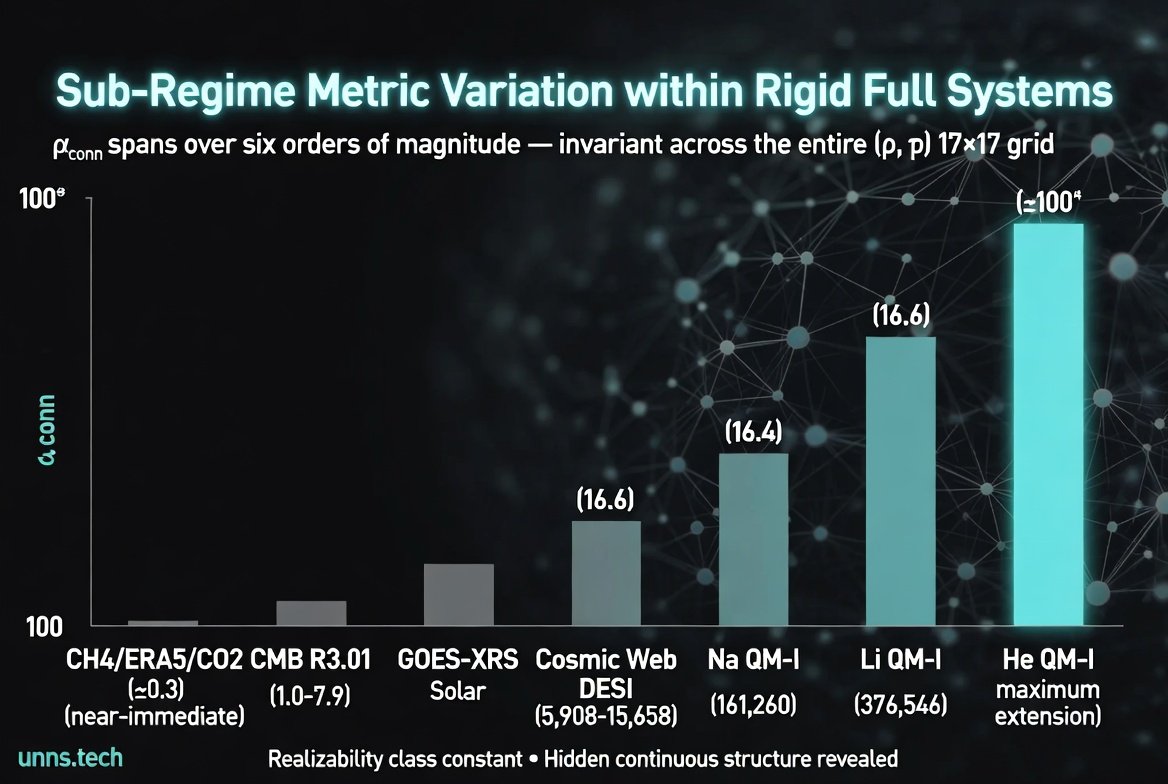
Realizability class is categorical — it assigns every ladder to one of four discrete regimes. But within a regime, the connectivity threshold κconn is a continuous structural coordinate that varies by over six orders of magnitude across the Full class alone. This variation is invisible to the verdict, yet constitutes genuine structural information.
Categorical class vs. continuous coordinate
Realizability class 𝒞(L) is categorical: it partitions ladders into discrete, mutually exclusive regimes. The connectivity threshold κconn is a continuous structural coordinate: it measures the depth of connectivity within a class. These are complementary, not redundant — same class does not imply same structure at the metric level. κconn is itself constant across the (α, μ) grid for every fixed dataset, confirming that sub-regime metric structure is a property of the ladder encoding, not of the deformation parameters.
The Connectivity-Margin Mechanism — A Structural Explanation
The corpus results call for a structural explanation of why realizability is locally rigid. We propose a candidate mechanism grounded in the geometry of the vulnerability graph.
Mechanism Candidate 1 — Connectivity-Margin Mechanism
A ladder L possesses a non-zero local rigidity region ΩL when its gap vector lies at a positive distance from the nearest realizability-class boundary induced by the vulnerability-graph predicate. In that case, sufficiently small (α, μ) deformations preserve the decisive connectivity relations underlying class membership, and the realizability coordinate ℛ(L) remains unchanged.
Define the connectivity margin m(L) as the minimum normalised distance of any decisive gap-ratio pair from the critical connectivity threshold κ*. When m(L) > 0: the class-defining connectivity relations of Gκ(L) are preserved under bounded deformation, and the structural commutator C(α, μ; L) = 0.
Status: candidate mechanism — consistent with the entire corpus but not yet a formally proved theorem. It is the most parsimonious structural account of the observed monochromatic phase maps and zero commutator.
The Field Generator — Automated Phase-Mapping Pipeline
All 22,817 corpus evaluations were produced by an open, deterministic pipeline called the Field Generator: a multi-layer system coupling a Python orchestration layer to the STRUC-PERC-I engine via a Puppeteer-bridged Node.js process.
Operating Modes
| Mode | UNNS_MODE | Grid | Use |
|---|---|---|---|
| Phase mapping | phase (default) | α ∈ [0.80, 1.20] × μ ∈ [0.80, 1.20], 17×17 pts | Primary corpus — all B1 results |
| Breakdown scan | break | α ∈ [1.0, 4.0], step 0.25 × μ = 1.0 fixed | Establishing outer boundary of ΩL |
| μ-sweep | mu | α = 1.0 fixed × μ ∈ [0.95, 1.05], 21 pts | Geoid and cosmic web B3 datasets |
Downloads
Regime Taxonomy — The PRP Four-Tier Classification
STRUC-PERC-I assigns each ladder to one of four realizability classes defined by the Percolative Realizability Principle. The phase-mapping corpus realises three of the four; Giant is present in the formal taxonomy but not observed in the current datasets.
Hard ≠ USL violation
Hard fragmentation is a structural condition of the gap-ratio distribution, not a violation of the Universal Structural Law. All 16 Hard datasets at physical values are admissible under the USL; they simply do not form a connected backbone under the vulnerability-graph criterion. Selection (the USL constraint) does not uniquely fix organisation (the percolative class).
Implications and Open Problems
What this work establishes
Before this work
- Realizability was a verdict attached to a fixed ladder
- Deformation behaviour of verdicts was unexplored
- Phase space structure was unknown
- Operator order was assumed to be structurally irrelevant (informal)
After this work
- Realizability is a locally rigid piecewise-invariant observable
- The deformation space is stratified, not smooth
- Operator commutativity is emergent, not fundamental
- Representation is the dominant structural variable
Open Questions
- Canonical ladder problem. Is there a physically motivated canonical encoding for each class of system that makes the realizability class an invariant of the system rather than the procedure? (Proposition 7.3 of Dual Observability — open)
- Universality of local rigidity (Conjecture 1). Does every admissible ladder possess a non-zero stability region ΩL? A proof would elevate Principle 1 to a theorem. A counterexample would fundamentally revise the theory.
- Non-commutative systems. Is there any ladder for which C(α, μ; L) ≠ 0? Such a ladder must sit near a structural boundary with asymmetric gap-distribution response.
- Margin functional m(L). Can the connectivity margin be operationalised within STRUC-PERC-I, computed across the corpus, and used to predict ΩL extent?
- Higher-dimensional deformation. Does rigidity extend to deformations involving fundamental constants αs or αG?
Falsifiability
Principle 1 is falsified by the existence of any admissible ladder L for which, for every ε > 0, there exists (a, m) with ‖(a, m) − (1, 1)‖ < ε and 𝒞(αa(μm(L))) ≠ 𝒞(L). No such ladder has been found in the corpus. The construction of a falsifying example is an explicit open problem. Practical search strategies focus on near-boundary ladders, highly irregular gap structures, and fine-grained deformation studies near ∂ΩL.
Corpus Coverage — 11 Physical Domains
The 93-dataset corpus spans the following physical domains, all returning zero inter-class transitions at physical parameter values:
| Domain | Datasets | Predominant class | κ_conn range |
|---|---|---|---|
| Atomic spectroscopy (QM-I) | He, Li, Na, K + Zeeman variants | Full / Hard (repr.-dependent) | <1 – 10⁶ |
| Molecular vibrational (simple) | CH₄, CO₂, H₂O, NH₃, O₃ | Full | < 0.3 — near-immediate |
| Molecular (combined) | CO, HD combined | Hard | — |
| Nuclear (U-238) | 5 sub-constructions | mixed | — |
| Atmosphere / ERA5 | 8 constructions | Full | 0.7 – 2.0 |
| CMB power spectra (Planck R3.01) | TT, TE, EE | Full | 1.0 – 7.9 |
| Cosmic web (DESI, SDSS, 2MRS) | 7 constructions | Full | 27.9 – 15,658 |
| Geoid (Earth, Mars, Moon) | EIGEN-6C4, JGM85, AIUB-GRL350A | Full at physical α | 0.7 – 6.3 |
| Solar / GOES-XRS | 1 (first solar domain) | Full | 16.6 |
| Crystallography (Materials Project) | 15 valid; 3 excluded | Full / Hard (norm.-dependent) | varies |
References and Resources
- Manuscript (this work): Bounded Structural Rigidity and Representation-Driven Structure — Full Working Manuscript (PDF)
- Corpus analysis report: Phase Mapping Corpus Analysis — α–μ Joint Operator Deformation (HTML)
- Field Generator pipeline: field_generator.zip — Python + Node.js + Puppeteer source
- Input data: base_ladders_input.zip — 93 ladder files used in the corpus
- Output data: FULL_OUTPUT.zip — Complete JSON evaluation grid (all batches)
- Percolative Realizability Principle: Percolative_Realizability_Principle.pdf — Four-tier taxonomy and PRP theorems
- Dual Observability: Structural_Realizability_Dual_Observability.pdf — Two-coordinate structural description
- STRUC-PERC-I Instrument: struc_perc_i_v2_4_0.html — Percolative chamber (live, browser-based)
Instruments: STRUC-PERC-I v2.4.0/v2.4.1 · Field Generator v1.0 · 93 datasets · 22,817 evaluations · 11 physical domains
All corpus evaluations produced by the field generator pipeline (Python + Node.js + STRUC-PERC-I). Engine source at struc_perc_i_v2_4_0.html. Full corpus results in JSON format available for download above.