
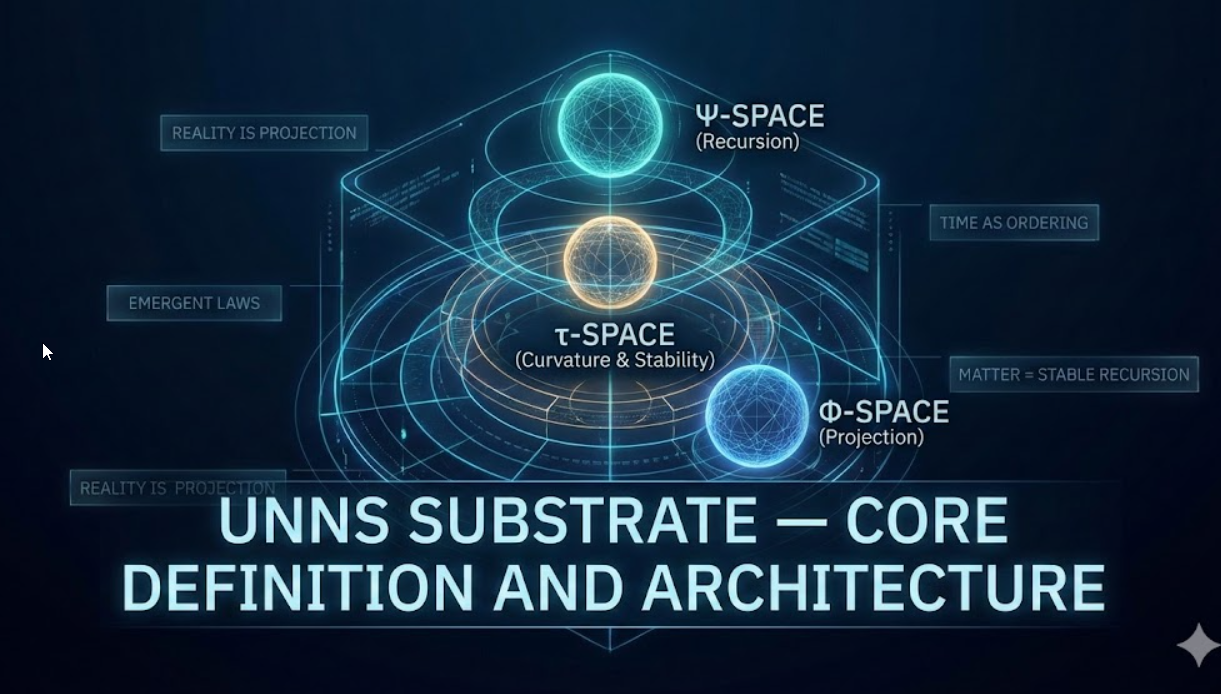
UNNS Substrate — Core Definition and Architecture
This document provides the official definition of the UNNS Substrate, its structure, its projection mechanics, and its foundational role within the UNNS framework. It supersedes all informal descriptions and should be treated as the canonical reference for researchers, developers, and contributors within the UNNS ecosystem.
Contextual Reading:
Introduction
The UNNS Substrate proposes a radical but structurally simple idea: reality is not governed by external laws, geometric axioms, or observers. Reality is the stable projection of a deeper recursive substrate.
In this view, mathematics, physics, time, causality, information, and even the appearance of matter all emerge as residual invariants of recursion.
1. Reality Exists Without Observers
In both classical physics and many interpretations of quantum mechanics, the observer plays a central role. The UNNS Substrate rejects this requirement entirely. Recursion operates independently of observation.
What observers influence is not existence but the projection of recursion into geometry.
This substrate–projection distinction is formalized in the UNNS tri-layer model:
- Ψ-space — Pure recursion, timeless and unbounded
- τ-space — Curvature and stability layer where invariants form
- Φ-space — Projection layer: geometry, time, matter, information
2. Recursion as the Foundation of Structure
UNNS begins with a simple premise: recursion is the engine of structure. Nothing more fundamental is assumed.
This means:
- All laws are emergent, not imposed;
- Constants arise from stability, not metaphysics;
- Geometry appears only as a projection;
- Time is not intrinsic but ordered recursion;
- Matter is stable recursive structure.
3. Constants as Invariants of Collapse
Traditional physics treats constants such as α or αs as fundamental. UNNS treats them as statistical survivors of recursive collapse channels.
Through Operator XII, recursion must pass stability thresholds. The constants we observe are the fixed points that persist after collapse.
This provides a coherent explanation for:
- Their numerical stability
- Their universality
- The illusion of fine-tuning
4. Geometry Is a Projection — Not the Substrate
In UNNS, geometry is not fundamental. It is the appearance of recursion when projected into Φ-space.
Space and time do not exist in Ψ-space. They are consequences of projection.
5. Time as an Emergent Ordering
UNNS resolves contradictions between thermodynamic time, relativistic time, and timeless quantum gravity by treating time as a multi-layer projection:
- Ψ-time: recursion ordering
- τ-time: curvature direction
- Φ-time: classical timeline
Time is neither fundamental nor an illusion— it is an ordered side-effect of recursive stabilization.
6. Matter as Stable Recursion
Matter emerges as the subset of recursion that forms persistent attractors in τ-space.
Interactions result from interlace (Operator XIII), spectral alignment (Operator XXI), and collapse channels (Operator XII).
7. The Operator Stack — Grammar of the Substrate
Operators in UNNS form the grammar by which recursion organizes itself. They are not functions—they are transformations on stability, structure, and projection.
- Operator XII — Collapse and channel stability
- Operator XIII — Interlace / mixing
- Operator XIV — φ-scaling of recursive amplitude
- Operator XVII — Matrix-mind multi-recursion
- Operator XXI — Spectral stabilization and τ-harmonics
- Operator XXVI — Structural recursion proof
8. Chambers as Lenses into the Substrate
Each Chamber exposes a different aspect of recursion:
- Chamber XVI — Structure emergence
- Chamber XXI — τ-curvature
- Chamber XXIII — Paradox resolution via UPI
- Chamber XXVI — Structural recursion proof
Together, they reveal the same insight: laws of nature are byproducts, not prerequisites.
9. UNNS Is Not a Physical Theory — It Is a Substrate
UNNS does not replace physics. It explains why physics has the form it does.
GR, QM, gauge symmetries, information theory—they emerge because recursion stabilizes into these patterns under specific τ-curvature conditions.
10. The Vision
UNNS envisions a foundational substrate where recursion generates structure, τ-curvature stabilizes it, and projection creates the world we perceive.
From this substrate emerge the constants, laws, geometry, matter, information, and observers. Nothing is fundamental except recursion itself.