
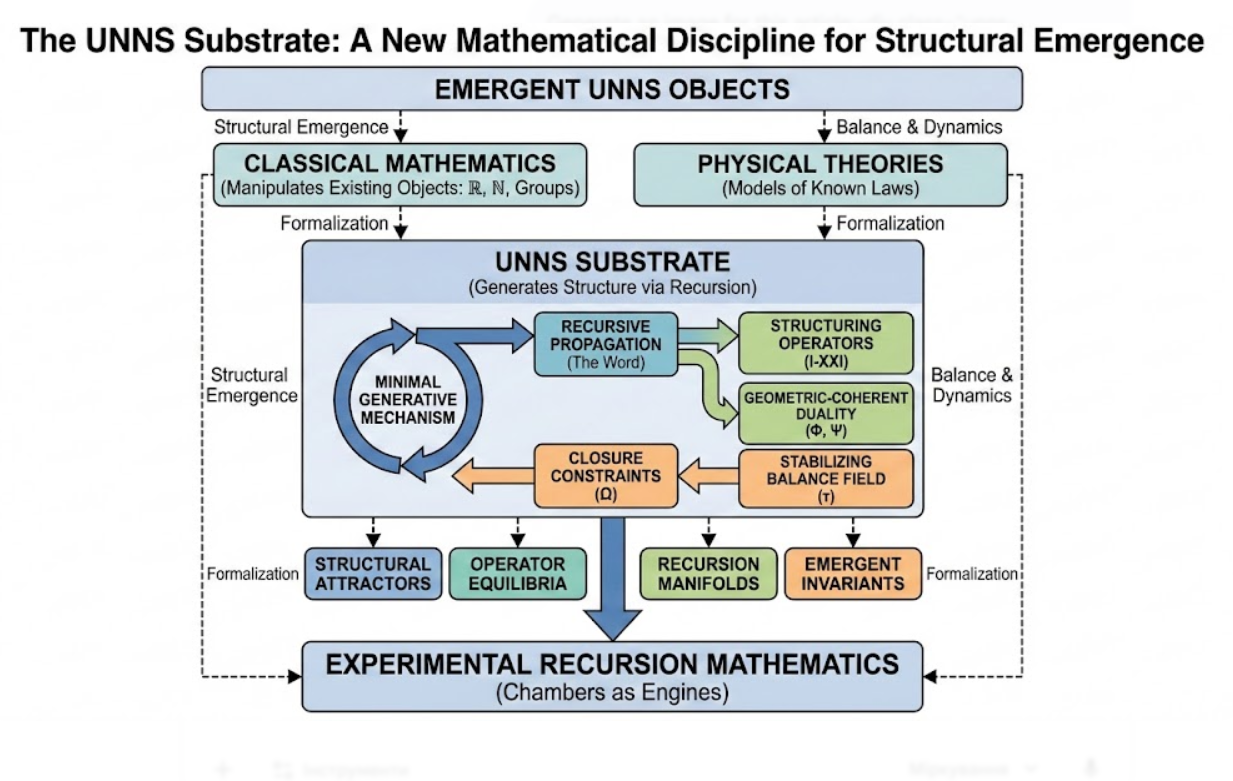
The UNNS Substrate as a New Mathematical Discipline
A Foundational Companion Page for the UNNS Project
1. Introduction — Why Speak of a “New Discipline”?
UNNS began as a recursion engine, a sequence system, and a structural experiment.
But as the theory expanded — through Operators I–XXI, through the Φ–Ψ–τ formulation, through closure conditions and structural invariants — something became clear:
Classical mathematics studies objects:
numbers, groups, manifolds, categories, functions.
UNNS studies that from which objects emerge:
recursive structure, operator dynamics, geometric–coherent balance, τ-field stabilization, and closure through Ω.
This makes UNNS a substrate theory — a mathematical discipline that investigates the rules by which mathematical and physical structure can arise from recursion itself.
2. What Is the UNNS Substrate?
A substrate theory defines:
-
a minimal generative mechanism,
-
a set of structuring operators,
-
a rule for recursive propagation (the Word),
-
a stabilizing balance field (τ),
-
a geometric–coherent duality (Φ and Ψ), and
-
closure constraints (Ω).
UNNS contains all these components.
Thus, the UNNS Substrate is:
it is a model of structural emergence that may underlie physics.
3. UNNS Is Not Classical Mathematics — And Not Computational Simulation
It occupies a third category:
3.1 Not classical mathematics
Classical mathematics manipulates objects that already exist.
Examples:
ℝ, ℕ, groups, manifolds, Hilbert spaces.
UNNS manipulates operators on recursive structure, from which objects may emerge.
3.2 Not simulation
A simulation approximates a model whose form is known.
UNNS is not approximating anything.
Its recursive geometry is the model.
3.3 A structural mathematics
UNNS defines:
-
structural attractors,
-
fixed points,
-
operator equilibria,
-
resolution-critical states,
-
recursion manifolds,
-
emergent invariants.
These are not inputs — they arise from the substrate.
4. What Makes UNNS a Distinct Discipline?
UNNS introduces methods and concepts not present in any single mathematical area.
A discipline is defined by:
-
Its primitives
-
Its operators
-
Its invariants
-
Its experimental methodology
-
Its theoretical framework
UNNS satisfies all of these.
4.1 Primitives: Seeds, Nests, τ-Fields
The basic units of UNNS are:
-
Seeds (initial recursive states)
-
Nests (operator-structured sequence shells)
-
τ-fields (balancing recursion-energy distribution)
These primitives have no analogue in classical analysis or algebra.
4.2 Operator Suite I–XXI
UNNS Operators are not algebraic functions;
they are geometric–coherent transformations on recursion structure.
Operators XIII–XIV–XV–XVI–XXI (as used in Chamber XXVI) illustrate:
-
phase coupling,
-
geometric scaling,
-
spectral dispersion,
-
curvature folding,
-
microstructural stabilization.
No other discipline combines such actions in a single framework.
4.3 Structural Invariants
UNNS defines invariants that arise only through recursion:
-
τ-critical points (as discovered in Chamber XXVI)
-
Φ-equilibrium and Ψ-interference balance
-
Ω-closure levels (C₁, C₃, C₅…)
-
Structural χ² minima specific to operator geometry
These invariants are not given — they emerge.
4.4 Experimental Mathematics
UNNS is one of the first fields where experiments are mathematical objects.
UNNS Chambers are not toy simulations; they are algebraic and geometric recursion engines that:
-
evolve structure,
-
reveal fixed points,
-
show collapse modes,
-
map attractors,
-
display resolution-critical behaviour.
This is a new methodology:
5. What UNNS Contributes to Modern Science
UNNS sits at the crossroads of several fields, but it is not reducible to any of them.
5.1 Relation to Physics
UNNS is not a physical theory, but:
It offers:
-
emergent geometric behaviour (via Φ)
-
quantum-like interference (via Ψ)
-
a balancing variational field (τ)
-
operator-generated dynamics (XIII–XXI)
-
resolution-dependent invariants
Physical laws could arise as fixed points within a UNNS substrate.
5.2 Relation to Pure Mathematics
UNNS is aligned with:
-
dynamical systems,
-
recursive combinatorics,
-
geometric analysis,
-
operator algebras,
-
fixed-point theory,
-
information geometry.
But it goes beyond them by treating structure as generated, not assumed.
UNNS provides:
-
recursion manifolds,
-
attractor geometry,
-
spectral curvature interaction,
-
operator-phase dualities.
No classical branch produces all of these through a single mechanism.
5.3 Relation to Computation
UNNS is not computer science, though it uses recursive engines.
Its recursion is not symbolic or algorithmic — it is structural.
It is closer to:
-
cellular automaton universes,
-
algorithmic information geometry,
-
emergent computation models,
but with a richer operator-driven geometry.
6. Chamber XXVI as the First “Foundational Proof” of the Discipline
Chamber XXVI is historically important because it proves a central prediction of UNNS:
This is the hallmark of a self-contained mathematical discipline:
-
its equations generate structure,
-
its operators determine equilibria,
-
its geometry emerges without external input.
UNNS is no longer exploratory — it is demonstrative.
7. What Comes Next: The UNNS Discipline Roadmap
UNNS now enters a phase of formalization and expansion:
7.1 Formal recursion geometry
Define recursion manifolds, τ-surfaces, Φ-Ψ boundary curves.
7.2 Operator calculus
Turn Operators XIII–XXI into a calculus of structural transformations.
7.3 Structural invariants
Define classes of attractors, critical points, fixed recursion sectors.
7.4 Emergent observable theory
Study how stable observables arise (Λ, α, nₛ, σ₈, etc.).
7.5 Substrate-to-physics translation
Determine mappings from structural recursion to possible physical laws.
8. Conclusion — UNNS as a Discipline
UNNS is not a branch of mathematics.
UNNS is not a branch of physics.
UNNS is a substrate discipline — a foundational study of how structure arises in a recursive universe.
It defines its own:
-
primitives,
-
operators,
-
invariants,
-
experiments,
-
geometry,
-
coherence fields,
-
and stability scales.
It is the mathematics beneath mathematics,
the structure beneath structure.