
Realizability Dynamics
in the Heliosheath
Executive Summary
The UNNS Substrate has historically been a static framework: physical systems are placed in realizability space and classified. This paper changes that. Using 11 years of Voyager 2 heliosheath plasma data — 628 DLCP-evaluated ladders across four observables — we demonstrate for the first time that physical systems do not merely occupy realizability space. They trace continuous trajectories through it, governed by structural laws.
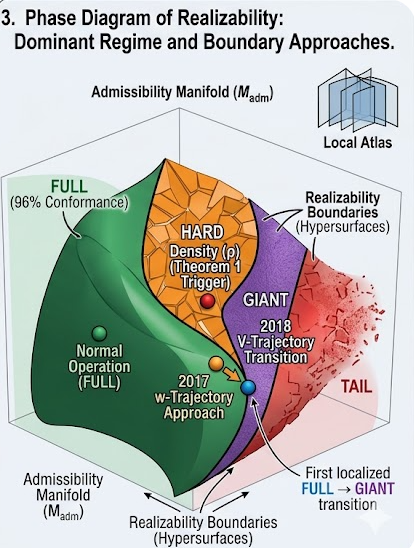
The principal result: structural class exhibits dominant-regime persistence (96.0% conformance) with controlled boundary excursions. Three GIANT windows in 2017–2018 — immediately before Voyager 2's heliopause crossing — constitute the first observed localized class transitions in any UNNS corpus, confirming that physical boundaries are preceded by detectable structural transition layers in realizability space. The UNNS Substrate is inherently dynamical: structural trajectories evolve, and boundary approach is detectable prior to transition.
🚀 A New Object: The Structural Trajectory
For the first time in the UNNS programme, the fundamental object of study is not a static ladder but a time-indexed family of ladders — and the trajectory they trace through the realizability manifold ℳadm.
Static UNNS (previously)
- Fixed observable set → one ladder
- One structural evaluation per system
- Class as a property of the moment
- No temporal information
- No boundary-approach detection
Dynamic UNNS (this work)
- Time-indexed ladder family → trajectory γ(t)
- 628 evaluations across 11 years
- Class as a property of the path through ℳadm
- Temporal structural coordinates: κ(t), tail(t), m(t)
- Boundary approach detected 1–2 years before physical crossing
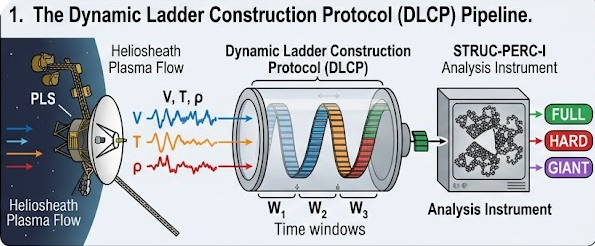
The Dynamic Ladder Construction Protocol (DLCP) formalises how a physical observable is converted into a sequence of time-local ladders: sliding windows of Δ=1024 samples (~55 hours each), stride of 256, with a sort+unique+finite adapter. Each window yields one point in ℳadm. The sequence of points is a structural trajectory.
The Core Shift
Systems are no longer classified once. They evolve structurally through ℳadm, and the coordinates of that evolution — κconn(t), tail dominance(t), margin m(L(t)) — are now time-series with physical interpretation. This is the first new geometric level in the UNNS programme since the Percolative Realizability Principle.
🛸 Why Voyager 2: A Unique Physical Laboratory
Voyager 2 is not simply a dataset. Between August 2007 (termination shock crossing) and November 2018 (heliopause crossing), it traversed the entire heliosheath — a plasma boundary region with known physical transitions, dense temporal sampling, and four independently measured observables from the same instrument.
Dense Temporal Sampling
PLS instrument returns measurements every ~192 seconds. A Δ=1024 window spans ~55 hours — dense enough to capture structural evolution on timescales shorter than a solar rotation.
Known Physical Transitions
The termination shock (2007-08-27) and heliopause (2018-11-05) are established physical events. The structural corpus can be evaluated against known boundaries.
Multi-Observable Simultaneity
V, T, w, ρ from the same instrument at the same moments. Four simultaneous trajectories on different charts of ℳadm — enabling cross-channel structural comparison.
Genuine Boundary Region
The heliosheath sits between two distinct plasma regimes. It is the only environment in which a structured approach to a realized physical boundary can be studied directly.
🔬 Six Key Findings
Finding 1 — Dominant-Regime Persistence: An Empirical Law
The dominant realizability class for each observable is the same in 2007 as in 2018. Despite the heliosheath undergoing continuous structural evolution — shocks, sector boundaries, temperature variations by factors of 30, episodic velocity collapses — the class label attached to each observable's ladder family does not change globally over 11 years. Velocity, temperature, and thermal speed remain predominantly in the FULL percolation regime; density remains in the HARD fragmentation regime.
This is not obvious. Class stability under large geometric deformation — κconn varying by a factor of 30 within the FULL class — means the topological structure of the gap distribution is more conserved than any individual structural metric. Topology is stable while geometry evolves.
Finding 2 — The Three-Phase Directed Trajectory
The annual mean κconn time series does not fluctuate randomly. It describes a directed, three-phase trajectory through realizability space:
- Rise (2007–2009): Thermal variables intensify rapidly post-termination shock. Temperature κ reaches 941.8 in 2009 — the highest value in the corpus. Velocity does not follow: thermal-kinematic decoupling is already active.
- Relaxation (2010–2016): Structural metrics broadly decline from the 2009 peak. Velocity shows two sharp episodic collapses (κ = 82.0 in 2014, κ = 98.2 in 2017) without thermal response — further evidence of channel separation.
- Convergence (2017–2018): All three FULL observables simultaneously approach structural minima. Temperature κ: −57% from peak. Thermal speed κ: −79% from peak. Velocity tail dominance: −55% from 2007.
Random traversal through an isotropic plasma would produce a flat average with noise. A directed three-phase structure implies an internal gradient field in the heliosheath that the trajectory follows.
Finding 3 — The Heliopause as a Structural Transition Layer
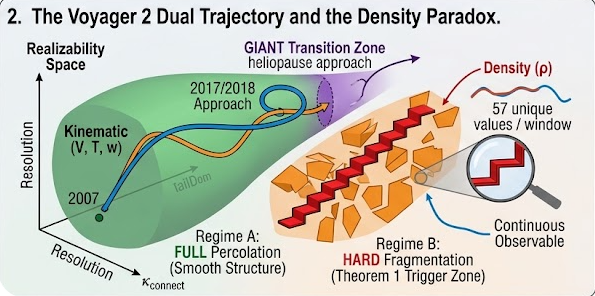
Three windows in 2017–2018 exit the FULL class and enter GIANT_COMPONENT_PERCOLATION. These are not noise: they share GR > 0.99 (backbone intact), occur in the final windows before the heliopause, and are spread across two observables (velocity and thermal speed).
Finding 4 — Thermal-Kinematic Decoupling: An Anisotropic Heliosheath
In 2009, temperature κ spikes to 941.8 (annual mean) while velocity κ remains at 269.3 — a thermal intensification event with no kinematic response. In 2014 and 2017, velocity κ drops to 82.0 and 98.2 respectively while temperature remains at 371.7 and 265.0. These channel-separated structural events demonstrate that the heliosheath is not a uniform, isotropic plasma: thermal and kinematic degrees of freedom evolve under different structural drivers.
Finding 5 — Density as a Discrete-Regime Observable
All 155 HARD density windows trigger Theorem 1 — the percolative USL violation that marks genuine structural fragmentation. The cause is representational: the PLS fitting procedure in the outer heliosphere returns approximately 57 unique density values per 1024-sample window. A near-discrete sorted sequence cannot achieve full percolation at any κ threshold.
Theoretical Significance
The density finding demonstrates a key principle: realizability class depends on the distributional structure of the measurement representation, not on the physical quantity being measured. The same physical system, measured through an instrument with limited resolution, lives in a structurally different region of ℳadm than it would under continuous measurement. Density joins TiO₂ density of states as the second canonical discrete-regime domain in the UNNS programme.
Finding 6 — Multi-Chart Simultaneity
Velocity, temperature, and thermal speed reside predominantly in the FULL chart of ℳadm throughout the traverse. Density resides predominantly in the HARD chart. The same physical system simultaneously occupies structurally different regions depending on which observable is laddered — the first direct instantiation of ℳadm's multi-chart structure in a real physical system. Near the heliopause, the FULL chart becomes permeable and partial inter-chart transitions occur.
📊 Interactive Corpus Dashboard
The full dashboard visualises the 628-run STRUC-PERC-I corpus: class distributions, κ trajectories, tail dominance time series, proposition system, and predictions for independent trajectories. It is embedded below and accessible directly at unns.tech/media/unns/rt_voyager2/voyager_dashboard.html.
⚖️ The Proposition System: A Formal Theory of Structural Dynamics
Five propositions govern trajectory behaviour in ℳadm. They were stated before the corpus was evaluated and tested against the 628-run Voyager 2 dataset. Together they define realizability dynamics: a continuous trajectory constrained within a dominant regime, with boundary approach expressed through coordinated structural softening and localised class excursions.
Temporal Structural Continuity
Structural coordinates (κ, tail dominance, GR, margin) evolve continuously or piecewise continuously, with every sharp variation attributable to a physical cause.
✓ ConfirmedDominant-Regime Persistence
DLCP trajectories remain in a dominant class (96.0% conformance), with deviations confined to localised, structurally conditioned excursions. Observable representation defines the baseline regime.
✓ ConfirmedDetectable Boundary Approach
Boundary approach is indicated by coordinated coordinate softening and emergence of boundary-adjacent classes. The 2017–2018 GIANT windows confirm localised transition onset.
◐ Partially ConfirmedTrajectory Regularity
Within the dominant class, γ(t) is locally smooth. Derivative discontinuities coincide with discrete physical events, not measurement noise.
✓ ConfirmedMargin as Temporal Indicator
Sustained decrease of m(L(t)) is a probabilistic forward indicator of boundary approach. Velocity tail dominance declines −55% over 11 years — the structural forecast of the heliopause transition.
✓ SupportedTrajectories in ℳadm
Physical systems evolve in ℳadm not as static classifications but as regime-stable trajectories with structurally detectable transition onset. The UNNS Substrate is inherently dynamical.
✦ Core ResultSynthesis Statement
Together, Propositions 1–3 define realizability dynamics as a continuous trajectory constrained within a dominant regime, with boundary approach expressed through coordinated structural softening and localised class excursions. Physical systems do not simply occupy realizability classes — they trace trajectories that evolve, soften, and partially transition before physical boundaries are crossed.
🌌 What This Changes: From Classification to Dynamical Theory
This result is not an extension of prior UNNS results. It is a categorical shift in what the UNNS Substrate is and what it can do.
UNNS Before This Work
- A structural classification framework
- Describes where a system is in ℳadm
- Static ladders, one evaluation
- No temporal information
- Boundaries are geometric objects
- Class transitions are theoretical
UNNS After This Work
- A dynamical geometric theory
- Describes how systems move through ℳadm
- Time-indexed ladder families, trajectory γ(t)
- Full structural time series
- Boundaries are transition layers, detectable before crossing
- Class transitions observed in real data (3 GIANT windows)
Relation to Other Theories
UNNS Realizability Dynamics does not replace MHD or statistical physics. MHD describes the equations of motion within the structural basin; percolation theory supplies the class geometry; dynamical systems theory provides the trajectory language. What UNNS adds is a new layer: the structural constraints on which realizability regions are accessible to a given physical system, and how the trajectory evolves as it approaches the boundary of those regions.
🔭 Predictions and Open Questions
The corpus results generate falsifiable predictions for independent trajectories — no additional data was used or fabricated to formulate them.
| Prediction | What would confirm it | What would falsify it |
|---|---|---|
| P1 — Dominant-Class Persistence | Any heliosheath traverse: observable stays in dominant class >90% of windows | Stochastic class switching uncorrelated with physical events |
| P2 — Metric Non-Universality | Voyager 1 (northward) shows distinct κ(t) profile while remaining within FULL | Identical κ profiles across structurally independent trajectories |
| P3 — Non-Identical Boundary Approach | Pre-crossing κ decline in any independent ISM-approach trajectory, at different rate from V2 2017–18 | Abrupt class transition at heliopause with no preceding structural softening |
| P4 — Continuity Constraint | m(L(t)) piecewise continuous in any slowly evolving system | >15× κ change in 75%-overlapping windows without physical cause |
The Definitive Open Test
The November 2018 heliopause crossing lies beyond this dataset. If ISM-side Voyager 2 PLS data becomes available at comparable resolution, Proposition 3 predicts a sustained FULL→GIANT or FULL→HARD transition within a few windows of the physical crossing, with the 2017–2018 GIANT excursions serving as the confirmed pre-cursor signal. That measurement would constitute the first full empirical confirmation of a class transition in realizability space coinciding with a physical boundary crossing.
💡 Implications and Significance
Predictive Structural Detection
If boundary approach is structurally detectable years before physical crossing, UNNS coordinates may serve as early-warning indicators for physical regime transitions in any domain — not just heliospheric plasma.
Cross-Domain Potential
The trajectory formalism applies wherever a time-indexed observable can be laddered. Atomic systems, condensed matter, cosmological structure, biological fitness landscapes — all are candidates for the same dynamical analysis.
Observable Relativity
The same physical system lives in different structural regions of ℳadm depending on which observable is laddered. Measurement is not neutral: the representation of a quantity partially determines its structural classification.
Heliosphere Reinterpretation
The heliosheath is not a uniform envelope. It is a structurally stratified, anisotropic medium with channel-separated dynamics and a directed structural gradient from termination shock to heliopause — all visible in the UNNS coordinates.
Structure Before Geometry
The structural basin constrains the effective geometry: the spatial boundary we call the heliopause is where the structural basin terminates. MHD and UNNS are complementary — not competing — theories of the same system.
A New Programme Layer
Admissibility (USL) → Realizability (PRP) → Local Geometry → Dynamics (this work). UNNS now has four structural layers, each adding descriptive power to the same geometric framework.
Resources & References
- Primary Manuscript: Structural Trajectories in Realizability Space: Voyager 2 Plasma as a Time-Resolved Test of the UNNS Substrate — UNNS Manuscript Series, 2025.
- Corpus Analysis Report: Voyager 2 STRUC-PERC-I Corpus Analysis (628 runs) — Full per-epoch, per-variable statistical report.
- Interactive Dashboard: Structural Trajectories Dashboard — voyager_dashboard.html — κ trajectories, class distributions, proposition system, predictions.
- Raw Data Pipeline: voyager_data_raw.zip — Raw CDF files, ladder pipeline, STRUC-PERC-I batch output (summary.json × 628).
- Percolative Realizability Chamber: STRUC-PERC-I v2.4.0 — Interactive instrument used for all evaluations.
- Companion Paper: Local Geometry of Realizability Boundaries in the UNNS Substrate — the geometric foundation assumed throughout this work.
- Data Source: Voyager 2 PLS High-Resolution Plasma Data, Heliosheath (NASA CDAWeb, VOYAGER2_PLS_HIRES_PLASMA_DATA_HSH, 2007-08-27 – 2018-01-01).