
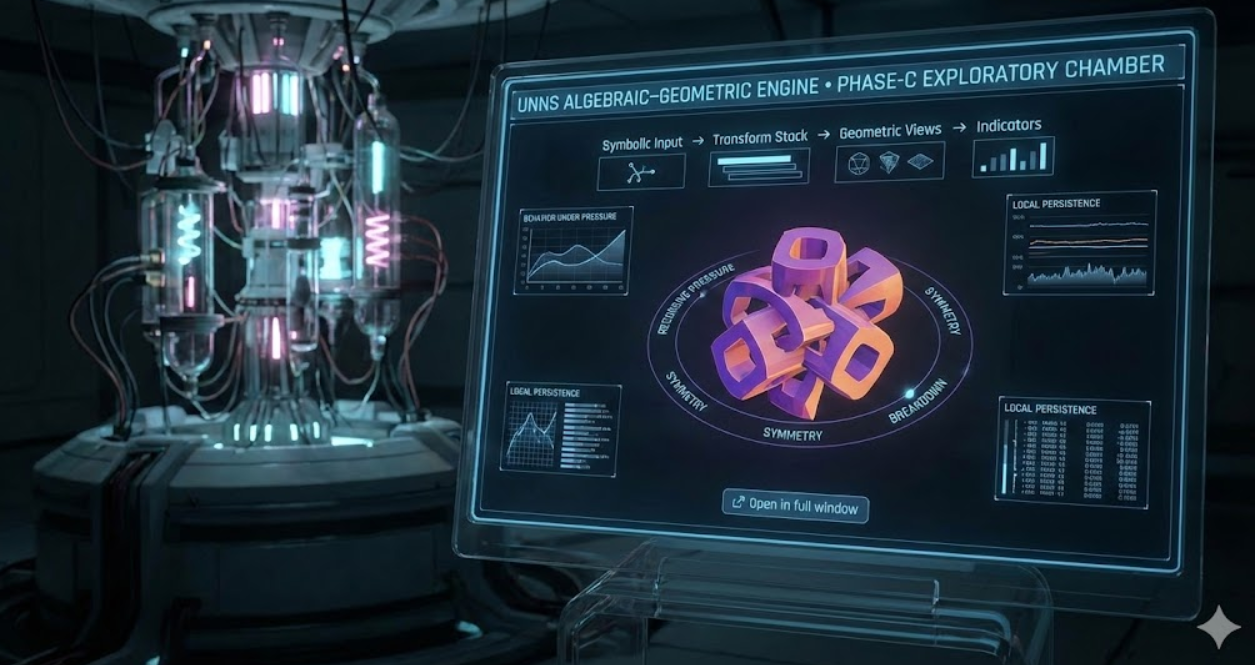
Phase-C Exploratory Chamber — a pre-collapse microscope for observing how symbolic structures behave under recursive and geometric transformations.
Where the Engine Sits in UNNS
The Engine is intentionally not a canonical classifier. Its purpose is Phase-C exploration: observe patterns, breakdowns, symmetries, and sensitivities before any substrate-level declaration is made.
What the Engine Does
The Engine starts from a symbolic expression and applies layered transformations, exposing geometric and structural responses. It is designed to support insight, not verdicts.
In other words: the Engine can show breakdown, oscillation, local persistence, symmetry, or sensitivity — but it does not “approve” or “reject” a structure. Canonical classification remains a Phase-B act recorded in the Operator Registry.
Open the Engine
The Engine is embedded below for immediate exploration. For a dedicated view, use the full-window link.
How It Connects to the Phase-B Registry
The Engine does not export or submit classifications to Phase-B. The hand-off is conceptual and curated: Phase-C exploration may motivate a Phase-B entry, but Phase-B remains non-computational and declarative.
Practical Use Cases
- Boundary probing: explore how candidate recursions respond to transformation pressure before any declarative classification.
- Undecidability intuition: visualize persistent complexity without pretending to “resolve” open systems.
- Structure discovery: notice symmetries, oscillations, and breakdown regimes that can later be discussed in Phase-B language.
- Chamber ecology: keep Phase-C chambers expressive and experimental while Phase-B remains canonical and declarative.
Closing Note
The Engine is one of the clearest examples of how UNNS separates exploration from admissibility. Phase-C chambers can be rich and dynamic — but the substrate’s canonical map is Phase-B.