
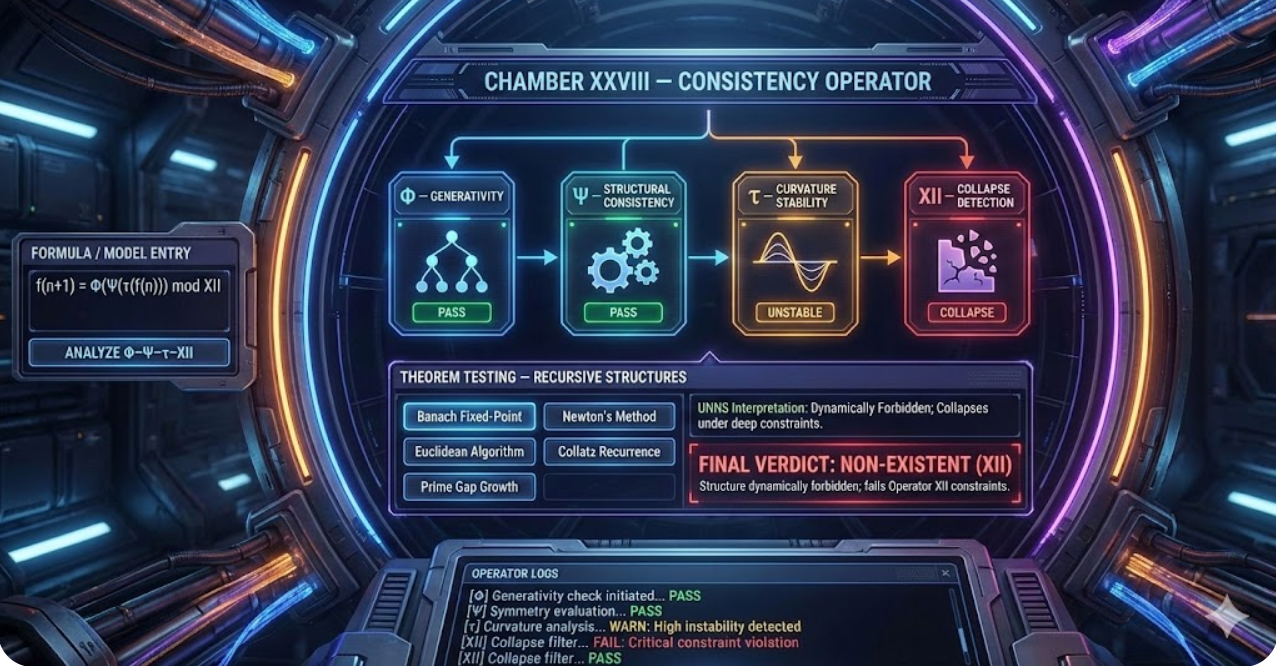
Φ–Ψ–τ–XII Structural + Recursive Dynamical Engine
Chamber XXVIII is the first UNNS laboratory built to answer a single question: “Can this structure exist in the UNNS Substrate?”
Unlike earlier Chambers, which focus on specific constants, fields, or τ-dynamics, Chamber XXVIII works one level higher. It accepts a formula, recursion, or simple model, and runs it through the full Φ–Ψ–τ–XII operator chain, treating the formula as a candidate universe inside the Substrate.
The result is not just a convergence test or a numerical diagnostic. It is an existence verdict in the UNNS sense: whether the structure is generable, coherent, τ-stable, and able to survive Operator XII collapse filters.
1. Interactive Chamber Embed
Use the embedded Chamber below to experiment directly with formulas, recursions, physical models, and theorem-inspired iterations.
Open Chamber XXVIII in fullscreen
2. The Four Operators: Φ, Ψ, τ, XII
Chamber XXVIII is driven by the Φ–Ψ–τ–XII recursion engine. Every input passes through four distinct stages:
- Φ — Generativity: Can the structure be unfolded as a valid recursion?
- Ψ — Structural Consistency: Are symmetry, coherence, and invariance preserved?
- τ — Curvature Stability: Does the recursive trajectory remain geometrically stable?
- XII — Collapse Detection: Does the structure survive deep substrate constraints?
Together, these stages act as a consistency engine: a way to test whether a candidate model can be hosted by the UNNS Substrate as a stable dynamical object.
Operator Flow Diagram
The Chamber interface mirrors this diagram: each operator has its own panel, numerical diagnostics, and a badge showing PASS, FAIL, STABLE, UNSTABLE, or COLLAPSE.
3. Theorem Testing and Real-World Models
One of the most powerful aspects of Chamber XXVIII is the Theorem Testing — Recursive Structures panel. Each button in this panel loads a carefully chosen recurrence inspired by a classical theorem or model:
- Banach Fixed-Point Theorem: A stable contraction map.
- Newton’s Method (sqrt(2)): Quadratic convergence under iteration.
- Euclidean Algorithm (GCD): Recursive reduction via remainders.
- Collatz Recurrence (3n + 1): A structurally simple but dynamically extreme map.
- Prime Gap Growth Model: A heuristic recursion inspired by prime distributions.
When a theorem example is selected, the formula is loaded, analyzed automatically, and a short “UNNS Interpretation” line explains what the verdict means in substrate language. This makes Chamber XXVIII a bridge between classical mathematics and UNNS-style existence classification.
Theorem Testing Diagram
In this way, each theorem is treated as a candidate “world” inside the UNNS Substrate. The Chamber does not decide whether a theorem is true or false, but whether its recursive formulation can exist as a stable dynamical object.
4. Reading the Verdicts
Chamber XXVIII outputs one of five possible top-level verdicts:
- ADMISSIBLE: The structure passes all operators and can exist as a stable substrate object.
- UNSTABLE (τ): Generable and coherent, but with dangerously high curvature.
- INCOHERENT (Ψ): Fails structural invariance or projection consistency.
- NON-GENERABLE (Φ): Cannot be unfolded as a valid recursion.
- NON-EXISTENT (XII): Dynamically forbidden; the structure collapses under deep substrate constraints.
Existence Types Diagram
The same language appears in the Chamber as badges next to each operator panel, and in the final verdict section. Over time, these five classes become a vocabulary for talking about “what kind of existence” a structure has in the UNNS Substrate.
5. How to Use Chamber XXVIII
Step 1 — Enter or Load a Formula
Type a recursion or model into the Formula / Model Entry box, or select a preset from the Load Example dropdown or the Theorem Testing buttons.
Step 2 — Run Φ–Ψ–τ–XII Analysis
Click Analyze. Φ tests generativity, Ψ checks structure, τ simulates the trajectory, and XII evaluates collapse conditions.
Step 3 — Read the Panels
Each panel offers numeric and qualitative feedback:
- Φ shows generativity depth and recursion tree snapshots.
- Ψ reports symmetry, coherence, and invariance scores.
- τ plots curvature over time and reports stability metrics.
- XII lists any triggered collapse conditions.
Step 4 — Interpret the Verdict
The final verdict block combines the operator results into a single existence classification. The operator logs at the bottom give a narrative of what happened, using Φ/Ψ/τ/XII labels and PASS/INFO/WARN/FAIL status tags.
6. The Role of Chamber XXVIII in the UNNS Project
Chamber XXVIII marks a turning point in the UNNS program: it turns the Substrate into a consistency engine for mathematics and physics.
Instead of asking only “Is this theorem true?” or “Does this model fit the data?”, we can now ask:
“Can this structure exist at all, as a dynamical object in the UNNS Substrate?”
The answer is not a proof, but a new kind of structural diagnosis. Some recursions are admitted. Some are unstable but allowed. A few are dynamically forbidden. The Chamber gives us a way to map that landscape and to see classical mathematics through the lens of recursive geometry and τ-curvature.
Chamber XXVIII is therefore both a tool and a statement: existence itself can be tested, operator by operator.