
From Fragmentation
to Coherence
What This Work Found
Physical systems that appear structurally fragmented in raw observational data frequently reveal hidden coherent organization once represented in transition-space coordinates. This manuscript is the first UNNS paper to study dynamics rather than static classification — investigating how structural realizability evolves under extreme forcing across five physically unrelated domains.
The central discovery: coherent organization survives arbitrarily close to apparent structural collapse. Systems do not simply fragment under extreme pressure — they enter a distinctive near-boundary regime where global connectivity is preserved even as structural tension approaches its maximum. This regime is called Forced Coherent Collapse (FCC), and its existence across nuclear explosions, astrophysical transients, seismic waveforms, particle collisions, and the Voyager boundary crossing suggests something fundamental about the geometry of extreme transitions.
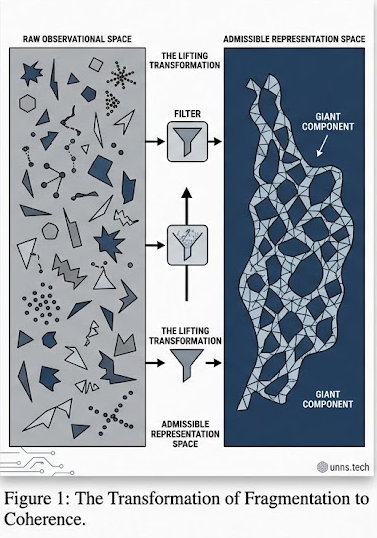
A second major finding: fragmentation can be representational rather than physical. Many apparent structural collapses disappear when the right observational lens is applied — a result with deep implications for how we interpret signals from extreme events.
🎯 The Core Discovery
At the heart of this manuscript is a single structural observation that changes how we interpret extreme physical systems:
This combination — vanishing margin with persistent connectivity — is what the manuscript terms Forced Coherent Collapse. It is structurally distinct from ordinary fragmentation (where GR collapses) and from ordinary stability (where margin remains large). It is a third regime: near-boundary coherence under extreme forcing.
Traditional Expectation
- Extreme forcing → fragmentation
- Heavy tails → instability
- Rupture → structural death
- Critical loading → collapse
- Boundary approach → disconnection
What the Corpus Shows
- Extreme forcing → FCC (coherent near-collapse)
- Heavy tails → coherent concentration mechanisms
- Rupture → preserved giant component
- Critical loading → near-zero margin, persistent GR
- Boundary approach → margin minimum, then recovery
The Deepest Reframing
Heavy tail dominance is conventionally associated with disorder and intermittency. This manuscript reframes it: in extreme systems, high tail dominance is a coherent stress-concentration mechanism — structural forcing localized into a small number of dominant transitions, with global connectivity intact throughout. The tail does not destroy the system. It organizes it under extreme load.
📐 The Margin Collapse Hypothesis
All empirical results in the manuscript are organized under a single working hypothesis of the UNNS Substrate Research Program:
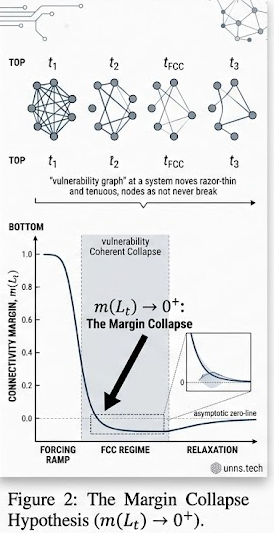
This hypothesis generates falsifiable predictions: stronger forcing (higher yield, larger energy release, closer proximity, lower redshift) should drive deeper excursions into the high-TD/high-GR frontier (FCC zone) with correspondingly smaller measured margins, while Δ-representations should systematically recover higher-margin states than raw embeddings.
Reading the Four Stages
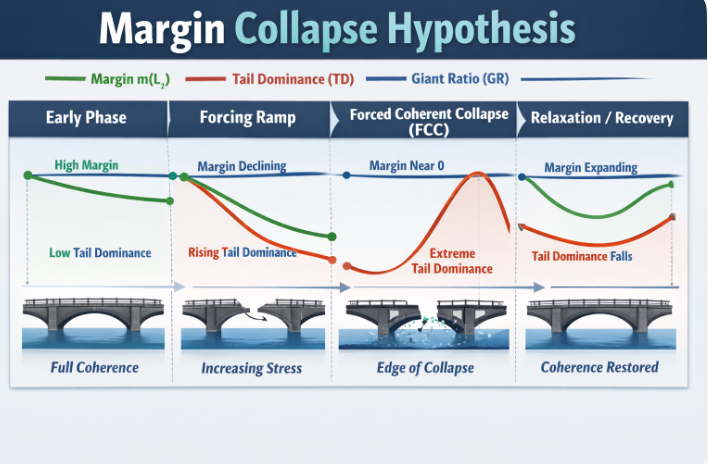
The diagram encodes the complete structural lifecycle of an extreme transition. In the Early Phase, margin is high and tail dominance low — the system sits well inside the admissible interior, represented by an intact bridge under no stress. During the Forcing Ramp, external loading increases: margin begins to fall and tail dominance rises as structural weight concentrates into a shrinking number of dominant transitions. The bridge begins to crack but holds.
At the FCC regime — the manuscript's central finding — margin approaches zero while tail dominance peaks near saturation. This is the "Edge of Collapse": the bridge is severely damaged, gaps dominate the gap distribution, and yet the spanning giant component persists. GR holds. The system does not fragment. It is coherent under maximum structural stress.
Finally, during Relaxation / Recovery, forcing decreases, tail dominance falls, and margin expands as the system reorganizes — the bridge reconnects. This recovery stage is directly observed in the Voyager corpus: after the heliopause crossing (FCC-adjacent), κconn increases by a factor of 1.6–2.4× in the ISM phase and full-coherence years (2013, 2017) return to 100% Full. The system exits FCC not through fragmentation but through structural recovery.
The Unified Scaling Law
A key quantitative outcome of the manuscript is a cross-domain transport law for how tail dominance evolves under source strength and propagation distance — the same functional form applies across nuclear explosions, earthquakes, and supernovae:
where S is source strength (yield, magnitude, luminosity), d is effective propagation distance (epicentral distance, redshift), φ(S) ∝ Sα scales with source, and ψ(d) is a decreasing attenuation/dimming function. The law implies TD increases with source strength and decreases with distance — producing the FCC trajectory along the upper Tail frontier as a controlled, measurable path through admissibility space. This is proposed as a corpus-supported transport model, not a universal law.
💥 Forced Coherent Collapse — A New Structural Regime
FCC is arguably the manuscript's most original contribution. It identifies a structural regime that fits none of the four standard STRUC-PERC-I classes — it is not ordinary Full, not ordinary Tail, and certainly not Hard.
| Regime | Tail Dom. (TD) | Giant Ratio (GR) | Theorem-1 | Structural meaning |
|---|---|---|---|---|
| Full | low–mod | 1.000 | No | Globally connected, balanced gaps |
| Giant | low–mod | ≈1.000 | No | Strong backbone + bounded isolates |
| Tail | high | high <1 | No | Heavy tail; connected but gap-dominated |
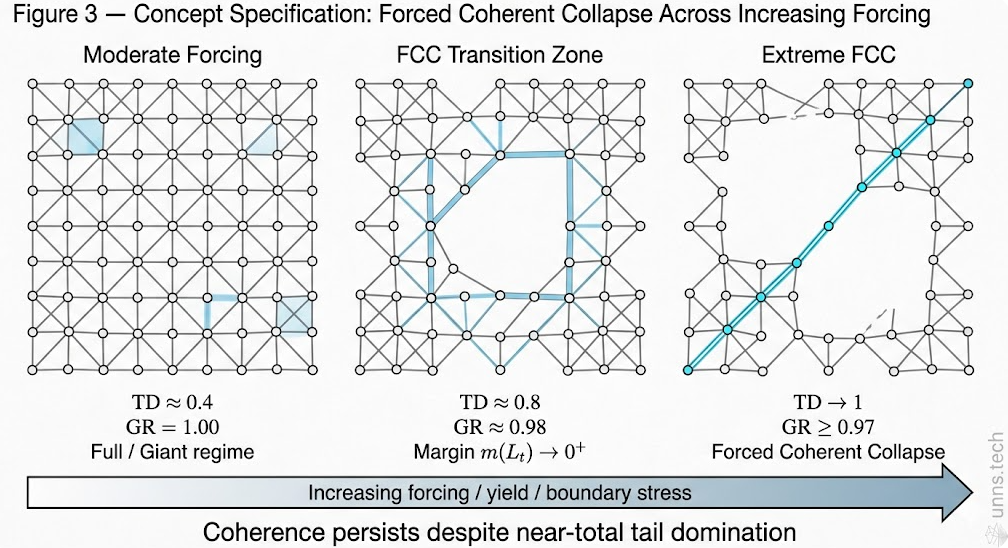
| FCC | very high (≥0.80, often →1) | ≥0.97 | No | Extreme tail forced by physics; backbone preserved |
| Hard | variable | < GRthresh | Yes | True fragmentation / collapse |
Canonical Realization: NK Nuclear Explosion Corpus
The proximal station IC.MDJ (Mudanjiang, China, ~360 km from the test site) shows the defining FCC signature: tail dominance saturates toward 0.997 for the largest event while GR remains at 0.975 — and Theorem-1 is never triggered. As estimated yield increases across three test events, mean tail dominance rises monotonically (0.753 → 0.827 → 0.886) while giant-component connectivity holds stable throughout. The forcing concentrates structural change without destroying global coherence.
Why FCC Is Not Just "Extreme Tail"
Ordinary Tail-class systems approach fragmentation as TD → 1. FCC is the specific case where GR remains robustly stable — at or above 0.97 — even as TD approaches saturation. The distinction is a demonstrated connectivity floor. The system is collapsed in its gap distribution but coherent in its connectivity structure.
Data source: IRIS Data Management Center — North Korea Nuclear Explosion Special Event, 2013.
🌐 Five Domains, One Structural Geometry
The manuscript evaluates STRUC-PERC-I across five physically unrelated domains — systems that share no common microscopic physics, energy scale, or mechanism — and finds the same structural organizing principles operating in each.
Supernova SN Ia
ZTF20acobvxk · 64 photometric epochs · MJD 59124–59204. Raw magnitude ladder: Hard (Theorem-1). Δmag and curvature: Full percolation with κconn = 141–185 and TD = 0.75–0.81.
Δ-layer: FULLSeismic Waveforms
Non-sensitive (IU network, May 2026) and Nevada earthquake (2026). Same source; full verdict spectrum FULL→HARD across five stations by propagation distance. RISC demonstrated empirically.
RISC at teleseismic distanceNuclear Explosions
DPRK tests 2006/2009/2013 · 10 stations · 29 station-event pairs. Zero Hard outcomes. IC.MDJ: TD up to 0.997, GR ≥ 0.971 throughout. Canonical FCC realization.
FORCED COHERENT COLLAPSEParticle Collisions
CMS Open Data H→ZZ→4ℓ · 104 events · 2012 LHC run. All three ladder representations: Full percolation with GR = 1.000 and κconn = 2–85. Transition-native representation.
FULL · all representationsVoyager Boundary Transport
V1 magnetic field 2011–2017 · 3,500 windows. 97.4% Full. Boundary-adjacent GIANT excursions concentrate in 2011–2012. Post-crossing recovery: κconn jumps 1.6–2.4×. Nonterminal transport.
NONTERMINAL BOUNDARY TRANSPORT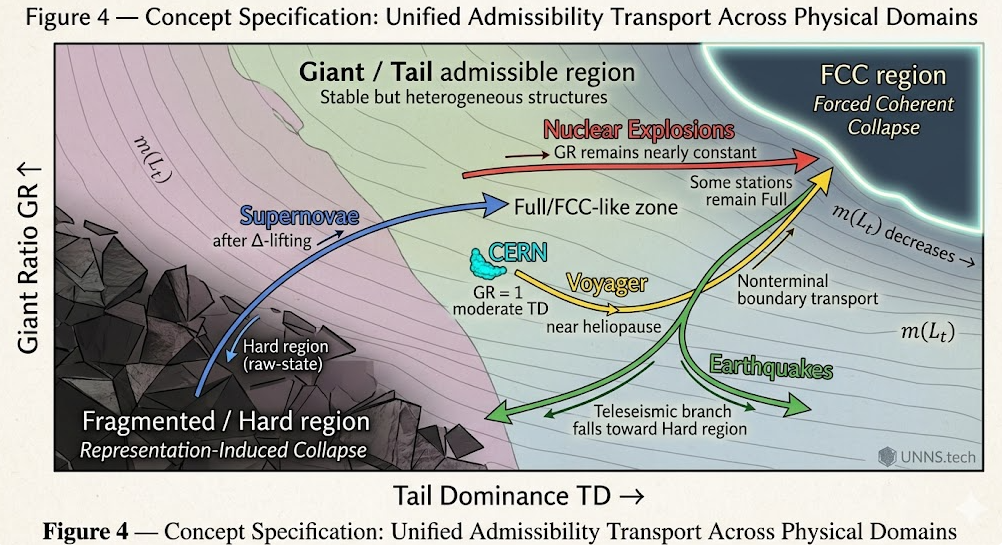
🔬 Representation-Induced Structural Collapse (RISC)
One of the manuscript's most important theoretical contributions is the demonstration that structural fragmentation is not representation-invariant. Observable collapse and physical collapse are not the same thing.
The Core Insight
The same physical system can appear structurally fragmented (Hard-class, Theorem-1 active) or structurally coherent (Full-class, GR = 1.000) depending on how the data is encoded into a structural ladder. This is not a methodological artifact — it is a fundamental property of how observational geometry maps onto realizability space.
The manuscript documents three distinct RISC mechanisms — a classification not previously available in any UNNS corpus:
Absolute-Scale Embedding
SN Ia raw magnitude ladder. A single bright-end magnitude gap dominates the raw embedding, triggering Theorem-1. The Δ-lifting removes this artifact, recovering Full percolation with κconn = 141.
Propagation-Distance Deformation
Nevada earthquake, IU.HRV station (Massachusetts, ~3,100 km). Teleseismic signal attenuation reduces n to 217 and creates a dominant outlier gap. Same source; FULL at nearby stations, HARD at teleseismic distance.
Measurement-Resolution Discretization
Voyager 2 density channel. PLS fitting resolution produces ~57 unique values per 1,024-sample window — systematic sparsity unrelated to heliocentric position. Density: 98.7% Hard. Velocity/temperature: 93–97% Full from the same plasma.
🛸 Voyager — Nonterminal Boundary Transport
All other domains in the manuscript study explosive or terminal transitions — processes that end. The Voyager datasets add something qualitatively different: a system that approaches a physical boundary, traverses it, and continues. The structural question is whether realizability coherence survives this multi-year continuous boundary transit.
The Voyager~1 corpus delivers the manuscript's most structurally profound result. Boundary-adjacent Giant excursions concentrate in 2011–2012 (69% of all excursions in those two years); 2013 and 2017 are 100% Full. The structural boundary estimator t* = 2012 is stable across a 4× variation in window scale. After crossing the heliopause, κconn increases by a factor of 1.6–2.4× — the post-crossing ISM state is actually more structurally connected than the pre-crossing heliosheath.
The Voyager 2 plasma corpus simultaneously documents the third RISC mechanism: the density channel (98.7% Hard) vs the kinematic channels (93–97% Full) from the same plasma. PLS fitting resolution produces ~57 unique values per 1,024-sample window — systematic sparsity that triggers Theorem-1 independently of any physical plasma structure.
Instrument access: STRUC-PERC-I v2.5.0 Chamber (Voyager evaluation)
🔄 What This Manuscript Changes
Earlier UNNS manuscripts established structural classification — admissibility, rigidity, realizability boundaries, and transition observability. This manuscript extends that program toward dynamic realizability: not only what structural class a system occupies, but how it moves through admissibility space under forcing and transport.
| Earlier UNNS Framework | This Manuscript |
|---|---|
| Admissibility classification | Admissibility transport |
| Static structural states | Dynamic realizability trajectories |
| State-class labeling | Boundary evolution and crossing |
| Coherence measurement | Coherent collapse (FCC regime) |
| Phase classification | Near-critical transport |
| Single-observable per domain | Observable-dependent realizability (RISC taxonomy) |
| Terminal or short-duration events | Long-duration nonterminal boundary transport (Voyager) |
The Deepest Theoretical Consequence
The manuscript suggests that realizability boundaries are not walls — they are frontiers. Systems can approach them, fluctuate near them, partially cross them, reorganize structurally, and recover coherence. The heliopause crossing demonstrated in the Voyager corpus is the first UNNS trajectory that enters, traverses, and exits a boundary region in realizability space while maintaining admissibility throughout.
🔗 Data, Instruments & Resources
All datasets used in this manuscript are publicly available. The full analysis pipeline and instrument outputs are archived below.
| Resource | Description | Access |
|---|---|---|
| Manuscript | Beyond Fragmentation — 42-page working manuscript, all propositions and corpus results | Full PDF → |
| Corpus Analysis | UNNS Explosive Dynamics Analysis — interactive corpus summary | Open → |
| STRUC-PERC-I v2.5.0 | Live instrument chamber — Voyager magnetic field evaluation | Open Chamber → |
| Data Pipeline | Input/output pipeline archive — all domain ladders and STRUC-PERC outputs | Download → |
| Foundational Library | Prior UNNS manuscript archive — rigidity, realizability, dual observability | Download → |
| IRIS NK Data | IRIS DMC Special Event: North Korea nuclear explosion, 12 Feb 2013 | IRIS → |
| CERN Open Data | CMS H→ZZ→4ℓ candidate events, 2012 dataset (Record 5200) | CERN → |