
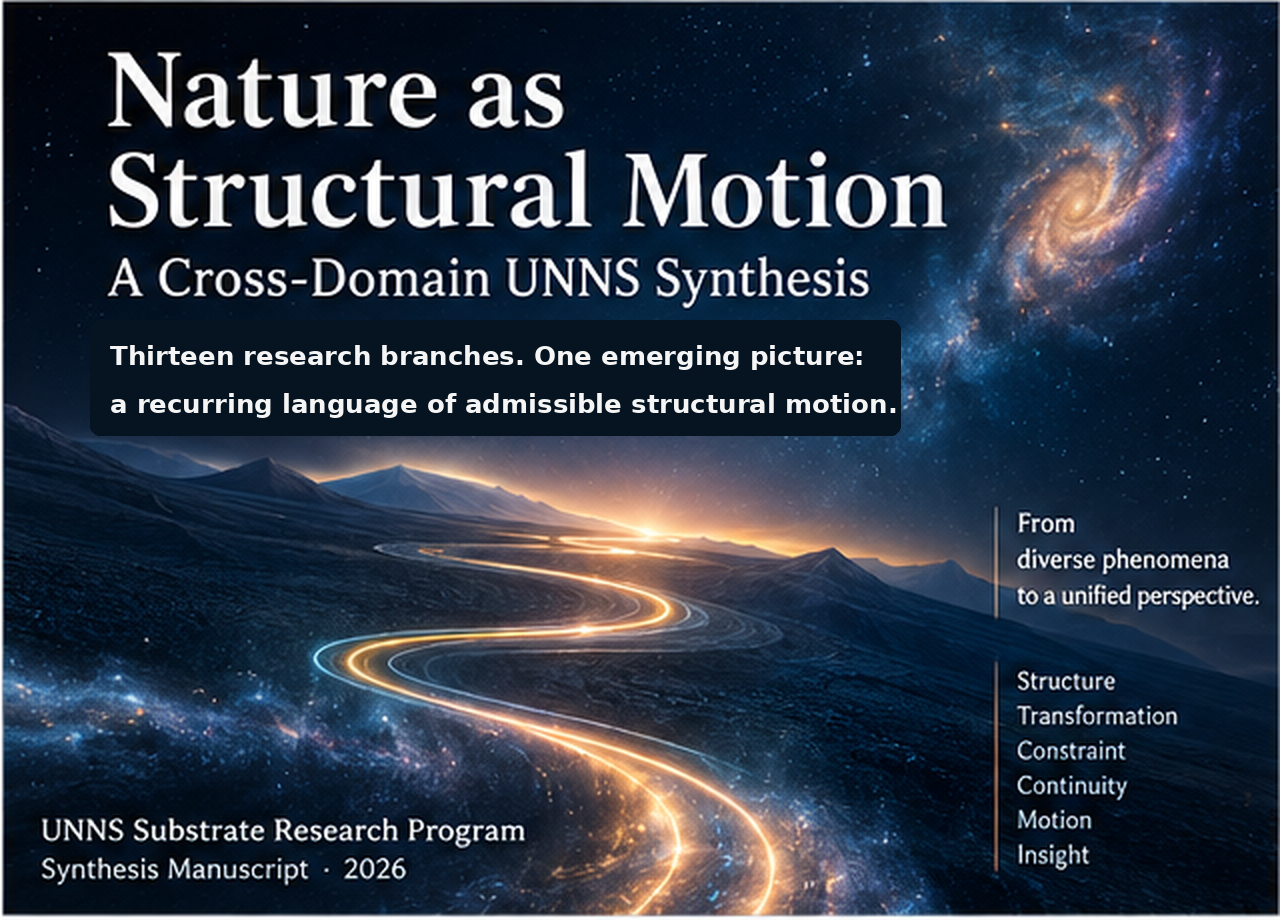
The UNNS Substrate and the
Structure of Change
Overview
For several years, UNNS investigations have approached very different systems — galaxies, collapsing stars, particle transitions, confined color charge, plasma boundaries, turbulence, neutrino detectors, cosmological evolution, and temporal recurrence — as separate structural problems. Individually, each study produced its own domain-scoped result.
Read together, in the synthesis manuscript Nature as Structural Motion, they reveal something that was not obvious at the outset: physically realized structures do not merely occupy admissible states. They appear to follow a small, recurring vocabulary of structural change — and that vocabulary is one clarified layer of the wider UNNS Substrate, not a replacement for it.
This article is a conceptual guide to that synthesis, not a compressed version of it. For the formal derivations, the full corpus-dependency accounting, and the quality-gated evidence tables, the manuscript above is the reference throughout.
🧭 The Central Interpretation
Earlier UNNS work asked a single question, state by state: is a represented structure admissible? A ladder was evaluated, a verdict was returned, and that verdict was reported as a property of the system at that instant.
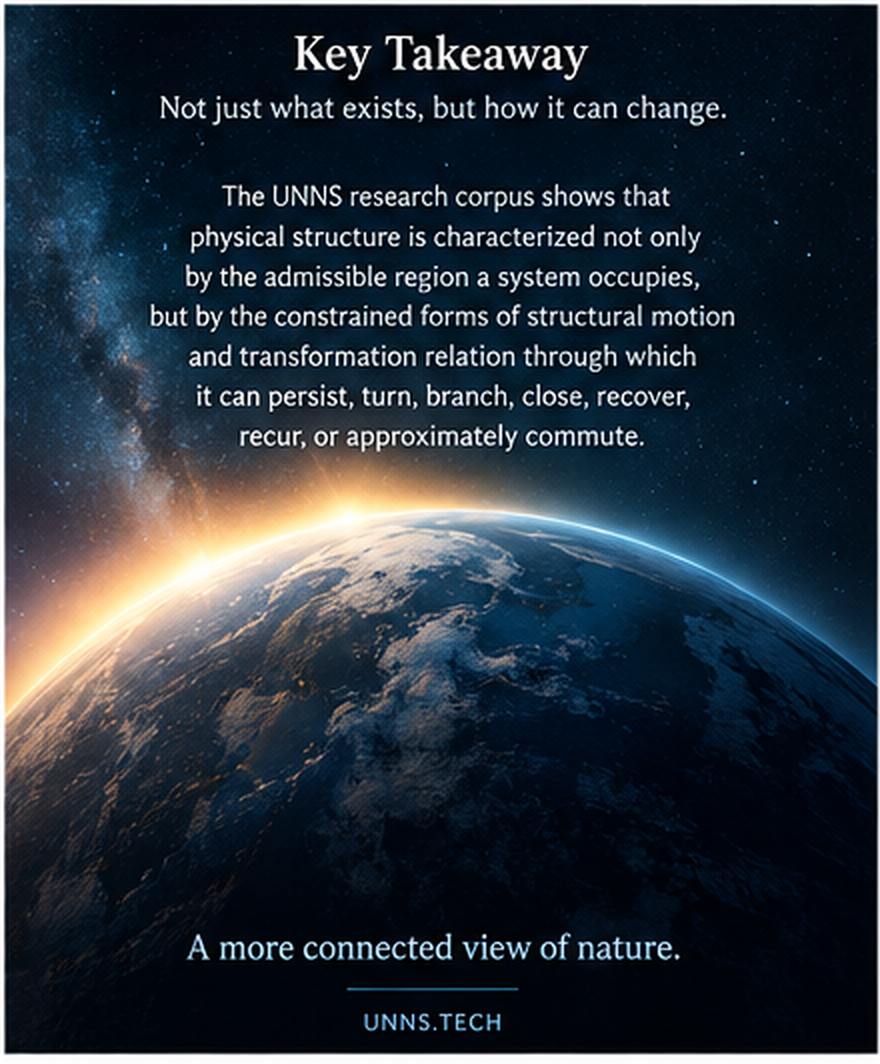
The present synthesis allows a richer question. Instead of asking only whether a single state belongs to the admissible region, it follows a trajectory of states and asks what kind of structural behavior that path exhibits — does it persist, approach a limit, turn, branch, preserve a closure, recover under a better representation, recur under a temporal grammar, or approximately commute with another transformation?
That distinction is why the synthesis introduces its own common vocabulary for a structural state: a ladder (the ordered physical sequence itself), a chart (the representation or instrument through which the ladder is expressed), and an auxiliary coordinate that carries whatever closure, route, or orientation information a scalar admissibility verdict leaves out. Thirteen branches, previously written in thirteen different native formalisms, can now be read against one shared language — without erasing what makes each of them physically distinct.
🌊 Stability Does Not Mean Staying Still
This may be the single clearest public-facing interpretation of the synthesis:
When the thirteen branches are compared side by side, eight recurring forms of structural change emerge — not assumed in advance, but read off the corpus after the fact. Four describe the shape of a trajectory; four describe how a trajectory relates to closure, charts, grammars, or the order of operations. Kept separate, this distinction stops the taxonomy from treating a cosmological bounce, a chart recovery, and the commutation of two analysis operators as the same kind of mathematical object.
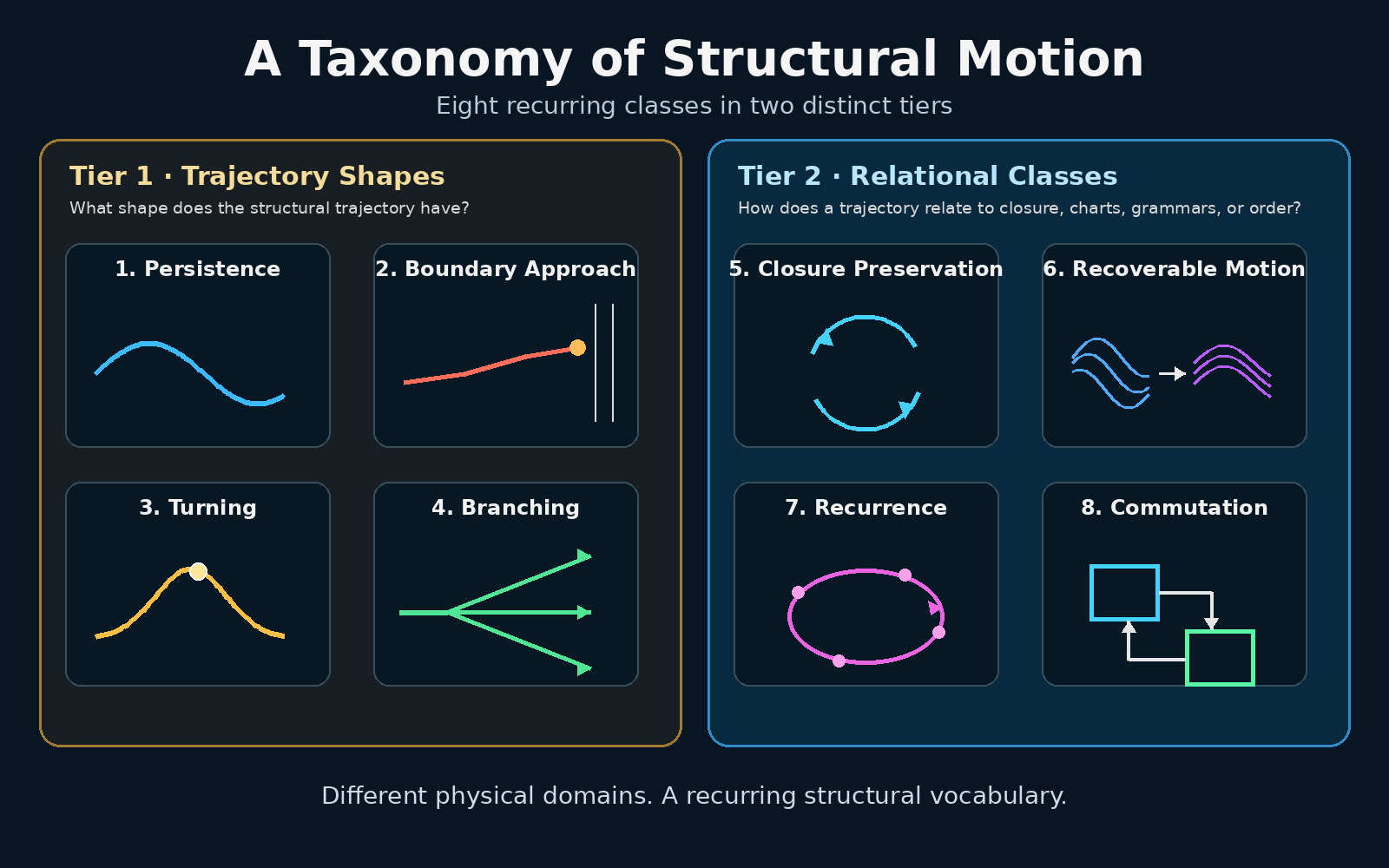
Remain Stable While Deforming
A structure remains within the same admissible region while undergoing deformation or perturbation, without a boundary encounter.
Approach a Boundary Without Crossing It
A trajectory moves toward reduced structural margin without a demonstrated crossing; under an identity-preserving flow, the Margin-Confinement Law excludes genuine crossing.
Turn at a Finite Structural Limit
A trajectory reverses at a definite locus, with a genuine orientation flip — not merely a value's minimum.
Branch Into More Than One Regime
One admissible configuration routes into several structurally distinct admissible outcomes.
Survive Because a Route Is Preserved
Global connectivity can persist even while the coherence of a specific route degrades — closure is the more sensitive signal.
Appear Broken Until Recovered
A structure looks fragmented under one chart and admissible under another, locality-preserving one.
Organize Through a Temporal Grammar
A sequence is tested for recurrence under an explicit, frozen grammar rather than assumed periodic by inspection.
Nearly Independent of Order
Two transformations applied in either order reach almost the same result — and the exceptions cluster in informative ways.
🚧 A Boundary Can Organize Change
The public intuition is usually that a boundary means failure: a structure reaches the edge, and something ends. The synthesis gives a different picture. In several UNNS studies, a structural boundary behaves less like a cliff and more like an organizer — a place where trajectories compress, turn, branch, or require repair.
Anchored examples from the corpus: at the physical heliopause crossing, Voyager 1's structural connectivity margin reaches its minimum; under the identity-preserving UNNS interpretation, the trajectory approaches but does not cross the structural admissibility boundary (Margin-Confinement). A cosmological trajectory turns at a finite locus H=0, ρ=ρc, with its orientation coordinate reversing from −1 through 0 to +1 (loop quantum cosmology bounce, read structurally). And the stellar ABC bridge is classified as branching: its pre-supernova, post-collapse light-curve, and spectral layers remain internally admissible while occupying strongly different cross-regime structural positions (bridge distances dAB=0.401, dBC=1.287, dAC=1.365).
Turning Is Not the Same as a Simple Minimum
A quantity declining and later rebounding is not automatically a "turning point" in the structural sense. Voyager's connectivity margin reaches a minimum and later recovers, but no orientation coordinate is defined or reversed there — so it supports approach and recovery, not the formal turning class. A genuine turning point requires structural orientation, not merely a scalar reversal.
🔍 The Same Physical System Can Look Structurally Different
One of the strongest empirical themes across the whole synthesis is that representation cannot be treated as neutral preprocessing. The same underlying physical object can appear structurally fragmented or fully admissible, depending entirely on the chart through which it is observed.
Fragmented → Recovered
Ladders that fragment under a raw chart recover to full percolation under a locality-preserving Δ-lifted representation of the same underlying process.
Hard → Full
Raw supernova magnitude reads as structurally hard-fragmented; the Δ-magnitude and curvature representation of the same events reads as fully admissible.
Orientation Erased
A magnitude-only encoding renders two physically distinct routes structurally indistinguishable — the orientation information is recovered only by a signed encoding.
This does not mean any representation is acceptable. Quite the opposite — the choice of chart becomes something that must itself be tested, not assumed. That safeguard is what keeps representation-dependence a scientific finding rather than an excuse.
🔗 Connected Is Not the Same as Admissible
The charge-routing and stellar-collapse results make this especially clear. A structure can remain globally connected while losing the coherence of a specific route — and conversely, a structure can appear fragmented under one representation while remaining recoverable under another. Connectivity, on its own, describes only one aspect of realizability.
Charge Boundary Routing
In the mixed corpus, structures remain globally connected — 42 of 42 completed ladders reach full percolation — while route-transition admissibility, measured separately, falls from 0.985 in the allowed corpus to 0.859 in the mixed one.
Stellar Collapse
All pre- and post-collapse layers remain internally fully percolating, yet the cross-regime bridge distances (0.401, 1.287, 1.365) show the layers do not occupy equivalent structural positions.
Many readers instinctively equate "connected" with "stable." The synthesis is saying that the structural situation is richer than that: a graph can stay in one piece while the thing that actually mattered — the route, the closure, the orientation — quietly comes apart.
🌐 A Common Structural Language — Not a Common Microscopic Physics
UNNS does not claim that galaxies, plasmas, confined color charge, supernovae, time crystals, and turbulence obey one microscopic mechanism. They plainly do not. The synthesis asks a different question: whether physically unrelated systems can nevertheless exhibit comparable forms of structural organization, once each is represented as an admissible structural object.
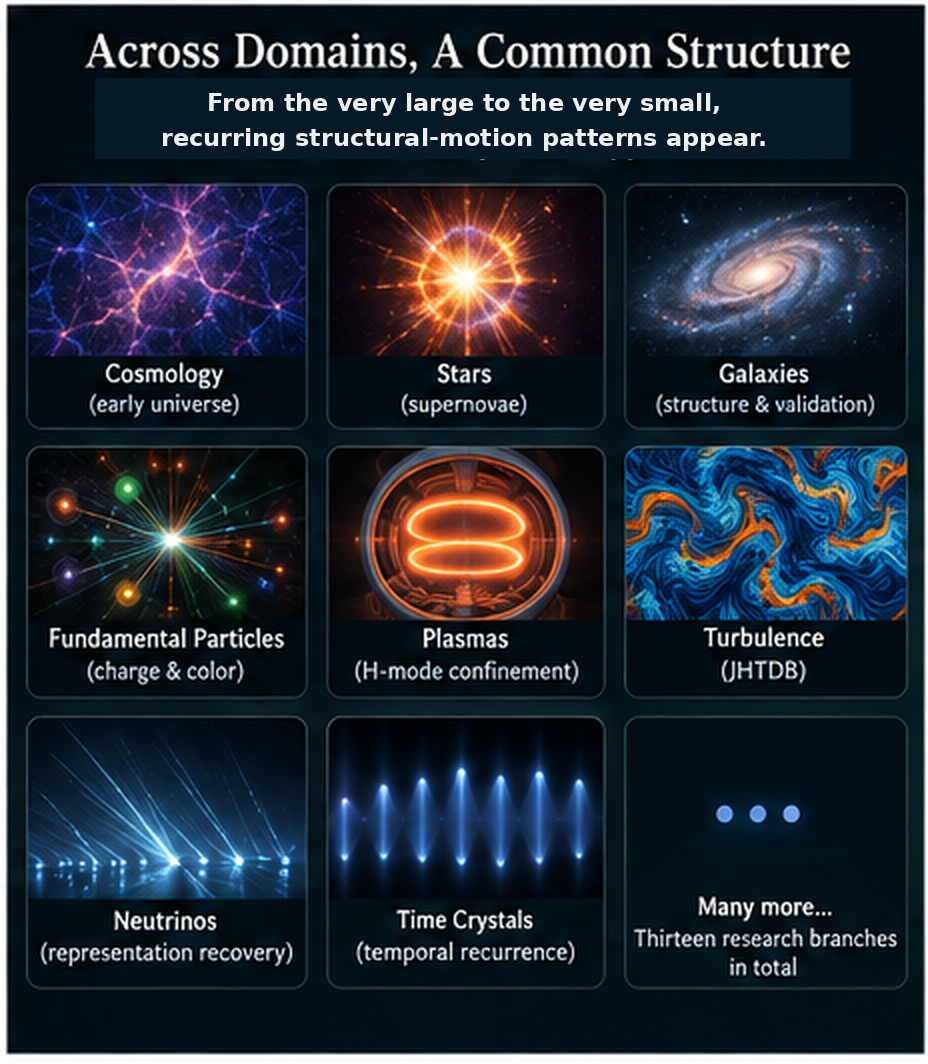
Thirteen Branches, Eight Motion Classes
The chart below follows the manuscript's cross-domain evidence matrix. Each branch is mapped only to the motion class or classes that the synthesis assigns from its documented results; the class assignment is a framework-level interpretation, not a native verdict returned by the source branch.
⚠️ The Failures Matter
The synthesis became more credible, not less, when its failures were kept visible. Negative results reveal where a structural grammar stops working, where a representation breaks down, or where a hypothesis still needs a better test. None of the following is hidden in the manuscript — each is treated as a load-bearing result:
- Turbulence's scale–time commutation test replicated only partially, not fully.
- Two independently constructed temporal-recurrence grammars both encountered a domain boundary on the same prospective candidate, for different reasons.
- A galaxy predictive-transfer test did not clear its preregistered confirmation gate.
- Representation-recovery transforms are not universal — some degraded cases still fail to recover.
- The near-turning localization pattern is observed in the pilot corpus, but its interpretation as a general Turning-Locus Shielding effect remains a hypothesis requiring replication.
- Stellar branching evidence remains pilot-scale, from a single tri-domain bridge.
Failure as a Map, Not an Embarrassment
The manuscript reads these failures as clustering at grammar boundaries, transform failure modes, and prediction-architecture mismatches — a way of mapping where a structural method's language stops working, rather than noise to explain away.
🏛️ The Wider UNNS Architecture
It would be easy to read this synthesis and conclude that UNNS is its eight motion classes. That is not the claim. Structural motion is not proposed as a complete definition of the UNNS Substrate — it is one layer of a broader structural program. The Substrate first requires a representation of a system as an ordered structural object; asks whether that representation is admissible; studies the internal organization of admissible space; and only then asks how admissible structure may transform.
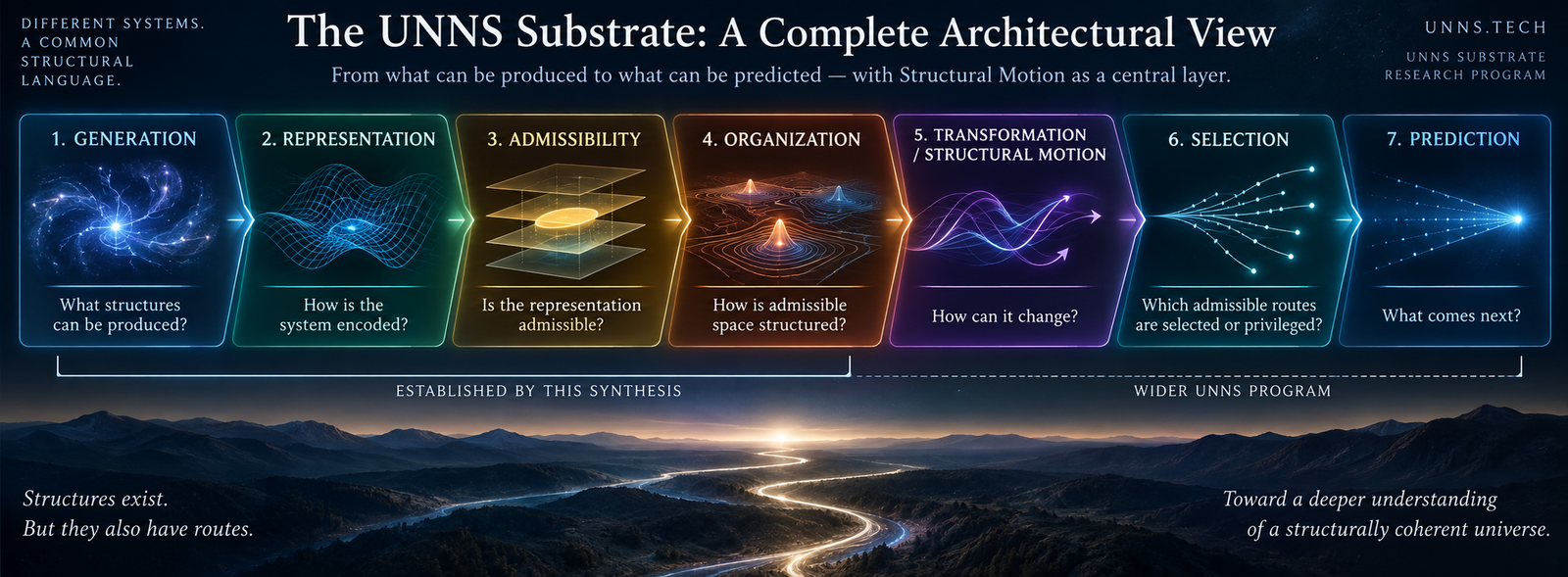
The relation is one of proper inclusion, not identity. This manuscript's central claim is not that eight motion classes exhaust the Substrate, but that — within it — admissibility alone is insufficient to characterize change. The admissible modes of change are themselves structured.
📚 Where This Sits Among Existing Ideas
UNNS intersects conceptually with several established fields, without replacing any of them:
| Field | Shared Language | What UNNS Asks Differently |
|---|---|---|
| Dynamical systems & bifurcation theory | basins, attractors, structural stability | Whether a represented structure remains admissible, not merely which basin a flow settles into |
| Catastrophe & critical-transition theory | qualitative reorganization near a boundary | Where the transformed representation sits relative to admissibility, and which route is preserved or selected |
| Percolation theory | connected components, giant ratios, thresholds | An admissibility criterion applied to ordered structural representations, not random site or edge occupation |
| Topological data analysis | persistent structure, connectivity features | A promising future bridge — the present branches do not yet compute persistent homology |
| Phase-transition theory | qualitatively distinct regimes separated by boundaries | Whether transition classes can be described by admissibility geometry, not only by an order parameter |
The manuscript is explicit that these are analogous structural pictures, not the same mathematical objects as UNNS's own admissibility manifold. UNNS does not replace a physical mechanism — a cosmological bounce, a lattice-QCD confinement calculation, an established plasma model — it adds a structural classification of how that mechanism's outcome is realized.
🔮 From Classification to Prediction
Today, the program can increasingly say: this is persistence, this is approach, this is turning, this is branching. The natural next question is whether, knowing where a structure is and how it is moving, one can predict which admissible route becomes available next. That would take UNNS from a structural diagnostic toward a genuinely predictive theory of admissible transitions.
The manuscript is careful to leave this as an open problem rather than an achieved result. That restraint is itself part of the synthesis's discipline: it says clearly where the current evidence stops.
🌌 The Larger Picture
The thirteen projects synthesized here do not tell us that nature is governed by one hidden microscopic mechanism. They tell us something subtler. When very different physical systems are translated into structural form, they repeatedly confront the same kinds of questions: Can the structure persist? How close is it to a boundary? Can it turn? Can it branch? Does it require closure? Is an apparent failure physical, or does it belong to the representation? Can the structure recur? Do transformations commute?
The emerging UNNS picture is therefore not merely a map of admissible structures. It is becoming a map of admissible ways of changing. Nature, on this reading, is not made only of states that exist. It is made of structures whose possibilities are constrained by the routes through which they can become something else.
Resources & References
-
Primary Manuscript (PDF):
Nature as Structural Motion: A Cross-Domain UNNS Synthesis
Full formal framework, corpus-dependency accounting, eight-class taxonomy, cross-domain evidence matrix, negative results, and external literature context. UNNS Substrate Research Program · 2026. -
Video — Structural Motion Across the Substrate:
Nature_Motioni.mp4