
When the Same Result Hides a Different Structure
Overview
Two numbers can be equal — ab = cd — while the routes that produced them share nothing underneath. Common Refinement is the question of when that gap can always be closed: when any two factorization routes to the same endpoint can be reconstructed from one shared four-factor structure, a = ef, b = gh, c = eg, d = fh. The UNNS Substrate project's Structural Route Closure result answers this exactly, and proves an equivalence that anchors everything that follows: primal factor traceability ⇔ global four-factor route closure.
What emerged is not one theorem but a classification: positive integers close globally without exception; rank-one systems close exactly when an index RCI(H) equals 1; higher-rank affine systems close exactly when a defect ARD(H) equals 0; and an audited transfinite candidate uses exact repair and strict descent toward a primal base, with its extracted Route-Closure Induction mechanism independently formalized and Lean-kernel verified. A further 30-system computational extension shows three distinct, non-equivalent structural coordinates: route-closure status varies while perturbative admissibility and eventual percolative connectivity remain saturated across the tested corpus.
🧩 From Equality to Route Closure
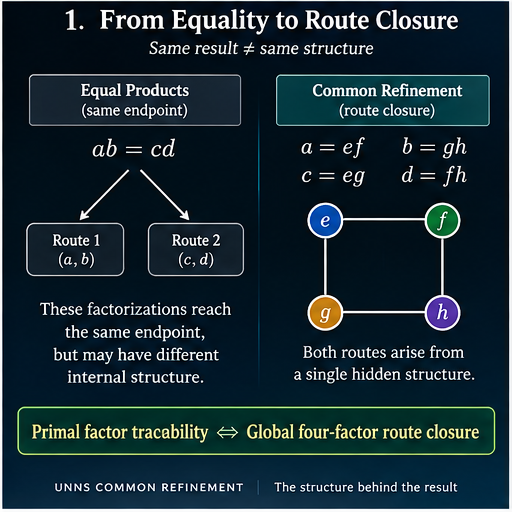
Start with something deceptively ordinary. Two products are equal: ab = cd. Grade-school arithmetic says that's the end of the story — the numbers match, done. But equality of the endpoint says nothing about whether the two routes that reached it are secretly the same route in disguise, or genuinely different paths that happen to land on the same value.
Common Refinement asks the sharper question: does there exist a hidden four-factor square — elements e, f, g, h with a = ef, b = gh, c = eg, d = fh — from which both routes can be reconstructed? If so, the equality isn't just numerical coincidence; it's the shadow of one shared internal structure. If not, two routes can reach the same number while remaining, in every structural sense that matters, different objects.
For the positive integers under ordinary multiplication, this equivalence holds unconditionally — it is the classical Euclid's-lemma machinery in a new structural language, and it is the fully route-closed control case against which every other regime is measured. The interesting question — the one the rest of this project answers — is what happens once the ambient structure stops being the positive integers.
📊 A Classification Across Structural Regimes
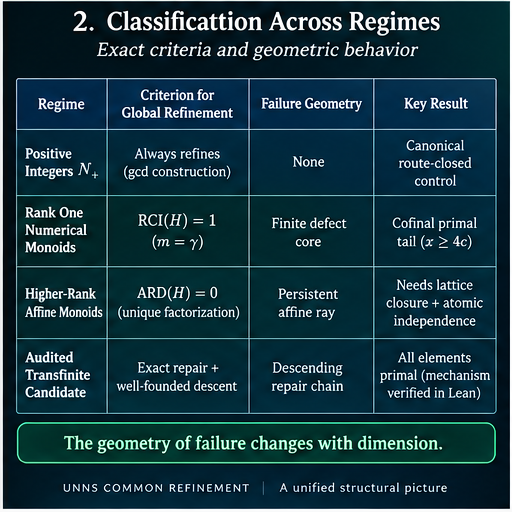
Once the question is sharpened, it becomes possible to classify exactly which systems close their routes and which do not — not by trial and error, but by an explicit numerical criterion in each regime.
| Regime | Closure criterion | What failure looks like |
|---|---|---|
| Positive integers | Always closed | No failure mode — the fully route-closed control |
| Rank-one numerical monoids | RCI(H) = 1 | Finite defect core, always eventually repaired |
| Higher-rank affine monoids | ARD(H) = 0 | Persistent defect ray — can propagate indefinitely |
| Audited transfinite candidate | Well-founded repair mechanism | Exact repair + strict descent to a primal base |
The rank-one criterion, RCI(H) := m/γ — the ratio of the smallest nonzero element to the generator of the ambient group — was validated computationally rather than left as an abstract claim. Every one of 793 rank-one generator families (generators in the range 1–12, generator-set sizes 1–4) was checked exhaustively.
An Exact Classification, Not a Statistical Pattern
For every one of the 513 systems predicted to be non-refinable, the canonical counterexample construction was verified directly, and an exact finite search confirmed zero systems among them for which a valid refinement witness nonetheless existed. The rank-one criterion is exact, element by element — not a majority trend.
At higher rank, the picture generalizes: an affine monoid closes its routes exactly when ARD(H) := |Atoms(H)| − rank(H) equals zero — that is, exactly when the number of atoms matches the rank of the ambient group, with no redundant generating directions left over. ARD effectively measures the excess of atoms over group rank; every unit of excess opens a new possibility for dependence, and dependence is what makes route closure fail.
🌍 The Geometry of Failure and Repair
Knowing that a system fails to close its routes is one thing. Knowing how the failure is shaped turns out to depend, sharply, on dimension.
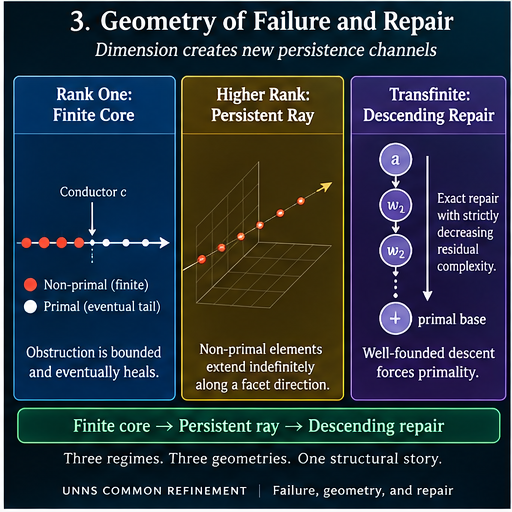
Rank one: a finite core, then permanent repair
Among the 513 non-refinable rank-one families, 414 (80.7%) already show a non-primal element near the bottom of the system. But in every single case, the non-primal locus is confined to a finite obstruction core: a median of 18 non-primal elements (maximum 130 across the whole corpus), after which the system becomes permanently, cofinally primal. The proved Cofinal Primal-Tail Theorem guarantees this repair happens by 4c (four times the conductor) at the latest — and the empirically observed onset ratio across the corpus ranges from 2.1 to 3.5, with a median of 2.67, comfortably inside that bound.
Higher rank: the ray that never has to stop
At rank two or above, geometry hands failure a new tool it didn't have before: a nonzero facet direction along which a defect can be translated indefinitely while preserving its witness. Where rank-one obstruction is finite and eventually heals, higher-rank obstruction can propagate along a persistent affine ray — forever, if nothing intervenes. This is the cleanest place the project connects factorization theory to polyhedral geometry: cones, facets, lattice saturation, and unimodularity stop being abstractions and start deciding whether a defect terminates or runs on without end.
Dimension Creates New Persistence Channels
At rank one, geometry offers no nonzero facet direction, so an obstruction cannot be translated forever while preserving its witness. At rank two or above, such directions exist — and that alone is enough to let a defect acquire an indefinitely extensible carrier. Dimension is not just a count here; it is what decides whether failure is a phase or a permanent feature.
The transfinite mechanism: repair made rigorous
The audited transfinite candidate replaces persistent obstruction with something stronger than "the defect eventually goes away": an explicit repair mechanism whose extracted induction principle was formally checked. Every unresolved case is reduced by exact local resolution, to a strictly smaller residual, under a well-founded ordering, until a certified primal base is reached and the original object is reconstructed. All four ingredients are required — a repair that merely changes a verdict without shrinking the residual, or without terminating, is not a repair in this sense.
The extracted route-closure induction proposition was independently formalized rather than merely asserted: it reuses the external Conway-refinement repository's own primality and four-factor-refinement machinery, deliberately declining to introduce a parallel notion of refinement, and the kernel accepted every one of its 837 build jobs and every one of its 829 cached-replay jobs.
🔄 Route Closure Is a Coordinate, Not a Proxy
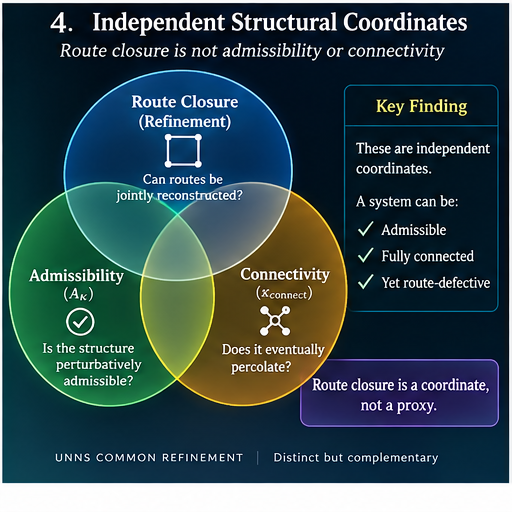
It would be convenient if route closure simply tracked other structural properties already in use across the UNNS Substrate — if a system that was admissible, or eventually connected, were automatically route-closed too. A frozen 30-system pilot corpus, built from five classes of six systems each and carrying 18 TRACEABLE and 12 NON_TRACEABLE labels, was built specifically to test that convenience. It failed.
Admissibility is saturated — and blind to route closure
Every one of the 30 systems, measured by the STRUC-I admissibility observable Aκ, returned the identical maximal value Aκ = 1 — including all 12 systems that are provably route-defective by the rank-one and affine theorems. Because the observable carries no variance in this corpus, the precise statement is not that admissibility and route closure are "uncorrelated" — a constant cannot support that claim — but the stronger fact that route-closure status does not separate STRUC-I admissibility here at all. Losing route closure carried no admissibility consequence.
Percolation: an instrument audit that mattered
The percolative connectivity coordinate initially told a more dramatic story — and then that story was corrected. The first instrument pass, STRUC-PERC-I v2.5.0, returned 25 FULL_PERCOLATION, 4 HARD_FRAGMENTATION, and 1 TAIL_FRAGMENTATION verdicts, suggesting a localized eventual-connectivity failure outside rank one. An internal audit found that reading did not survive scrutiny: v2.5.0's coarser interquartile-range scale and plateau-stopping rule had mistaken a finite-scale threshold effect — not a genuine absence of connectivity — in five higher-dimensional systems.
Two deterministic fixes — a nonterminal-plateau correction for four systems and an effective-zero interquartile-range correction for a fifth — brought every one of those five verdicts to FULL_PERCOLATION, with the other 25 unchanged. The audited instrument, STRUC-PERC-I v2.5.1, is the one this project now cites throughout.
Three Distinct, Non-Equivalent Coordinates
The corrected picture is not that percolation confirms route closure either. All 30 systems now register FULL_PERCOLATION, regardless of route-closure status — the same pattern already seen with admissibility. Route closure, perturbative admissibility, and eventual percolative connectivity are three distinct, non-equivalent structural coordinates: across this corpus, route-closure status varies while the other two remain saturated. A system can be fully admissible and fully connected while remaining, underneath, internally route-defective.
📚 Where This Sits, Mathematically and Physically
None of this replaces established theory — it sits deliberately alongside it, borrowing machinery and, in places, giving that machinery a structural interpretation and a failure geometry it did not previously have.
Refinement Monoids & Riesz Decomposition
The four-factor square is essentially the refinement/Riesz decomposition structure already studied in commutative monoids and ordered groups. The contribution here is reinterpreting it as structural route closure and following its failure geometry across regimes.
Reinterpreted, not replacedSchreier & Pre-Schreier Theory
"Every element is primal" connects directly to the pre-Schreier property. UNNS adds the language of factor traceability and asks, concretely, what the failure looks like geometrically when that property fails.
Acknowledged lineageNumerical & Affine Semigroups
Rank-one results sit inside numerical semigroup theory, where conductor and gap structure decide the outcome; at higher rank, cones, facets, saturation and unimodularity take over — the cleanest bridge from algebra to polyhedral geometry in the project.
Conductor bounds persistencePercolation, Stability & Catastrophe Theory
Percolation supplies connectivity, giant components, and thresholds — but the corpus now shows decisively that percolative connectivity is not the same object as route closure. A graph can connect while its encoded algebraic routes stay non-traceable.
Related, not identicalCharge Routing, Confinement & Plasma
Charge routing, color confinement, and H-mode plasma each formalized route or closure structure in a domain-specific way. What they did not supply was one domain-independent mathematical object shared across those domains. Common Refinement now provides an exact algebraic prototype of route coherence, without implying that the physical constructions are mathematically identical to it.
Exact prototype, not identity claim📡 Route Coherence Joins Structural Motion
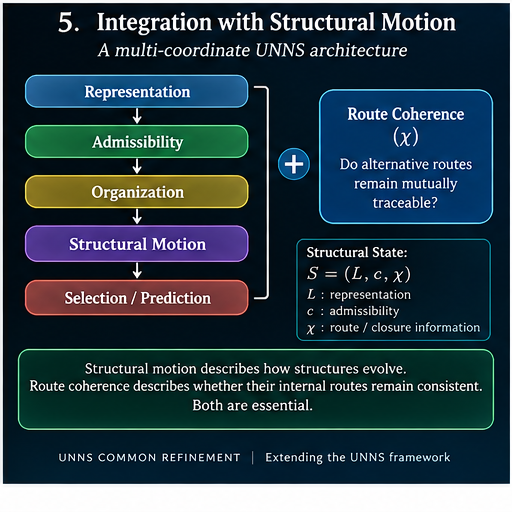
The wider UNNS Substrate synthesis, Nature as Structural Motion, describes how admissible structures move — through representation, admissibility, organization, and transformation. Its structural state S = (L, c, χ) made the third coordinate, χ, deliberately branch-specific: different branches instantiate it as a closure label, orientation coordinate, downstream-regime tag, or other route-relevant structure. Common Refinement supplies one of its strongest exact algebraic realizations.
This is not a claim that bifurcation theory, catastrophe theory, or percolation theory are secretly the same thing as route closure. It is a narrower and more useful claim: UNNS structural motion asks how a represented state moves among admissible regions, margins, routes, charts, and grammars; route closure asks, orthogonally, whether the alternative internal histories of that same state remain mutually reconstructible. The two questions do not answer each other, and that is exactly why keeping them separate is valuable.
Structural Identity Has (At Least) Two Levels
Two decompositions can satisfy ab = cd and be identical at the endpoint level while differing at the route level. So structural identity separates into endpoint identity and route identity — and the 30-system corpus shows two systems can even share the same perturbative-admissibility verdict and the same eventual percolation verdict while still differing in route closure itself. What a structure is depends partly on which internally admissible relations connect its components and histories, not solely on its final state or scalar observables.
✨ What the Project Has Gained
Individually, the pieces above are exact algebraic facts, a validated computation, a Lean formalization, and a corpus audit. Assembled into one structural program, they support a claim none of the pieces could make alone:
Key findings, condensed
The Closure Chain
endpoint equality ⇏ route identity, but
primal factor traceability ⇔ global route closure.
Then: RCI(H) = 1 ⇔ rank-one closure, while failure gives a finite defect core → a cofinal primal tail.
At higher rank: ARD(H) = 0 ⇔ affine closure, while ARD(H) > 0 forces a persistent defect ray.
In the audited transfinite candidate: exact repair + strict well-founded residual descent + primal base + reconstruction ⇒ route closure.
And across the structural extension: route closure ≠ admissibility ≠ connectivity.
What This Enables — Prediction
A system's coordinates now predict the kind of obstruction geometry before every failed element is enumerated. RCI(H) > 1 predicts a finite rank-one obstruction with eventual repair; ARD(H) > 0 at rank ≥ 2 predicts a persistent defect ray. That is already predictive in a theorem-level structural sense.
What Remains Open
Not every physical "route" elsewhere in UNNS has been shown to be a common-refinement route; RCI and ARD are not proven universal physical observables; the transfinite realization awaits independent specialist review; and connectivity scale does not track route closure monotonically — the affine results show the clean rank-one relation does not generalize.
The Most Important Open Branch: Canonical Refinement
Existence has been completely classified in the finite regimes studied and established within the audited transfinite candidate realization. A deeper problem remains: if several valid common refinements (e, f, g, h) exist for the same equality, are they all structurally equivalent, or does one deserve to be called canonical? Answering that would connect Common Refinement directly to UNNS selection and prediction, likely through a canonicality functional measuring minimal structural distortion or maximal route stability.
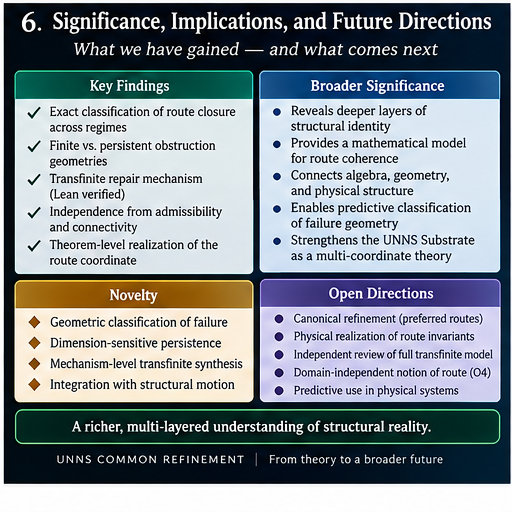
Before this investigation, UNNS could be summarized as: physical and mathematical structures occupy constrained admissibility spaces and move through them in constrained ways. That remains true — but it is no longer the whole picture. The relations among routes themselves turn out to form another level of structure, distinct from state, representation, and admissibility alike. Route coherence has become, in its own right, a mathematical object.
Resources & References
-
Primary Manuscript (PDF):
Structural Route Closure in the UNNS Substrate
Full derivation, proofs, Lean formalization, 793-family and 30-system corpora, and complete references. UNNS Substrate Research Program · 2026. -
Interactive Dashboard:
Structural Route Closure Dashboard
Audit trail, Principal Theorem ladder, and correlation with Nature as Structural Motion. Embedded above. -
Analytics & Reproducibility Instrument:
UNNS_COMMON_REFINEMENT_ANALYTICS.html
Self-contained reproducibility page with SHA-256 provenance and claim–evidence mappings for the principal results. -
Project Repository:
github.com/ukbbi/UNNS — UNNS_COMMON_REFINEMENT
Frozen records, Lean 4 formalization, kernel build evidence, and the 30-system corpus outputs (commit 760a81d6…). -
Companion Manuscript:
Nature as Structural Motion — A Cross-Domain UNNS Synthesis
Introduces the structural state S = (L, c, χ), with χ left branch-specific as a route/closure coordinate; Common Refinement supplies one of its strongest exact realizations. -
Video Walkthrough:
ucr.mp4
UNNS Common Refinement: Structural Route Closure — embedded above.