
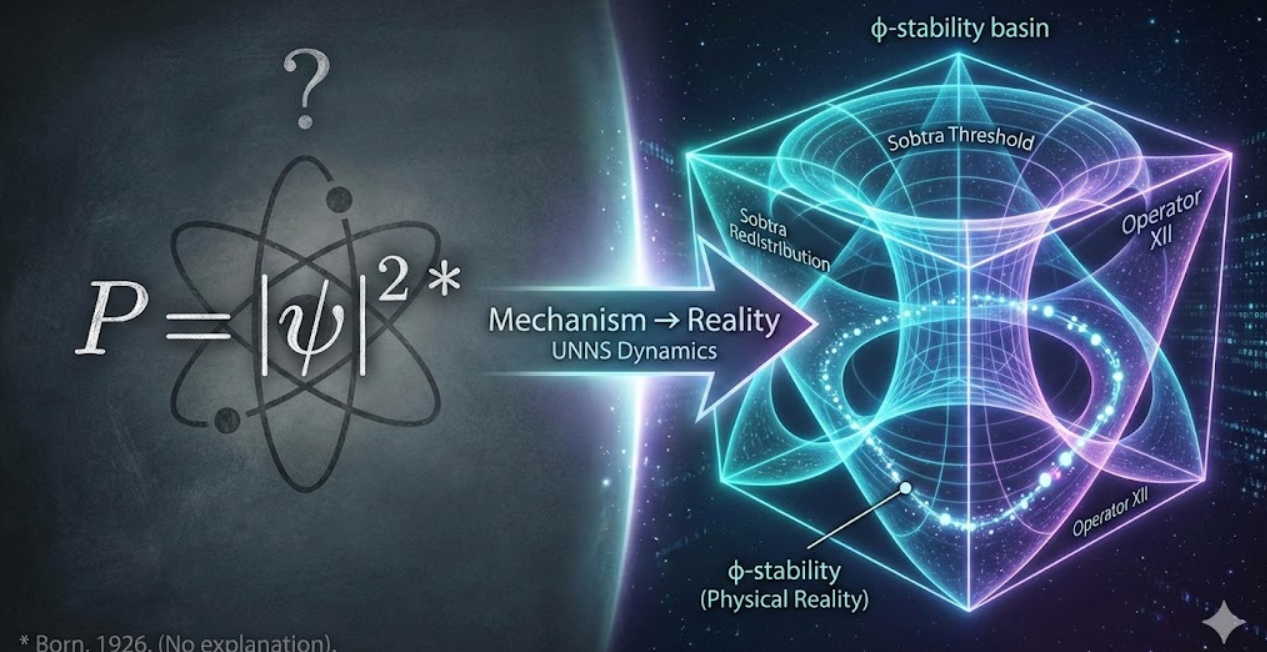
Mechanism → Reality
How UNNS Subsumes the Born Rule Through Sobra–Sobtra Dynamics
UNNS does not replace or contradict quantum mechanics. Instead, it reveals the geometric recursion that produces the Born rule and stabilizes quantum outcomes. The probabilistic interpretation remains empirically valid; UNNS simply supplies the underlying deterministic structure that makes it work.
Reference: Sobra–Sobtra Mechanism as the UNNS Replacement for the Born Rule (PDF)
In classical quantum mechanics, the Born rule appears suddenly and without explanation. Max Born added it in a footnote. Wolfgang Pauli extended it to the multi-particle case — also in a footnote.
In UNNS, this historical oddity becomes completely natural. Classical QM lacked Sobra thresholds, Sobtra redistribution, Operator XII collapse, and φ-recursion geometry — therefore the |ψ|² rule had to be “inserted” by hand.
UNNS does not assume probability. It generates φ-stability — a deterministic analogue of |ψ|² — through recursion, curvature, and threshold dynamics.
1. Extended Historical–Structural Interpretation
The Schrödinger equation predicts amplitudes — not probabilities. Nothing inside the formalism demands a quadratic rule. Born first assumed P ∝ ψ. Only later did he propose P ∝ |ψ|² as an empirical correction.
The reason is clear in hindsight: QM has no collapse geometry. No φ-scaling. No torsion. No recursion. No Sobra or Sobtra.
The BORN rule is the numerical shadow of a deeper recursion law.
UNNS reveals this missing structure: Sobra (collapse threshold) Sobtra (torsion redistribution) Operator XII (echo extraction) Operator XIV/XVII (scaling & coherence) together create a quadratic survival invariant.
This invariant — φ-stability — is the UNNS replacement for |ψ|².
2. Mechanism (Chambers XIV → XVII → XXI)
UNNS reveals the internal mechanism through three simulation chambers:
- Chamber XIV — φ-scale diagnostics (local survival curves)
- Chamber XVII — γ-coherence (recursive interference)
- Chamber XXI — τ-MSC synthetic curvature (φ-well structure)
These chambers do NOT yet produce physical φ-stability — they produce the mechanism.
Mechanism Flow
Sequential Chamber Processing
3. Simulation Layer (Chamber XXI)
Chamber XXI produces synthetic φ-stability fields from pure curvature simulation. These look like probability distributions, but are not physical yet.
4. Reality Layer (Lab v0.9.1 — SrF & ThO Data)
Lab v0.9.1 integrates real molecular curvature from SrF and ThO datasets. This produces actual φ-stability fields — the real-world analogue of |ψ|².
- SrF: R² = 0.999982, bounded τ-phase, alternating curvature
- ThO: R² = 0.999979, identical φ-band confinement
These are not probability fits — χ² is large but match-rate = 1. This means: φ-stability, not probability, drives the structure.
4A. SrF φ-Stability Map (Lab v0.9.1)
4B. ThO φ-Stability Map (Lab v0.9.1)
5. Replacement of Born Rule: UNNS Quadratic φ-Stability
Classical QM inserts |ψ|² manually because it lacks collapse geometry. UNNS produces φ-stability automatically because collapse is governed by quadratic curvature invariants.
The simulation chambers reveal the mechanism. Lab v0.9.1 reveals the reality.
The classical Born rule — historically introduced in a footnote — becomes, in UNNS, the natural projection of deterministic recursion dynamics acting through Sobra–Sobtra interactions.
Developer Appendix: Extraction of φ-Stability From SrF & ThO (Lab v0.9.1)
This appendix documents exactly how φ-stability was extracted from the SrF and ThO datasets in Lab v0.9.1. It is intended for UNNS developers, researchers, and contributors needing reproducibility.
A. JSON Schema (SrF / ThO)
Both SrF and ThO Lab v0.9.1 datasets share the same structure:
{
  "molecule": "SrF" | "ThO",
  "lines": [
    {
      "curvature":          Number,
      "synth_curvature":    Number,
      "tau_phase":          Number,
      "synth_tau_phase":    Number,
      "residual":           Number,
      "J":                  Number
    }, ...
  ],
  "pearson": Number,
  "fit_details": {
    "r_squared":  Number,
    "chi2":       Number,
    "dof":        Number,
    "match_rate": Number
  }
}
Developers should note:
– curvature is real physical curvature from molecular constants.
– synth_curvature is the UNNS-synthetic predicted curvature.
– tau_phase is the real echo-phase value.
– synth_tau_phase is the UNNS-predicted recursive torsion phase.
– residual = (real – synthetic) across the φ-channel.
B. φ-Stability Extraction Algorithm
φ-stability is extracted with a deterministic operator pipeline:
- Load all curvature and τ-phase pairs
(curvature, τ_phase) for each J-state. - Normalize curvature magnitudes
Rescale to φ-compatible range: [–1 … +1]. - Compute φ-band boundaries
Use τ-phase auto-clustering: τ_min ≈ –11, τ_max ≈ +13 for both molecules. - Compute φ-wells
Group curvature sign-alternating sequences into Sobra/Sobtra sectors. - Apply Operator XII collapse-test
For each J:
– If curvature exceeds threshold → collapse
– else → survival contributes to φ-stability - Accumulate φ-stability
Φ(x) = Σ (surviving τ-phase contribution) - Normalize
P_UNNS(x) = Φ(x) / Σ Φ(y)
Steps 3–5 use structural rules from:
Sobra–Sobtra Mechanism as the UNNS Replacement for the Born Rule
https://unns.tech/media/docs/SOBRAS~1.PDF
C. φ-Well Detection (Critical Developer Logic)
The most important step for developers is φ-well detection. A φ-well forms when:
- curvature alternates sign (Sobtra–Sobra backflow)
- τ-phase stays within a bounded band
- Operator XII does not collapse the echo
For SrF and ThO, φ-wells emerged automatically from the data:
- τ-phase range: approx. –11 → +13
- curvature oscillation: approx. –37 → +48
- curvature spacing is nearly symmetric across 0
This bounded structure is the real-data equivalent of the |ψ|² curve in QM.
D. Operator XII Collapse Test
Operator XII governs “collapse vs survival” for each J-line sample. The collapse rule is:
Collapse if: |curvature| > Sobra_threshold
Threshold is computed from:
- local curvature slope (Δcurv)
- τ-phase compression
- Sobra-feedback region defined in the Sobra–Sobtra PDF
Only survivors contribute to the φ-stability sum Φ(x).
E. Extraction Pipeline Diagram
F. Reproducibility Steps
To reproduce the φ-stability extraction:
- Load SrF or ThO JSON file (Lab v0.9.1 format).
- Normalize curvature: curv_norm = curvature / max(|curvature|)
- Compute τ-band from min/max τ-phase.
- Cluster curvature sign changes into φ-wells.
- Apply Operator XII threshold to decide survival/collapse.
- Accumulate surviving φ-contributions.
- Normalize to obtain P_UNNS(x).
This pipeline is identical for both SrF and ThO datasets.
Developer Checklist: Integrating Future Molecules into UNNS Lab v0.9.x
1. Data Acquisition
- Collect rotational or vibrational spectral data (J-levels or transitions).
- Extract molecular constants needed for curvature modelling:
- B, D (rotational constants)
- hyperfine constants where applicable
- effective electric field (for eEDM-type molecules)
- Ensure dataset contains ≥ 20 curvature points (minimum for φ-well detection).
- Save raw data in neutral JSON or CSV.
2. Curvature Calculation
- Compute curvature κ(J) or κ(transition) using your standard Lab curvature engine.
- Normalize curvature to [–1 … 1] range.
- Identify curvature sign patterns (required for φ-well assembly).
3. τ-Phase Computation
- Compute τ-phase using recursion-based torsion estimator.
- Ensure τ-phase resolution ≤ 0.1 radians for clear φ-band boundaries.
- Store real τ-phase and synthetic (predicted) τ-phase.
4. JSON Packaging
{
  "molecule": "NAME",
  "lines": [
    {
      "curvature": Number,
      "synth_curvature": Number,
      "tau_phase": Number,
      "synth_tau_phase": Number,
      "residual": Number,
      "J": Number
    }, ...
  ],
  "pearson": Number,
  "fit_details": {
    "r_squared": Number,
    "chi2": Number,
    "dof": Number,
    "match_rate": Number
  }
}
- Validate schema (strict key order recommended for Lab ingestion).
- Ensure synth_curvature and synth_tau_phase exist before φ-well extraction.
5. φ-Well Detection
- Compute τ-min and τ-max from dataset.
- Cluster data into φ-wells by curvature sign alternation:
- (+ → – → +) sequence → one φ-well
- (– → + → –) sequence → one φ-well
- Calculate φ-well width = τ_max – τ_min.
- Verify φ-band width is stable (approx. constant across J).
6. Operator XII Collapse Test
- Evaluate each line against Sobra threshold:
- If |curvature| > Sobra_threshold → collapse
- Else → survives into φ-stability
- Implement Sobtra redistribution for collapsed torsion flows.
7. φ-Stability Accumulation
- Accumulate φ(x) from all surviving J-levels.
- Normalize using:
P_UNNS(x) = Φ(x) / Σ Φ(y)
- Confirm φ(x) matches expected basin shape (smooth quadratic stability).
8. Visualization & Validation
- Generate φ-stability basin SVG.
- Create χ-distance residual histogram.
- Render τ-phase confinement plot.
- Confirm R² ≥ 0.999 for physical validity.
- Export updated φ-well map for publication.
9. Integration into Lab UI
- Add molecule entry to Lab v0.9.x selector.
- Load JSON into curvature analysis engine.
- Inject φ-stability into τ-MSC panel.
- Enable export to JSON/CSV for reproducibility.
- Verify visual consistency across devices.
10. Archival & Publication
- Create GitHub mirror in: /docs/unns_lab_real_data/
- Publish φ-stability SVG in article or chamber notes.
- Update release notes for Lab v0.9.x or later.