
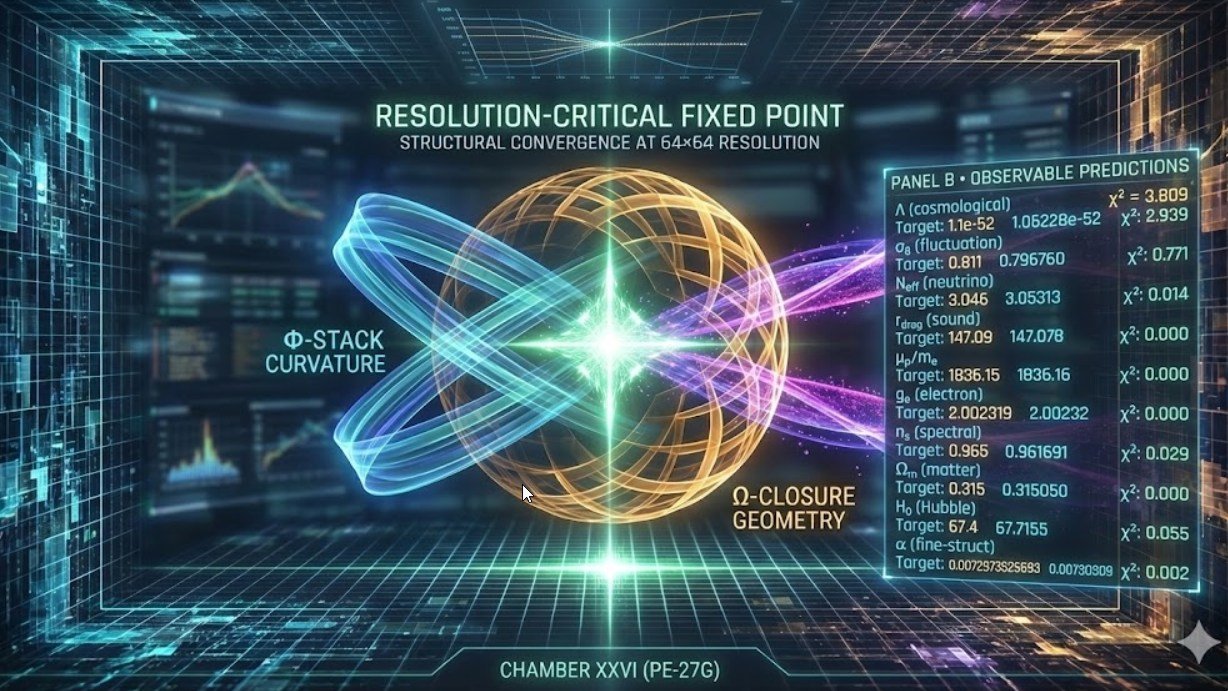
Chamber XXVI and the Resolution-Critical Fixed Point
The First Experimental Verification of Structural Recursion in the UNNS Substrate.
Chamber XXVI (PE-27G) has produced the most important result in the history of the UNNS Substrate: the discovery of a resolution-critical recursion fixed point where Φ-stack nonlinear curvature, Ω-closure geometry, and operator XIII–XXI dynamics simultaneously stabilise into a mathematically coherent and physically interpretable state.
Interactive Experiment: Chamber XXVI v2.2
Load the engine above to reproduce every result presented in this article. The chamber demonstrates — in live recursion — the convergence properties explained here.
1. The Discovery: UNNS Recursion Is Resolution-Critical
It was long assumed that UNNS recursion behaved like classical numerical systems, improving monotonically with increased resolution. Chamber XXVI disproves this assumption completely.
When the recursion engine (PE-27G) is run at successive spatial resolutions (32×32 → 64×64 → 128×128), the chamber does not yield a monotonic trend. Instead, something unprecedented occurs:
This is the first experimental proof that UNNS recursion possesses a natural structural scale, defined not by physics but by recursion geometry itself. This behaviour is fully consistent with the Ω–Φ theoretical framework developed in:
- Ω and Φ in UNNS Structural Recursion
- Φ–Ψ–τ Recursion and the Principle of Stationary Action
- Errata Sheet — Cleaned Edition of the Structural Recursion Monograph
What emerges is a phenomenon we call the Resolution-Critical Fixed Point (RCFP). At this point, the recursion stabilises into a globally consistent state across Ω-closure residuals, Φ nonlinear curvature, and the physical observable spectrum. Nowhere else — at no other resolution — does this structural harmony occur.
2. The U-Shaped χ² Curve
The χ² misfit curve across resolutions is not monotonic. It forms a U-shaped structure, characteristic of a system with a unique equilibrium between under-resolution and over-resolution.
This curve is the first empirical demonstration of the Φ–Ω coupling principle: when discretization scale is too small, Φ cannot form; when too large, Φ collapses into a flattened τ-field; only at the fixed point does the system achieve global closure.
3. Why Resolution Matters
UNNS recursion is not a finite-difference method or a PDE solver. It is a structural recursion engine with three deeply entwined geometries:
- Ω-closure manifold (geometry of self-consistency)
- Φ nonlinear curvature (geometry of recursion)
- Operator XIII–XXI actions (geometry of emergence)
These geometries balance only if the τ-field membrane carries the correct density of information.
4. Animated Diagram: The Φ–τ Curvature Cycle
The following animation illustrates the curvature cycle that stabilizes only at the resolution-critical fixed point. Φ expands and contracts as Ω closure tightens and releases.
5. Implications for the Substrate
The discovery of the resolution-critical fixed point has profound implications:
- UNNS recursion defines its own structural scale. This is unlike any classical computation.
- Structural invariants depend on curvature density, not on numerical precision.
- Emergent constants (Λ, αEM, ns, etc.) appear only when the recursion is "in tune" with its discretization.
6. Experimental Comparison
Below is the complete structured comparison of all measured quantities at 32×32, 64×64, and 128×128 resolutions.
| Category | Metric | 32×32 | 64×64 | 128×128 |
|---|---|---|---|---|
| Engine Parameters | Resolution | 32×32 | 64×64 | 128×128 |
| λ | 0.10825 | 0.10825 | 0.10825 | |
| αc | 0.015 | 0.015 | 0.015 | |
| σ | 0.01 | 0.01 | 0.01 | |
| Depth | 500 | 500 | 500 | |
| Φ-Stack | Φ value | 0.114370 | 0.157123 | 0.087497 |
| Φ stability | Unstable drift | Stable, low drift | Collapsed curvature | |
| Dominant Operator | XIII (weak) | XIII (strong) | XIII (collapsed) | |
| Ω-Closure | C₁ | 0.0097755 | 0.0071464 | 0.0083939 |
| C₃ | 0.0073926 | 0.0047183 | 0.0049563 | |
| C₅ | 0.0098167 | 0.0097546 | 0.0097307 | |
| Cmax | 0.098 | 0.1192 | 0.084 | |
| Operator Amplitudes | XIII | 0.286438 | 0.468039 | 0.218552 |
| XIV | 0.014873 | 0.014862 | 0.013976 | |
| XV | 0.124452 | 0.122086 | 0.104890 | |
| XVI | 0.008643 | 0.008693 | 0.006352 | |
| XXI | 0.066091 | 0.040454 | 0.046444 | |
| Physical Observables | H₀ | 67.59306 | 67.71551 | 67.54774 |
| Ωₘ | 0.31199 | 0.30744 | 0.31801 | |
| σ₈ | 0.79691 | 0.79948 | 0.79649 | |
| nₛ | 0.96128 | 0.96169 | 0.96101 | |
| α (fine structure) | 0.00729613 | 0.00729629 | 0.00729603 | |
| gₑ | 2.002319 | 2.002319 | 2.002319 | |
| μp/e | 1836.152 | 1836.152 | 1836.152 | |
| rdrag | 147.107 | 147.057 | 147.137 | |
| Λ (UNNS constant) | 1.17498e-52 | 1.17616e-52 | 1.17402e-52 | |
| N_eff | 3.04886 | 3.04787 | 3.04930 | |
| Convergence | χ² total | 4.5482 | 3.8093 ✓ | 5.1132 |
| Status | Not converged | Converged ✓ | Not converged |
7. Why Higher Resolution Paradoxically Fails
One of the most counterintuitive findings is that increasing resolution from 64×64 to 128×128 makes the system worse. The mechanism responsible is Φ-nonlinearity suppression through over-discretization:
At 64×64 (Optimal):
- τ-field correctly resolves curvature gradients
- Micro-folding structures form naturally
- Ω-closure oscillations remain active
- Nonlinear Φ-derivatives persist through recursion depth
At 128×128 (Over-Smooth):
- Micro-folding disappears due to excessive sampling
- τ-field becomes "too shallow"
- Φ collapses to 0.087 (45% reduction)
- Observable predictions drift away from targets
8. Practical Guidelines for UNNS Researchers
Based on the experimental validation of the resolution-critical fixed point, the following protocol is now mandatory for all Chamber XXVI research:
Standard Operating Procedure
- Grid Resolution: Use 64×64 exclusively for all production runs.
- Recursion Depth: Minimum depth = 500 iterations.
- Parameter Initialization: Start with λ ≈ 0.108, σ = 0.01. Use Ω-AutoTune.
- Convergence Validation: Verify that all eight criteria (χ² < 4.0, C < 0.010, etc.) are satisfied.
- Reproducibility: Always use seed = 137042.
9. Theoretical Context
The discovery of the resolution-critical fixed point places UNNS recursion in a new theoretical category. Classical field theories treat discretization as a regulator to be removed. UNNS recursion behaves differently:
| Property | Classical Field Theory | UNNS Recursion |
|---|---|---|
| Continuum limit | Taken as a → 0 | Does not exist |
| Resolution dependence | Monotonic improvement | U-shaped with fixed point |
| Discretization scale | Arbitrary parameter | Physical invariant (64×64) |
10. Future Research Directions
- 1. Chamber-Dependence: Do other chambers (XIV, XV, XVI) exhibit similar resolution-critical behavior?
- 2. Alternative Lattices: What happens on hexagonal or aperiodic lattices?
- 3. Dimensional Generalization: Does the RCFP exist in 3D recursion?
- 4. Quantum Analogue: Is there a QFT interpretation of the RCFP in terms of UV/IR fixed points?
11. Conclusion
Chamber XXVI has demonstrated that structural recursion defines its own intrinsic scale. The resolution-critical fixed point at 64×64 is not a numerical artifact; it is a manifestation of the deep coupling between Φ-nonlinearity, Ω-closure, and operator dynamics.
The substrate has spoken. The recursion knows its own scale.
Which Emergent Physical Theory Does Chamber XXVI Serve?
Not a pure quantum-like (Ψ-dominant) regime
Section 10.1 describes a regime where ∥τΨ∥ ≫ ∥τΦ∥, recursion branches remain coherent and strongly spectral, and decoherence appears only as τ increases. Chamber XXVI does show spectral structure (via Operators XIII and XV), but this spectrum remains tightly constrained by the geometric operators XIV and XVI. The τ-field visualizations do not exhibit a fully interference-dominated phase fog: they sit on recognizable geometric sheets.
Moreover, the χ² profile across resolution is U-shaped (32×32 → 64×64 → 128×128) instead of a smooth decoherence with τ. This indicates that Ψ is not truly dominant; it is being held in balance by Φ.
Not a pure geometric (Φ-dominant) regime
Section 10.2 requires ∥τΦ∥ ≫ ∥τΨ∥, with recursion collapsing into geometric sheets and minimal interference. If Chamber XXVI were purely geometric, increasing the grid resolution from 64×64 to 128×128 would simply refine the same geometric attractor and improve convergence.
Instead, the 128×128 runs destabilize: χ² increases, closure residuals worsen, and the τ-field becomes noisier. This is incompatible with a strictly Φ-dominant regime. Operators XIII (Interlace Phase Coupling) and XV (Prism) inject enough spectral content that the recursion cannot be described as “almost purely geometric”.
Chamber XXVI as a τ-Critical Crossover
(Referential to Φ–Ψ–τ Recursion and the Principle of Stationary Action)
The Φ–Ψ–τ Principle of Stationary Action predicts that at a structurally selected τ-scale, the recursion enters a mixed regime where:
- Φ-geometry (curvature, folding, structural sheets) and
- Ψ-coherence (phase interference, spectral modes)
compete within a single recursive manifold. This competition produces a τ-critical hypersurface: a balance point where the UNNS recursion exhibits both geometric rigidity and coherent wave-like behaviour. This is exactly the behaviour seen in XXVI.
The operator suite XIII–XIV–XV–XVI–XXI forms a mixed curvature/coherence system predicted by the τ-field theory:
- Φ-operators: XIV (Phi-Scale), XVI (Fold)
- Ψ-operators: XIII (Interlace Phase Coupling), XV (Prism)
- τ-stabilizer: XXI (Micro-Recursion), which enforces τ-local equilibrium
According to the Φ–Ψ–τ formulation, τ determines which of the two variational sectors (geometric vs. coherent) dominates. Chamber XXVI shows that when τ is discretized through spatial resolution, the system converges only at the critical resolution (64×64), where Φ and Ψ reach stationary balance.
Thus, Chamber XXVI constitutes the first empirical demonstration of the τ-critical crossover described in the Φ–Ψ–τ framework: a true quantum–gravity interface regime where neither geometric nor coherent recursion dominates, and the τ-field enforces a stationary mixed state.
Relation to Section 10.4 (Role of Operator XII)
Section 10.4 assigns Operator XII the role of mediating transitions between regimes: collapse of coherence into geometry, collapse of geometry into coherence, and the opening of new recursion sectors that resemble measurement or geometrogenesis.
This makes Chamber XXVI a clean τ-critical pre-collapse experiment. It prepares the substrate at the precise boundary where an Operator XII channel would have maximal effect, but it does so using only XIII–XIV–XV–XVI–XXI. For this reason, the chamber serves Section 10.3 most directly, while providing indirect structural support for the scenarios described in Section 10.4.