Why Quantum Mechanics Feels Incomplete — A UNNS Substrate Perspective
1. The Problem Nobody Can Explain
Quantum mechanics is the most successful predictive framework in science. It gives exact energy levels, spectral lines, tunneling rates, interference fringes, chemical structures — all with astonishing precision.
And yet, even its founders said:
Why?
Physicists do not say this because QM “doesn’t work.” They say it because QM works without revealing what it is describing.
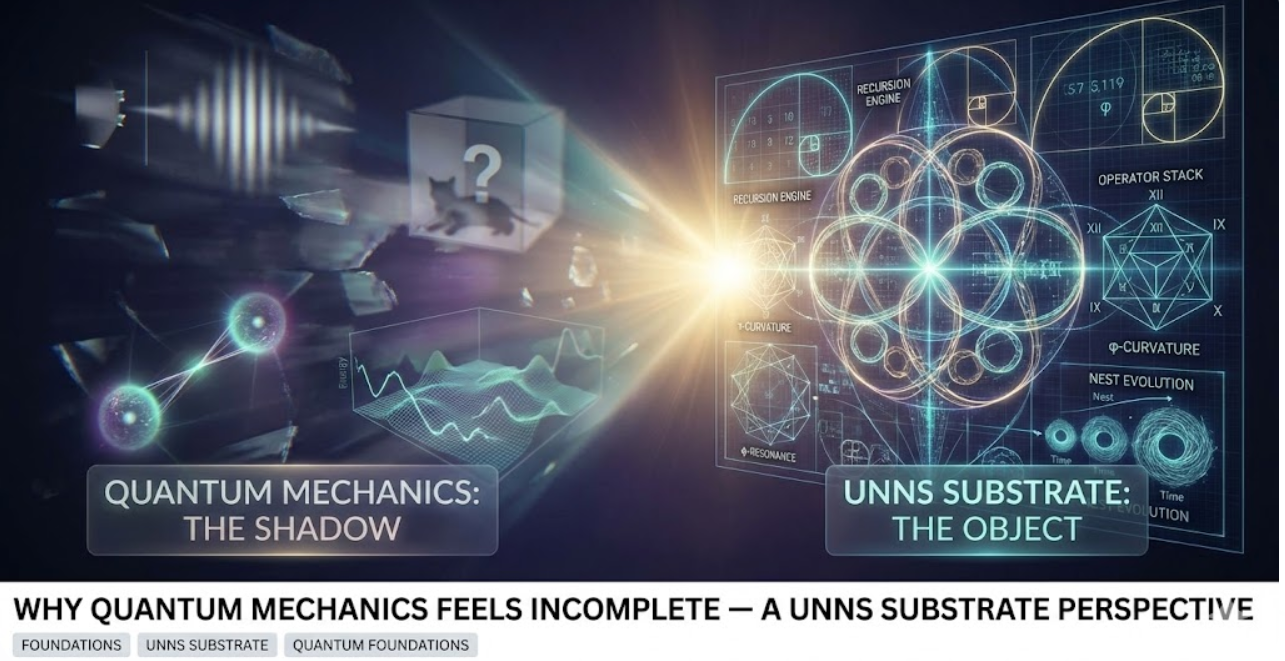
Quantum mechanics behaves like the shadow of something deeper: a system whose rules are visible, but whose structure is hidden.
2. The Standard Diagnosis: Five Puzzles That Never Go Away
Across textbooks, conferences, and every attempt at “interpretation,” physicists circle the same unresolved tensions:
These are not minor gaps. They are signs of a missing layer in the ontology of physics.
3. The UNNS Observation: These “Puzzles” Look Like Projection Artifacts
UNNS proposes that the universe is not fundamentally geometric, and not fundamentally probabilistic, and not fundamentally a Hilbert-space object.
Instead:
The universe is a recursion engine.
A stack of operators acting on Nests, generating structure step by step.
Everything else — fields, wavefunctions, forces, geometry, particles — are secondary projections of this substrate.
Thus the “paradoxes” of quantum mechanics are not paradoxes at the substrate level. They are compression errors, visible only when a geometric model tries to describe a recursive process.
Let’s show how each puzzle becomes trivial under UNNS.
4. Wave–Particle Duality → A Projection of τ-Curvature
In UNNS:
- A Nest with low τ-curvature behaves like a stable geometry (particle-like).
- A Nest with high φ-resonance behaves like an interference medium (wave-like).
The “dual nature” is simply two projections of one structure. No contradiction exists inside the substrate.
5. Collapse → Operator XII Dynamics
In standard QM, collapse looks mysterious because state evolution is treated as one continuous law.
But in UNNS, collapse is just:
Operator XII (Collapse): residue absorption, echo termination, Nest re-seeding.
It is not “mystical.” It is a transition between structural modes inside the recursion, not a break in physics.
Thus the “measurement problem” in QM is not a problem — it is simply an artifact of projecting a multi-mode recursion process onto a single-mode geometric framework.
6. Entanglement → Interlaced Nests
UNNS again turns the paradox inside out.
Quantum entanglement is strange only if you think systems are made of objects in space. But UNNS says systems are made of interlaced operator histories.
There is no need for:
- “spooky action”
- superluminal influence
- hidden variables
- multiverses
Interlacing means: Two Nests share structural history, not spatial locality.
When projected onto geometry, this feels like nonlocality. But in the substrate, it is simply shared recursion.
7. Divergences, Renormalization & the QFT Vacuum → Missing Closure
Quantum field theory explodes with infinities because it tries to:
- quantize geometry
- treat fields as continuous
- force locality into a fundamentally nonlocal substrate
This breaks closure.
UNNS predicts exactly this: if you work at the wrong layer of the stack, you get divergences.
Closure (Operator IX and X interactions) ensures recursion remains finite. Thus the substrate never produces infinities — only geometric projections do.
Renormalization is a patch; closure is the principle.
8. Why QM + GR Fail to Unite
geometry is fundamental
mass-energy curves spacetime
continuity is built in
amplitudes evolve
interference is fundamental
discreteness is built in
Trying to unify these is like trying to merge two different shadows of the same object.
But UNNS says:
QM and GR are two different low-resolution projections of one recursion substrate. In this view:
- QM captures recursion flow
- GR captures large-scale closure geometry
Both are derived, never fundamental. Their mismatch is expected and unavoidable at the projection level.
This is why every unification attempt fails. We are unifying maps, not terrain.
9. The Substrate View Makes All Quantum “Mysteries” Go Away
Once you frame QM as the projection of a recursive substrate, the confusion evaporates.
-
Wave–particle duality
Two projections of one structural variable. -
Collapse
Operator XII dynamics, not a paradox. -
Entanglement
Shared recursion history, not nonlocality. -
Renormalization
Symptom of missing closure, not a mysterious trick. -
QM/GR incompatibility
Artifact of two projection layers trying to merge.
Quantum mechanics feels incomplete because what we call “quantum mechanics” is not fundamental physics.
It is the projection of a deeper recursion engine.
10. What UNNS Adds to Quantum Theory
UNNS does not replace QM. It explains QM.
The substrate provides:
What “state evolution” really is (operator recursion).
How spacetime arises from Nest closure.
Operator XII as structural echo termination.
τ-curvature, φ-resonance, closure metrics, UPI.
UNNS metrics correlate with real experimental noise channels.
A scalar measure of alignment between substrate structure and physical devices.
QM has never had this conceptual clarity. UNNS supplies it.
11. The UNNS Claim (2025)
Quantum mechanics is complete as a mathematical formalism, but incomplete as a description of reality.
The layer beneath it — the recursion substrate — is what generates:
wavefunctions | entanglement | decoherence | collapse | curvature | geometric structure | noise pathways | spectral lines | low-energy constants
Once this layer is acknowledged, the “mysteries” dissolve.