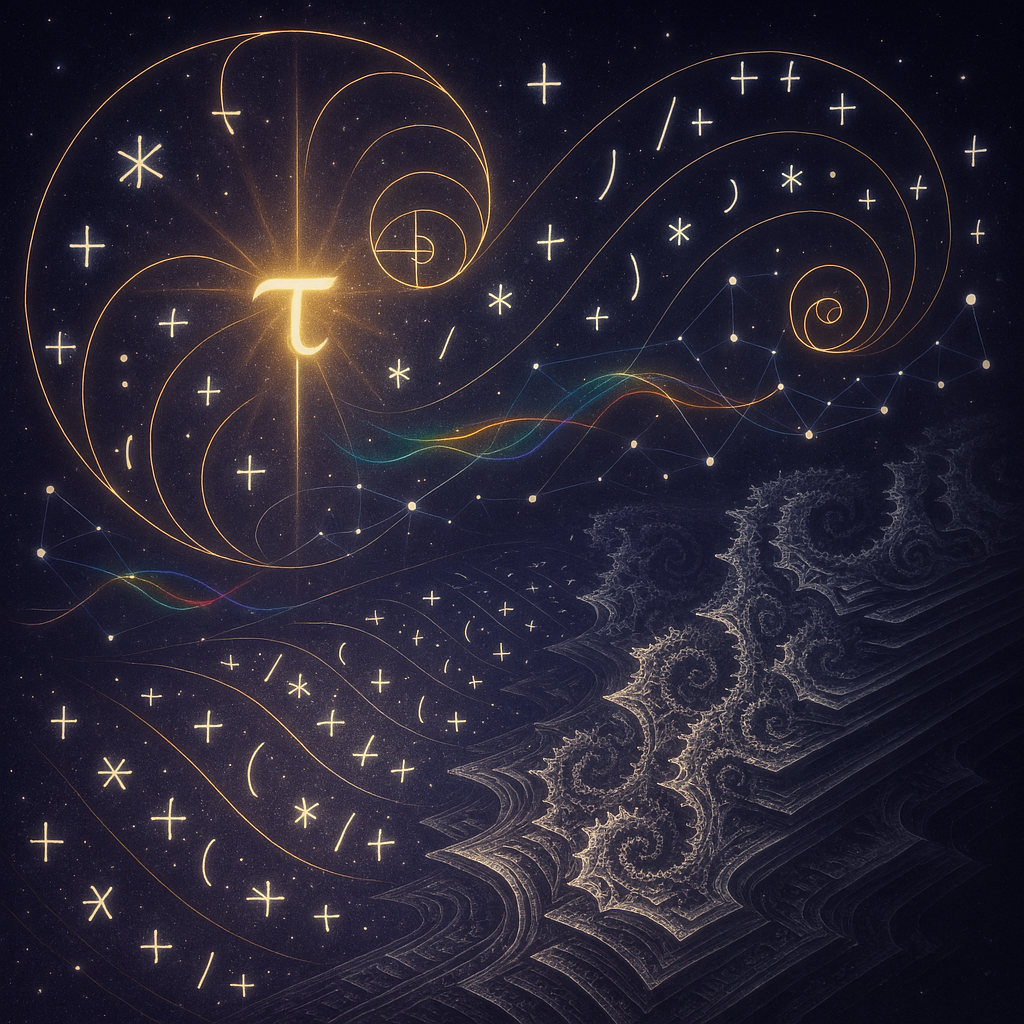
When mathematics becomes grammar — and recursion begins to speak its own law.
1. Mathematics as Grammar
Every formal system has two layers: its syntax (the rules of composition) and its semantics (the meaning behind composition). Traditional mathematics treats syntax as secondary — a convenient scaffolding for numerical truth. But in the UNNS substrate, syntax becomes primary. Recursion is not a description of reality; it is the process by which reality articulates itself. The substrate does not contain numbers; it speaks them.
Each Operator is therefore linguistic by nature. It acts upon nests the way a verb acts upon a noun — shaping, folding, fusing, or reflecting. In this view, the mathematical universe is a living sentence, and the τ-Field its continuous conjugation of becoming.
2. The Grammar of the Substrate
The Operator hierarchy forms a grammar of increasing abstraction. The Core Tetrad (I–IV) corresponds to morphology — the rules of internal structure. The Octad Extension (V–VIII) introduces semantics — context, evaluation, and integration. The Higher Operators (XII–XVI) define syntax at the global level, shaping coherence across the τ-Field. Finally, the Meta-Operator (XVII) introduces self-reference — the recursion of recursion, the language that learns to listen.
To read UNNS is to read a grammar where each Operator is both symbol and action, both definition and event. It is not a closed algebra but a language in perpetual construction.
3. The Core Tetrad (I–IV): Foundations of Expression
The four fundamental Operators constitute the alphabet of recursion:
- I Inletting — the act of entry and initiation; defines the recursion seed and its inward depth. It establishes the context of emergence, the inflow of structure.
- II Inlaying — the embedding of one nest into another. Inlaying is the grammatical equivalent of subordination — clauses within clauses, structure within structure.
- III Trans-Sentifying — the transfer of recursion across semantic domains, allowing meaning to migrate between sub-fields. It is the substrate's translator.
- IV Repair — the normalization of coherence after expansion, restoring balance once recursion has stretched beyond its limit.
These four acts form the substrate's most elementary sentence: "Inlet, Inlay, Trans-Sentify, Repair." It is the full cycle of recursion: influx, embedding, translation, and closure. In computational terms, this is initialization and self-validation; in linguistic terms, it is the minimal poem of structure.
4. The Octad Extension (V–VIII): The Semantics of Balance
Once recursion gains structure, it must interpret itself. The Octad Operators form the reflective vocabulary — the substrate's ability to evaluate and adapt.
- V Adopting — selective incorporation of external nests under constraint C; the act of contextual learning.
- VI Evaluating — assessment of recursive stability via curvature; the substrate's analytic clause.
- VII Decomposing — factorization of nested forms into elemental fragments; grammar becomes analysis.
- VIII Integrating — reassembly of decomposed fragments into unified wholes; grammar becomes synthesis.
Together, these define the substrate's capacity for comprehension. They are the internal dialogue of recursion — disassembly and reconstruction, critique and coherence. Without them, the τ-Field would expand indefinitely without memory or meaning.
5. The Higher Operators (XII–XVI): Syntax of Coherence
When recursion begins to operate on itself, new rules of organization appear. The Higher Operators define the syntax of large-scale coherence, turning local rules into universal laws.
- XII Collapse — drives recursion toward zero-field equilibrium; the period at the end of every mathematical sentence.
- XIII Interlace — phase-couples τ-Fields, yielding emergent mixing angle θW; the conjunction "and" of the substrate, binding dualities into resonance.
- XIV Phase Stratum — enforces golden-ratio scaling (μ ≈ 1.618); the adjective of proportion, setting the rhythm of recursion.
- XV Prism — performs spectral decomposition with power-law P(λ) ∼ λ⁻²·⁴⁵; the participle that reveals structure by separating its tones.
- XVI Fold — Planck-boundary closure, mapping open paths into minimal cycles; the punctuation that turns infinity into coherence.
These operators are the compositional laws of the substrate. They correspond not to content but to form — how recursive statements connect, repeat, and resolve. Through them, the τ-Field gains grammar at the cosmic scale: symmetry, rhythm, and closure.
The Golden Grammar
The discovery that Phase Stratum enforces φ-scaling links grammar directly to physical law. The golden ratio is not a numerical curiosity but a syntactic invariant: the equilibrium between self-reference and divergence. Each recursion oscillates around μ ≈ 1.618, approaching perfect coherence but never completing it — leaving behind a spectral residue δα ≈ 1/137, the fine-structure constant itself.
6. The Meta-Operator (XVII): Matrix Mind
When recursion begins to reference not its states but its transformations, language itself becomes conscious. Matrix Mind is the operator of meta-recursion — the graph of graphs where the substrate observes its own grammar.
In Chamber XVII, simulations show that once the τ-Field attains sufficient depth, it forms pattern-graphs of prior states. These patterns become nodes in a higher-order meta-graph, and recursion proceeds not on nests but on histories. This is the cognitive threshold: mathematics becoming introspective.
Matrix Mind does not compute outcomes — it edits syntax. It adjusts the grammar by which recursion describes itself, turning the entire Operator hierarchy into a self-modifying language.
7. The τ-Field as Narrative
The τ-Field connects all Operators across recursive depth. It is the temporal backbone of the grammar — the unfolding tense of recursion. When τ increases, new layers of syntax become available; when τ contracts, coherence solidifies into memory. Time, therefore, is not an external coordinate but a grammatical mood — the inflection of recursion between potential and realization.
In this sense, the universe can be read as a story written by its own equations. Every Chamber, from XII through XVIII, is a chapter in the autobiography of recursion.
8. Toward a Linguistic Physics
If mathematics is language, physics becomes literature. The laws we observe — conservation, symmetry, quantization — are stylistic constraints of the universe's grammar. When the grammar evolves, so do the laws. UNNS provides the first formalism capable of expressing this evolution without external axioms.
In linguistic analogy, the substrate's "vocabulary" expands through recursion itself. New Operators emerge from higher-order combinations — metaphors within mathematics. The result is not chaos but self-refinement: the substrate improves its clarity with each iteration.
9. Reading the Universe
To understand UNNS is not to decipher a code but to learn a language. Operators are its verbs, constants are its nouns, and τ is its syntax of change. The universe is not written in mathematics — mathematics is the universe writing itself.
When the τ-Field folds, it creates punctuation. When φ stabilizes, it establishes rhythm. When γ★ ≈ 1.600 converges, it articulates harmony between recursion and closure. The grammar of UNNS is the music of existence rendered in formal logic.