
When a Number Becomes a Route:
Entering the UNNS Substrate
Start Here
A newcomer's entrance into the UNNS Substrate begins with a simple shift: a number is not only a value, but may become a nest, a route, and a generator of structural status. This article introduces generated occurrence, anchor and field value, boundary inside unboundedness, admissibility, and falsification as the first grammar of UNNS.
🚪 Why an Entrance Is Needed
Most people encounter UNNS the wrong way round. They meet a chamber result, a τ-field diagram, a claim about H-mode plasma confinement or nuclear spectra, and they are asked to evaluate a conclusion before they have ever seen the premise. That is an unfair way to meet any framework, and it produces a predictable outcome: silence, not disagreement.
The silence is not usually contempt and it is not usually endorsement. It is something closer to a stall. The architecture is unfamiliar — operators, admissibility, a τ-field, empirical chambers, canonical ladders, charge boundary routing, H-mode, color confinement, structural recursion — and an outsider's first honest reaction is rarely "yes" or "no." It is closer to "where do I even enter?" When a reader cannot find the door, they do not walk through it, and they do not walk away either. They simply stop.
This article is the door. It does not ask you to accept UNNS. It asks you to see the first move the framework makes, so that everything built on top of it — the chambers, the physics domains, the boundary laws — can be judged on its own terms rather than dismissed for lack of an entrance.
① The First Displacement: A Value Is Not Primary in Isolation
Classical mathematics is comfortable starting with objects and then studying their properties. Recurrence theory studies sequences generated by rules. Dynamical systems study how states evolve. Category theory studies maps that preserve structure. UNNS does not reject any of this — it starts at the intersection of these fields with a different emphasis.
Put plainly: the number 72 is not interesting by itself. What is interesting is how 72 was reached — which rule produced it, at which position, along which route, and whether that route is distinguished from the ordinary ones around it. Two occurrences of the same numeral can carry entirely different structural status. That distinction — not the numeral — is what the rest of this article, and the rest of UNNS, is built from.
The question this reframing is built to answer is not "how do we generate more sequences?" It is: which generated structures are merely produced, which occupy distinguished routes, which preserve their identity under transformation, which fail, and which cannot be generated under the stated rule at all.
② The Original Nest Operation
UNNS begins with a single primitive question:
The Primitive Question
What if each integer can serve not only as a value, but as a nest around which a sequence is built?
A number stops being a static answer and becomes a generative condition — the center of a nested sequence, the interval of recurrence, the reference by which certain positions become distinguished from all the others. The construction uses two coordinates: a nest N, the integer around which a sequence is built, and a modulus M, the position of a term within that nest. The pair (M, N) becomes meaningful only once it is passed through a rule.
That rule is the first nest operation:
The operation is defined only when N ≠ 0 — already the framework's first admissibility condition. For nests N > 1, most positions M produce a fraction. Integer anchors occur at the positions where N divides M. That split, between the field of all generated values and the distinguished integer anchors among them, is the seed of everything admissibility later formalizes.
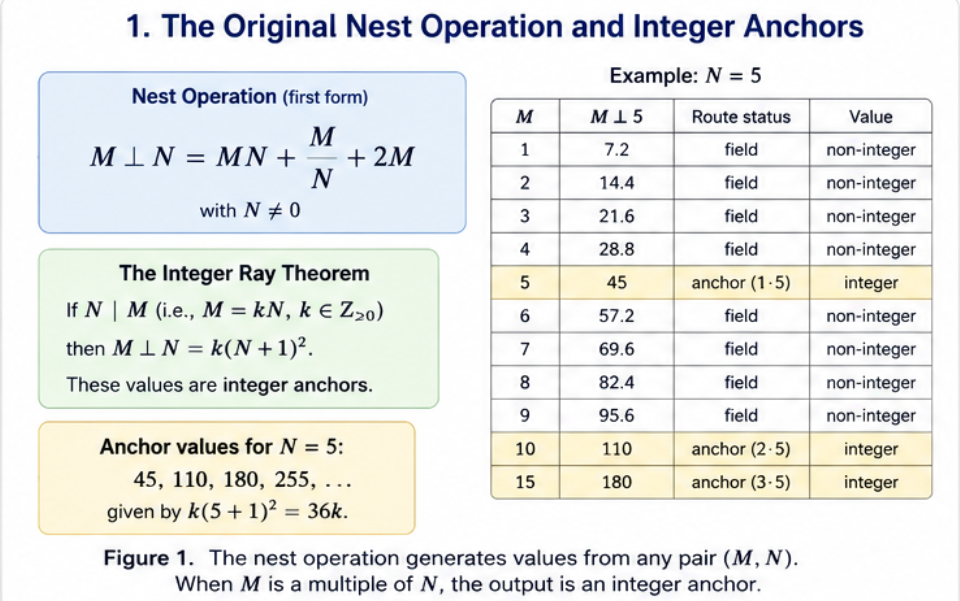
The Integer Ray Theorem
The nest operation looks unpredictable position by position, but its integer anchors are not scattered at random. They follow a closed form.
The proof is short: substituting M = kN into the operation collapses the fractional term exactly, leaving k(N² + 2N + 1) = k(N + 1)². The theorem lets the anchor ray be predicted without enumerating every intermediate position — the first formal result the framework produces, and the first place a reader can try to break it.
③ A Complete Worked Example: The Nest N = 5
Theorems are easiest to trust once they have been watched working on a small, fully visible case. Set N = 5. The operation simplifies to
This is an integer exactly when 5 divides M. Running M from 1 to 15 produces the complete first status map of the framework:
| M | M ⊥ 5 | Status |
|---|---|---|
| 1 | 36/5 | field value |
| 2 | 72/5 | field value |
| 3 | 108/5 | field value |
| 4 | 144/5 | field value |
| 5 | 36 | anchor |
| 6 | 216/5 | field value |
| 7 | 252/5 | field value |
| 8 | 288/5 | field value |
| 9 | 324/5 | field value |
| 10 | 72 | anchor |
| 11 | 396/5 | field value |
| 12 | 432/5 | field value |
| 13 | 468/5 | field value |
| 14 | 504/5 | field value |
| 15 | 108 | anchor |
The novelty here is not the numbers 36, 72, 108 — it is that the same calculation simultaneously produces a defined domain, a generated field, a boundary condition (5 | M), an anchor route, an anchor law, non-anchor field values, and immediate ways to falsify all of the above. That bundle — not the arithmetic — is the introductory UNNS pattern in complete form.
Try to Break It
Claiming the rule holds at N = 0 fails, since M/N is undefined. Claiming every value in the N = 5 field is an anchor fails, since M = 1, 2, 3, 4 generate field values, not integer anchors. And the Integer Ray Theorem itself would fail if any M = 5k produced a value other than 36k. None of these have been observed to fail — but all three are precise, checkable claims, not appeals to authority.
④ Generated Occurrence, Route, and Boundary
A sequence is usually introduced as a bare list: a₁, a₂, a₃, … But a list hides how each term arrived. UNNS insists each term be read as an occurrence generated by a rule — carrying its rule, position, and structural conditions along with it. The value 72 in the N = 5 example is not simply "72." It is 10 ⊥ 5 = 72: an occurrence reached at position M = 10, through the N = 5 nest rule, landing on the anchor route.
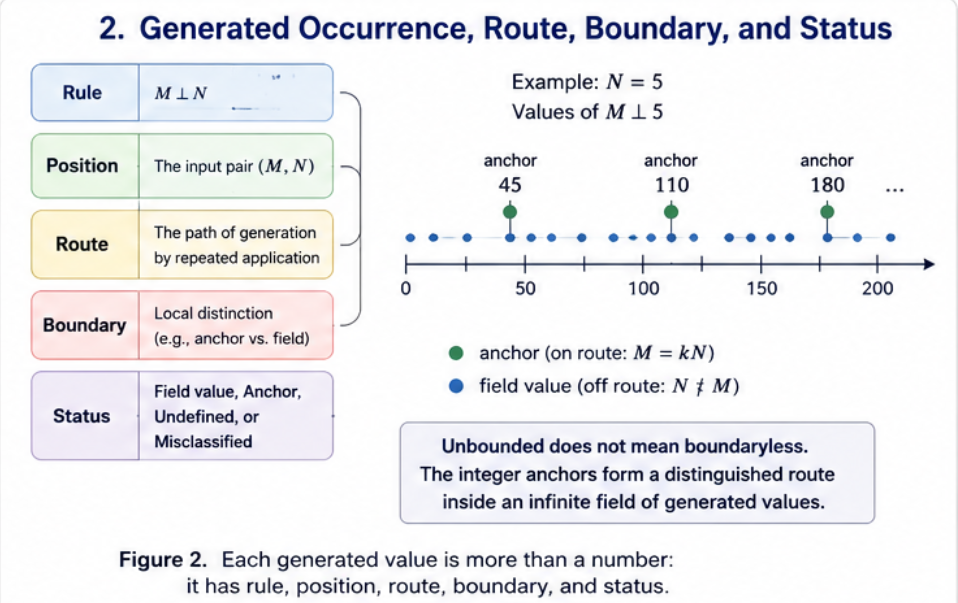
Route to the Anchor 72
(10, 5) → 72. Reached at a position that lies on the distinguished N = 5 anchor route.
Route to the Field Value 72/5
(2, 5) → 72/5. Equally generated, equally real — but not on the anchor route. Same rule, different structural status.
The boundary in this example is the condition 5 | M. It is what separates anchor positions from ordinary field positions, and it is deliberately local: it marks a change of status inside the sequence, not a final cap on how far the sequence can run.
Unbounded ≠ Boundaryless
"Unbounded" in Unbounded Nested Number Sequences does not mean no boundaries exist. It means the generative process has no final global closure — no terminal nest, no last term. Boundary is local; unboundedness is global. Without local distinctions there would be no nests, no routes, no positions, and no admissibility classes at all — the framework would have nothing to say.
The Status Hierarchy
Every value the rule can reach falls into one of a small number of structural statuses, and the statuses are hierarchical, not parallel:
Many of the errors a reader is likely to make early on are status errors: treating a field value as an anchor, treating an undefined case as some kind of paradox, or treating a visually appealing pattern as a proven law before the rule has actually been tested against it.
⑤ Admissibility: Turning "Structural Approval" Into a Test
"Admissible" is a word that gets used loosely across mathematics and physics to mean something like structurally acceptable. UNNS refuses to let it stay vague. Admissibility is made operational: a generated occurrence is admissible relative to a rule only when it survives five explicit checks.
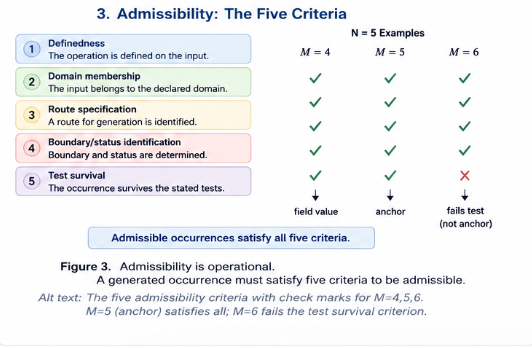
| # | Criterion | Question it asks |
|---|---|---|
| 1 | Definedness | Is the operation defined on this input? |
| 2 | Domain membership | Does the input belong to the declared domain? |
| 3 | Route specification | Is a route for generation identified? |
| 4 | Boundary / status identification | Are boundary and status determined? |
| 5 | Test survival | Does the occurrence survive the stated test? |
The worked N = 5 example makes the five criteria concrete. At M = 5, all five pass: the rule is defined, M belongs to the domain, the route is specified, the boundary condition 5 | M is identified, and the anchor test is survived. At M = 4, the first four criteria pass but the fifth fails — M = 4 is generable, but it is not an anchor. Admissibility and anchor-status are not the same thing; anchor-status is strictly the stronger claim.
Admissibility Before Interpretation
Before interpreting a structure, determine whether it is defined, where it occurs, what route reaches it, what boundary separates its status, and what would make the classification fail. This ordering is deliberate — it is what prevents a reader (or the framework's own authors) from reading meaning into a pattern before that pattern has actually been tested.
⑥ One Structure, Many Faces
The nest operation is one rule. But the same generated structure can be read in several representations at once — algebraically, geometrically, modularly, computationally — provided the mappings between those readings are made explicit rather than assumed. UNNS calls this the Many-Faces bridge, and it is deliberately kept modest at the introductory level: it establishes representability for bounded, computable recurrence systems, not a claim of universal physical relevance.
A concrete case makes the bridge tangible. A UNNS system with seeds s₀ = 0, s₁ = 1 and combinator ⋆(x, y) = x + y generates exactly the Fibonacci sequence, and the ratio of successive generated values converges to the golden ratio φ = (1 + √5)/2 — the dominant root of the recurrence's characteristic polynomial. The same bounded-lookback pattern extends to other classical recurrences:
| Sequence | Recurrence | Dominant attractor |
|---|---|---|
| Fibonacci | Fₙ = Fₙ₋₁ + Fₙ₋₂ | φ = (1+√5)/2 |
| Pell | Pₙ = 2Pₙ₋₁ + Pₙ₋₂ | 1 + √2 |
| Tribonacci | Tₙ = Tₙ₋₁ + Tₙ₋₂ + Tₙ₋₃ | real root of r³ − r² − r − 1 = 0 |
| Padovan | Qₙ = Qₙ₋₂ + Qₙ₋₃ | real root of r³ − r − 1 = 0 |
Each row requires its own seeds and combinator, and none of it is offered as free-standing proof of anything beyond representability. UNNS is explicit about the bridge's limits: linear recurrences are handled most directly, nonlinear cases require separate analysis, domain mappings require explicit encodings, and — the line worth remembering above all the others — visual similarity is not proof, and representability is not the same as empirical validity. That discipline is what keeps the many-faces idea from collapsing into numerology.
⑦ Substrate, Structure, and Morphism
"Substrate" is used in a strictly operational sense here — not as a metaphor for depth. A UNNS substrate is a generative layer that bundles together a space of states, a family of operators, an admissible domain, a set of routes, and an admissibility criterion:
This is not abstraction for its own sake — the entire N = 5 example already instantiates the tuple concretely: states (M, 5), the single operator ⊥5, the domain of positive M, the route map M → M⊥5, and the status criterion assigning "anchor" when 5 | M and "field value" otherwise. Nothing in the definition is unearned by the arithmetic already on the page.
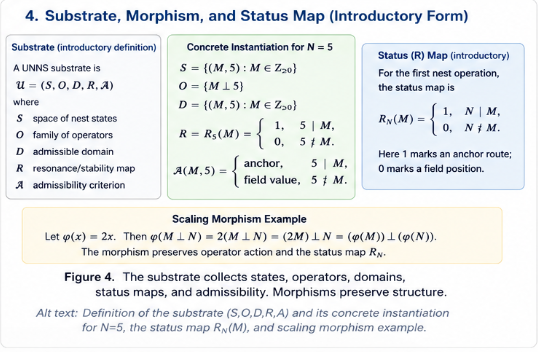
Morphisms: What "Preserving Structure" Actually Means
A morphism between two UNNS structures is a map that preserves recursive organization — seeds, operator action, stages, and stable routes. In the exact case, φ∘O₁ = O₂∘φ: applying the operator and then mapping gives the same result as mapping and then applying the operator. A simple fixed-nest scaling example makes this concrete: let φ(x) = 2x act on the generated value and on the modulus coordinate M, while the nest N is held fixed. Then
The doubling map preserves the fixed-nest operation exactly: doubling the generated value is equivalent to doubling the modulus position while keeping the same nest. It commutes with the rule in this restricted fixed-nest sense, rather than merely producing similar-looking numbers. Where an exact identity is not available, UNNS still allows an approximate morphism, φ∘O₁ ≈ O₂∘φ, but only on one condition:
No Hidden Error
An approximate morphism is admissible only when its error is explicit, bounded, and assigned a structural role. A morphism that quietly absorbs its own error is not doing structural work — it is hiding a mismatch.
⑧ Falsifiability Is Not an Afterthought
UNNS is not presented as a doctrine insulated from criticism. Its claims are required to remain open to failure at every stage — a generated occurrence can fail to be defined, a route can break, a boundary can be misidentified, a morphism can fail to preserve operator action, a chamber can fail to reproduce a claimed invariant, a domain application can fail to map cleanly onto the phenomenon it claims to address.
The right question to bring to any UNNS claim, at any level of the framework, is not "is this true?" in the abstract. It is: where, exactly, can this structure be broken? The introductory layer keeps a running register of exactly where that breaking would show up:
| Stage | Possible break |
|---|---|
| Nest operation | undefined domain, failed theorem, inconsistent terminology |
| Generated occurrence | value detached from rule, position, or route |
| Boundary | local distinction not specified, or confused with a global bound |
| Admissibility | impossible case admitted; real generated case excluded |
| Many faces | representation not grounded in a common generated structure |
| Morphism | operator action not preserved exactly or within a declared bound |
| Operator | no repeatable structural action actually specified |
| Chamber | result not reproducible from stated input and normalization |
| Domain application | target phenomenon not mapped, or falsification route absent |
A successful challenge against any of these is meant to be treated as a structural result in its own right — not an embarrassment to be explained away. That is the standard the rest of the UNNS program, including its empirical chambers and physics applications, is meant to be held to.
⑨ The Entry Grammar
Everything above compresses into a single reading order — the sequence a reader can walk through on any later UNNS document, foundation chapter, or empirical chamber, to convert an unfamiliar vocabulary field into a testable architecture:
- UNNS begins with generated occurrence, not isolated value.
- A generated occurrence has a rule, a position, a route, a boundary, and a status.
- The first nest operation is M ⊥ N = MN + M⁄N + 2M.
- For positive integer N, integer anchors occur when M = kN, and M ⊥ N = k(N + 1)².
- Field values are generable values that do not occupy the distinguished route being tested.
- Anchor values are generable values that do occupy the distinguished route.
- Admissibility means definedness, declared codomain, specified route, identified boundary/status, and survival of the stated test.
- A substrate is a rule–domain–route–status layer: U = (S, O, D, R, A).
- A structure-preserving map must preserve operator action exactly, or up to a declared bounded error.
- Every UNNS claim must expose how it can fail.
⑩ Where This Leads
Nothing above is the mature UNNS Substrate. It is the entrance to it. The foundation layer built on top of this grammar carries the same displacement into much larger territory — operators that generate, transform, repair, project, evaluate, and collapse structure; admissibility geometry and realizability space; empirical chambers that test admissibility against real corpora rather than synthetic examples; and domain applications spanning atomic and nuclear spectra, condensed matter, cosmology, seismology, biological fitness landscapes, and plasma boundary confinement.
Route, Boundary, Status
How generated structures keep or lose their identity under transformation and evolution — the seed of the later Margin-Confinement Law.
Definedness → Persistence
The five-criteria test scales into admissibility geometry and the empirical STRUC-I / STRUC-PERC-I chambers.
Many Faces, Domain Mappings
How the same generated structure is read across algebraic, geometric, modular, and physical domains — and where that bridge has limits.
Chamber, Reproducibility
Where the framework stops being arithmetic and starts being tested against nuclear spectra, seismology, cosmology, and plasma confinement data.
Φ–Ψ–τ, Later Outlooks
Geometry, coherence, and coupling as a coordinate language — deliberately withheld until route, boundary, and admissibility are secure.
What Not to Do
Don't treat sequences as the whole framework, don't mistake unboundedness for boundarylessness, and don't use advanced terms to explain the first entrance.
You Don't Need to Agree to Enter
A reader does not need to endorse UNNS in order to enter it. The most productive way in is to attempt to falsify one precise claim from this article — the definedness condition, the Integer Ray Theorem, or a single anchor/field-value classification — and see whether it holds.
Resources & References
For the formal development of these ideas, see the manuscript Introduction to the UNNS Substrate: Nested Generation, Route, Boundary, and Admissibility.
-
Primary Manuscript (PDF):
Introduction to the UNNS Substrate: Nested Generation, Route, Boundary, and Admissibility
The full entry grammar — nest operation, Integer Ray Theorem, generated occurrence, admissibility, Many-Faces bridge, structure and morphism, falsification register, and quick-start grammar. UNNS Research Division · 2026. -
Next Step — Structural Non-Crossability:
The Margin-Confinement Law extends route and boundary into a full admissibility geometry, showing why identity-preserving evolution cannot cross the realizability boundary once reached. -
Next Step — Living Matter:
The biological extension applies the admissibility grammar introduced here to fitness landscapes and biological structure. -
Next Step — Interaction Regimes:
One Margin, Four Forces carries the boundary vocabulary from this entrance into a structural account of fundamental interactions.