
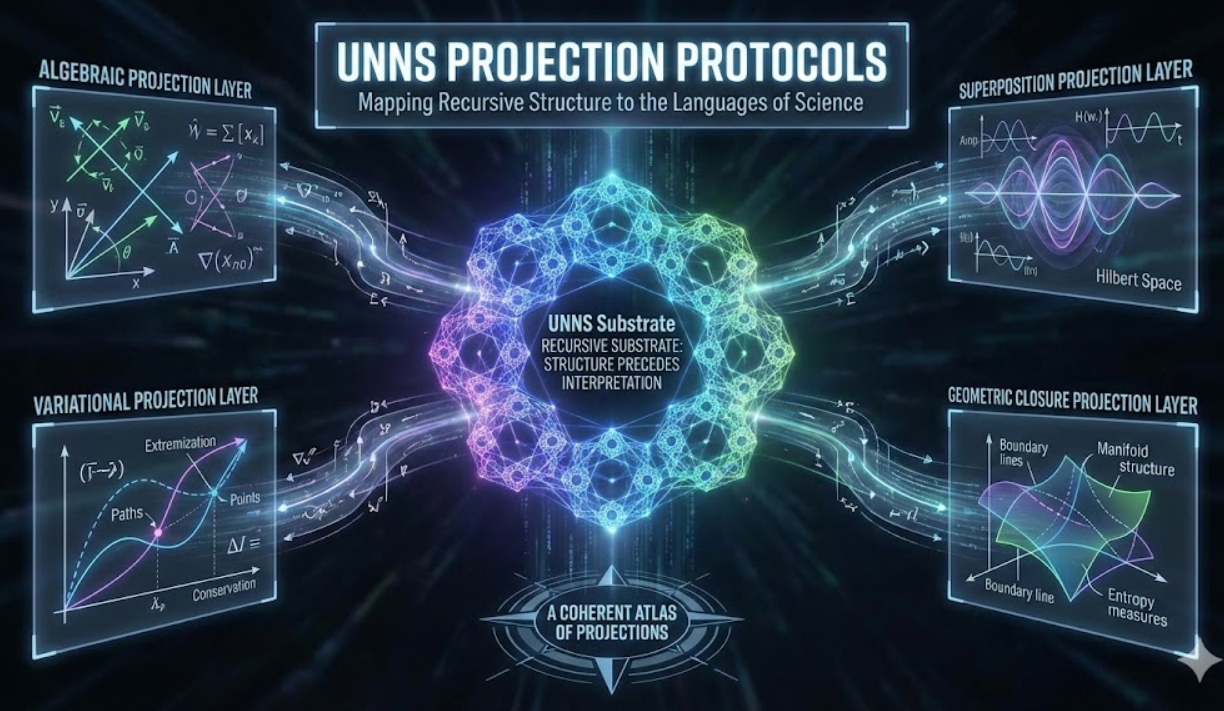
Mapping Recursive Structure to the Languages of Science
Introduction
The UNNS Substrate begins with a simple premise:
structure precedes interpretation.
Before equations describe forces, before geometry becomes spacetime, before probability becomes prediction, there exists a deeper layer of organization — a recursive substrate from which formal structures can be constructed, projected, and tested for stability.
The UNNS Projection Protocols document this process.
They present a systematic way to map recursive structures into the mathematical languages commonly used across science — linear algebra, variational principles, Hilbert spaces, and geometry — while preserving the internal invariants of recursion itself.
What emerges is not a single theory, but a coherent atlas of projections:
a disciplined method for exploring how complex formal systems arise from discrete recursive foundations.
From Recursion to Formal Structure
At the core of UNNS lies a recursively generated substrate: nested numerical processes governed by operator relations rather than axioms imposed from above.
The Projection Protocols ask a specific question:
What formal structures can be constructed from recursion without breaking its internal consistency?
Each protocol represents a mapping step — not an assumption — from recursive relations to increasingly expressive mathematical frameworks.
Projection is not reduction
Projection does not simplify recursion; it organizes it.
Each mapping preserves certain invariants while suppressing others, revealing which structures remain
stable under transformation.
The Four Projection Layers
The protocols are organized into four conceptual layers, each corresponding to a class of formal language.
1. Algebraic Projection Layer
Vectors, tensors, and operator spaces
The first projection maps recursive sequences into vector spaces.
This introduces linear structure without assuming continuity or geometry.
Recursive elements become basis states.
Operator composition becomes algebra.
This layer enables:
- Superposition
- Operator chaining
- Structural comparison across systems
It is the minimal language required to talk about recursion relationally rather than sequentially.
Algebraic Projection
2. Variational Projection Layer
Action, constraint, and curvature
Once operators interact, structure acquires tension.
The variational projection introduces principles of extremization — not as physical laws,
but as organizational constraints.
Recursive paths are compared by consistency rather than cost.
Curvature arises from non-commuting operations.
This layer introduces:
- Action-like functionals
- Conservation-like invariants
- Structured evolution of recursive states
3. Superposition Projection Layer
Hilbert spaces and path structures
The third projection organizes recursion into superposition spaces.
Here, recursive alternatives coexist.
Histories are summed, not selected.
Operators act as transitions rather than instructions.
This layer provides the formal machinery for:
- State amplitudes
- Interference patterns
- Global consistency across recursive trajectories
It is the most expressive projection — and also the most delicate.
4. Geometric Closure Projection Layer
Curvature, boundaries, and collapse
The final projection addresses closure.
When recursive growth encounters incompatible constraints, geometry emerges as a
record of tension.
Boundaries encode information.
Collapse marks the loss of admissible extensions.
This layer introduces:
- Discrete curvature analogues
- Boundary–bulk relations
- Entropy-like measures of recursive complexity
Closure and Projection
Why Projection Protocols Matter
The importance of the UNNS Projection Protocols lies not in any single mapping, but in the method itself.
- A reproducible way to move between formal languages
- A test for structural stability under transformation
- A means of comparing theories at the level of construction rather than interpretation
Instead of asking which theory is correct, the protocols ask:
Which structures survive recursive projection, and why?
This shift opens a new mode of inquiry — one that treats mathematical formalisms as views of structure, not final authorities.
A Living Atlas
The Projection Protocols are not static.
- extended by new operators,
- stress-tested by computational chambers,
- refined through invariant analysis.
They form a conceptual backbone connecting UNNS ontology, laboratory tools, and future exploratory work.
Continue Exploring
The full interactive protocol map is available here:
→ UNNS Projection Protocols (Interactive)
https://unns.tech/media/unns/unns-protocols_fa_REALIGNED.html
This page is best read not as an answer, but as an invitation:
to explore how structure organizes itself — and how far recursion can be taken
without breaking.