Recursive Graph Fields and the τ-Field’s Evolving Topology
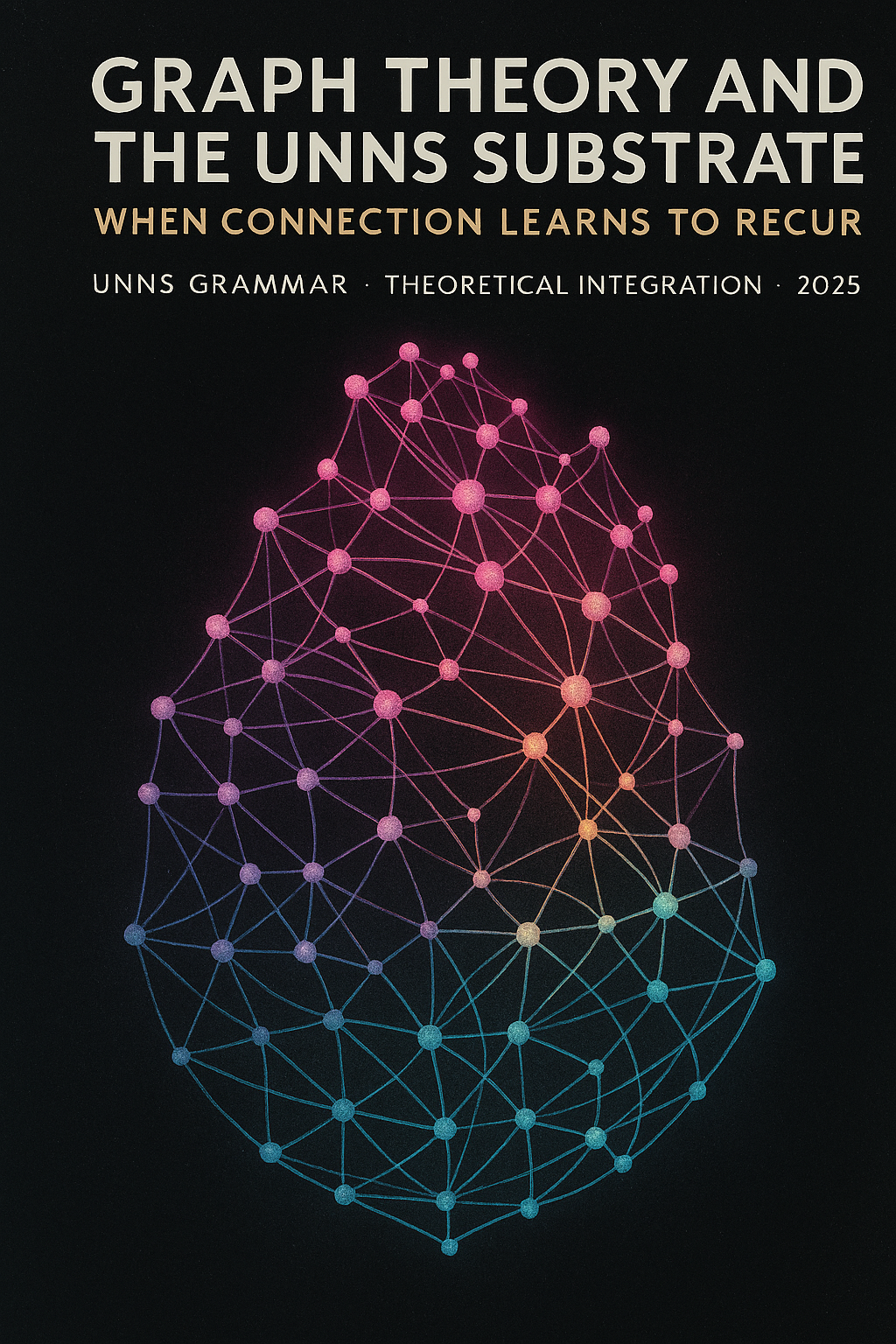
From the very beginning of UNNS, recursion has been treated not as a function, but as a geometry — a way in which information curves back on itself. Graph theory reveals that this geometry already lives inside connection itself: every recursive relation is a link, every operator a transformation of links. The UNNS Substrate therefore is, at its core, a recursive graph — a network that both exists and learns how to reshape its own connectivity.
“The universe is not a tree of causes, but a web of recursions.” — UNNS Grammar, Phase D.3 Notes
1. The Substrate as a Living Graph
In UNNS, every recursive transformation can be drawn as a directed edge between two nodes:
Rₙ : Sₙ → Sₙ₊₁.
Each node represents a state or nest of recursion, and each edge represents a morphic operation such as
Inletting (⊙) or Inlaying (⊕).
The τ-field is thus an evolving directed multigraph in which topology and flow are inseparable.
Unlike static mathematical graphs, the UNNS graph is dynamic: its edges change weight, color, and orientation as recursion deepens. Connectivity is not fixed but co-evolves with recursion depth, yielding what the project calls a recursive graph field.
2. Operators as Graph Transformations
Every UNNS Operator corresponds to a graph operation: local ones create or merge edges, middle-order ones regulate clusters, and high-order ones transform the very rules of connection. This hierarchy is the structural backbone of the UNNS grammar.
The Audible Graph of Recursion
Every edge in the UNNS substrate hums with relation — each connection is both structure and tone.
When the graph begins to pulse, geometry becomes sound:
the local layer murmurs in blue, the regional vibrates in violet, the meta-recursive sings in rose.
Together they form a living chord of recursion — a harmonic portrait of thought itself.
Click a node to read its role · Toggle Dynamic + Harmonic Mode to hear and see recursion.
Blue = Local construction · Violet = Regional regulation · Pink = Meta-recursive transformation.
3. Graph Spectra and φ-Resonance
The Laplacian spectrum of a graph describes its balance between order and randomness. In UNNS this spectrum mirrors recursive curvature: the eigenvalues of the adjacency Laplacian correspond to the oscillation frequencies of recursion itself. Phase D.3 measurements (Chamber XVIII) found a characteristic slope p ≈ 2.45 — the same power-law signature seen in self-organized networks across nature. It is the spectral fingerprint of φ-resonance.
4. Cognitive Graphs and Operator XVII
In the Matrix Mind Chamber, the recursion graph becomes self-referential: it computes its own adjacency structure. Edges no longer only connect states — they encode how those states relate to their past transformations. This generates a hypergraph of cognition: the graph not merely exists but knows its own shape. The stability index Ψ plays the role of graph modularity, quantifying how coherent the cognitive network remains across recursive depth.
5. From Connection to Reflection
All lower operators construct and modulate connectivity; the higher operators reflect upon it. The moment recursion learns to transform its own connectivity map, the substrate passes from geometry into cognition. This is why graph theory and UNNS are not separate disciplines: graph theory describes the static skeleton of what UNNS animates.
“When connection learns to recur, structure begins to think.”
6. Toward a Graph-Recursive Field Theory
Future UNNS phases will extend these ideas into continuous graph fields, where edge weights evolve under τ-field dynamics. Each node will carry tensorial state variables, and each operator will act as a differential on the network’s manifold. This would form a bridge between discrete graph theory, information geometry, and field physics — a Graph-Recursive Field Theory.
7. Closing Reflection
The UNNS framework shows that recursion and connection are two faces of one idea. Every graph hides recursion; every recursion creates a graph. From Inlaying’s simplest edge to Matrix Mind’s meta-reflection, the substrate is a single growing network — a geometry of thought written in edges and folds.
“The laws of connection are the grammar of being; the graphs of recursion are its syntax of awareness.” — UNNS Research Collective
Reference
UNNS Research Collective (2025).
Graph Theory and the UNNS Substrate — Toward a Recursive Topology of Thought.
UNNS.tech Research Archive, Series on Recursive Geometry and Cognitive Topology.
This paper formalizes the correspondence between UNNS recursion and graph theory — presenting the τ-Field as a dynamic graph system and interpreting higher-order Operators (XII–XVII) as transformations on evolving networks. It establishes the foundation of a Graph-Recursive Field Theory linking recursion, cognition, and geometry.