
Recursive Lattices, Glyphs, and Morphic Geometry
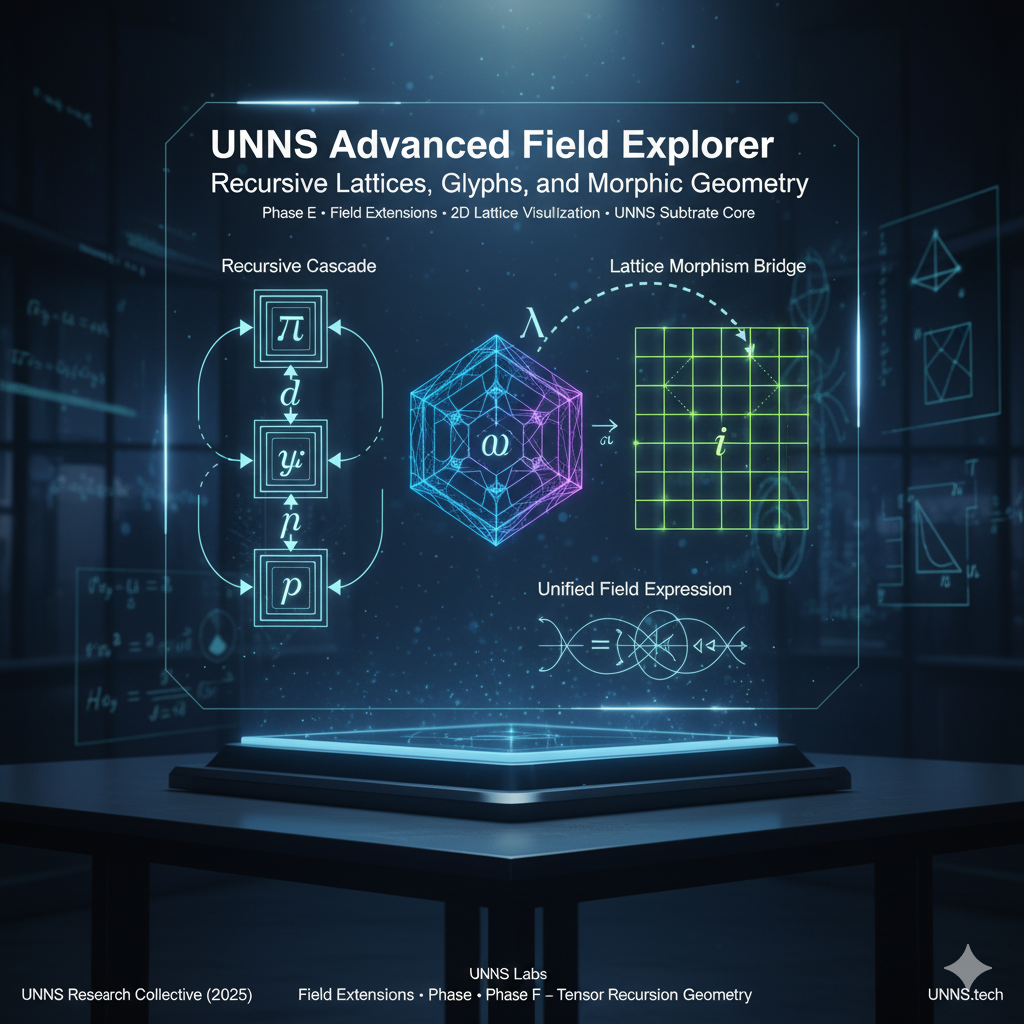
The UNNS Advanced Field Explorer (v 2) brings together recursive algebra, complex geometry, and field morphism visualization. It demonstrates that classical number sequences — Fibonacci, Pell, Tribonacci, Padovan — and their lattice counterparts (Eisenstein & Gaussian) are not separate domains but interconnected manifestations of the same recursive substrate.
🧩 1. Field Glyphs and Recursive Memory
Each algebraic constant appears here as a living glyph — φ (Golden Ratio), δ (Pell), ψ (Tribonacci), ρ (Padovan), ω (Eisenstein root of unity), and i (Gaussian unit). The Explorer visualizes how recursion transfers its memory signature as it transitions across field spaces, revealing that arithmetic closure is a morphic process.
🌐 2. Recursive Cascade: φ → δ → ψ → ρ
The first diagram encodes the recursive cascade between classical operators. What looks like four static constants — φ, δ, ψ, ρ — is in fact a sequence of successive closure conditions, each one extending the recursive alphabet while remembering the structure of the previous.
In the Explorer, moving along this cascade changes the effective recursion law, but not the underlying substrate. φ, δ, ψ, and ρ become four faces of one recursion engine, rather than unrelated constants.
💠 3. Lattice Morphism Bridge: ω ↔ i
The second diagram illustrates the lattice morphism bridge between Eisenstein (ω) and Gaussian (i) fields. On the left, a hexagonal structure hints at ℤ[ω]; on the right, a square grid hints at ℤ[i]. The dashed connection between them encodes the morphism Λ that projects one lattice into the other.
In the Explorer, the visual morphing between these lattices is not a cosmetic transition; it encodes an actual mapping of recursive structure between two complex integer rings. Geometry becomes a visible shadow of algebraic transfer.
🧮 4. The Unified Field Expression
The Explorer embodies the algebraic closure:
∀ S ∈ ℂ,  Sₙ₊₁ = Σₖ aₖ Sₙ₋ₖ
   ⟹  S ∈ ℤ[i, ω, φ, δ, ψ, ρ]
All recursive fields converge into a single morphic algebra, unifying 1-D and 2-D domains. This demonstrates the Field Unification Principle at the heart of the UNNS Substrate.
🧬 5. Experience the Explorer
For a better view, click here!
🧩 Appendix — Field Morphism Equations
The Explorer operates on recursive transformations expressed as coupled morphism matrices between algebraic and geometric field domains. Each morphism defines a structural bridge between field constants φ, δ, ψ, ρ, ω, and i.
1. Recursive Coupling Tensor:
Rᵢⱼ = Oᵢ(τⱼ) − Oⱼ(τᵢ)
This tensor measures differential recursion flow between two operators acting across τ-fields. It defines curvature-like dynamics — the precursor to UNNS–Maxwell coupling equations.
2. Field Morphism Matrix:
M =
⎡ φ   δ   ψ ⎤
⎢ ρ   ω   i ⎥
⎣ τ₁ τ₂ τ₃ ⎦
The morphism matrix M encodes the recursive state transitions between algebraic constants and their geometric realizations. Diagonal stability corresponds to equilibrium recursion (Φ-scale coherence), while off-diagonal terms represent morphic transfer.
3. Spectral Condition for Recursive Equilibrium:
det(M − λI) = 0 ⟹ λ ≈ {φ, δ, ψ, ρ}
Stable recursion occurs when the morphism eigenvalues converge toward golden–ratio–linked constants, maintaining symmetry and coherence across τ-field transitions.
4. Lattice Coupling Map:
Λ : ℤ[ω] → ℤ[i]
    (x + yω) ↦ (x + yi)
The map Λ defines a projection between Eisenstein (hexagonal) and Gaussian (square) lattices, enabling geometric continuity between complex field embeddings.
These morphic equations underlie the Field Explorer’s animation engine, linking algebraic recursion, tensor curvature, and geometric symmetry into one coherent substrate.
🌌 6. Significance
The UNNS Advanced Field Explorer visualizes recursion not as a numerical process but as geometry in motion. Through φ, δ, ψ, ρ, ω, i it exposes a universal recursive alphabet — a grammar where mathematics, structure, and cognition meet. It stands as a milestone in the transition from numeric recursion to tensor recursion geometry (Phase E → Phase F).