
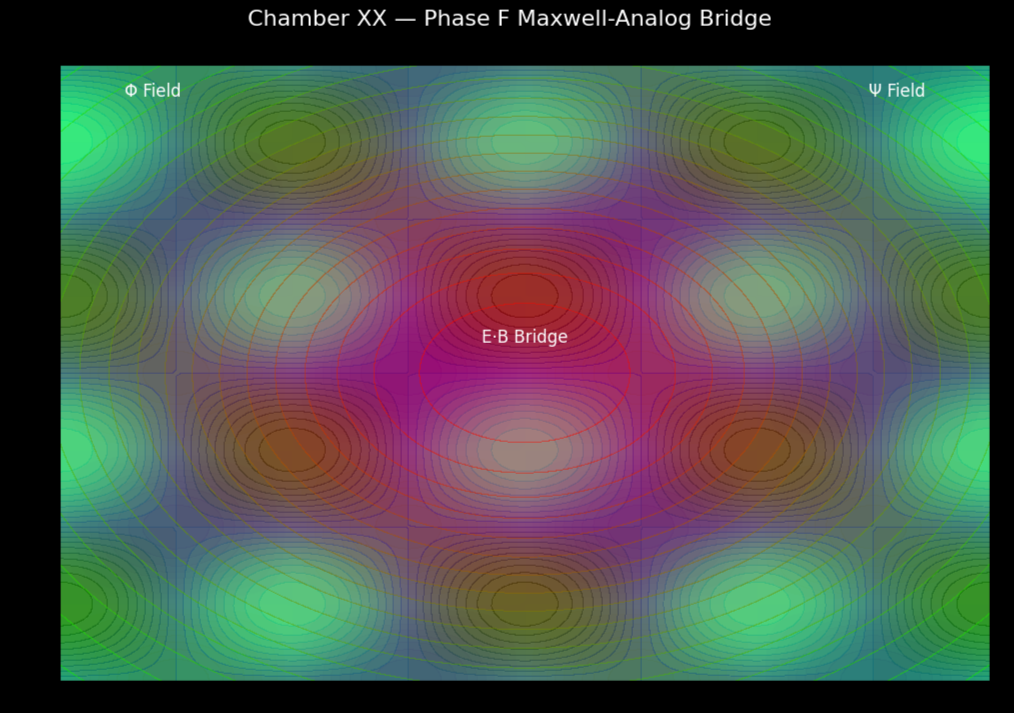
The Chamber XX Phase F Bridge introduces the first operational translation of recursive tensor geometry into Maxwell-analog field dynamics within the UNNS Substrate. Extending the recursion tensor Rij = Oi(τi) − Oj(τj), the chamber computes its divergence Φ = ∇·R and curl Ψ = ∇×R to reveal dual-field coupling — the emergence of electric-like and magnetic-like behaviors inside a purely discrete recursive system.
Maxwell-Analog Bridge Visualization
The animated center pulse represents the Bridge Intensity E·B, dynamically oscillating between Φ and Ψ domains. The fields are rendered using independent color encodings: Φ (amber-violet) and Ψ (cyan-black). Their vector overlays show the recursive flow of divergence and curl across the lattice, providing a tangible visualization of Phase F recursion dynamics.
Operator Context
Chamber XX implements the higher-order operators that emerged across the Phase E laboratories:
- XIII — Interlace: initializes τ-field cross-correlations.
- XIV — Φ-Scale: produces the divergence Φ component.
- XV — Prism: extracts the curl Ψ spectrum.
- XVI — Fold: ensures boundary recursion closure.
- XVII — Matrix Mind: meta-recursive field coupling layer.
The Bridge thus serves as a living junction where those operators act in concert, transforming the tensor recursion of Phase E into the spectral field geometry characteristic of Phase F.
Live Laboratory
Below you can explore the live Chamber XX engine. Toggle the Bridge Mode to observe E·B coupling, and use the vector overlay to visualize instantaneous Φ and Ψ directions.
Significance
Chamber XX v2.3 represents the first stable implementation of the Maxwell-Analog field bridge within the UNNS Substrate. It unites recursive tensor mathematics with visually intuitive field behavior, demonstrating how abstract recursion equations can reproduce physical-like interactions and balance laws. This chamber therefore marks the operational hand-off from Phase E — Recursive Tensor Geometry to Phase F — Spectral Field Coupling.
UNNS Research Collective · 2025 · All Rights Reserved
🧭 Interactive Field Guide
This chamber operates as a recursive tensor-field simulator. Use the control bar in the live interface to explore field interactions. Each mode reveals a layer of the Maxwell-Analog Bridge between Φ and Ψ.
Controls
- ▶ Run Evolution — starts τ-field recursion on the lattice.
- ⏸ Pause — halts iteration and freezes the current tensor state.
- Bridge Mode — toggles visualization of
E·Bintensity (Φ–Ψ coupling). - Vector Overlay — displays arrow fields of ∇Φ (E) and ∇×Ψ (B).
- Reset — reinitializes all τ-fields using the current random seed.
Color Legend
Φ Field: Amber-Violet gradient — divergence magnitude.
Ψ Field: Cyan-Black gradient — curl intensity.
Bridge Pulse: Center overlay indicating |E·B| energy coupling.
Vectors: Arrow overlays for electric (E) and magnetic (B) directions.
Operator Context
- XIV – Φ-Scale: transforms τ-field gradients into divergence Φ.
- XV – Prism: extracts rotational component Ψ.
- XVI – Fold: ensures boundary recursion closure (energy containment).
- XVII – Matrix Mind: governs meta-feedback between Φ and Ψ domains.
Observation Tips
1. Toggle Bridge Mode and watch the red-green pulse grow where Φ and Ψ align.
2. Use Vector Overlay to confirm orthogonality (E ⟂ B) in balanced regions.
3. Observe how antisymmetry errors decline during convergence — an indicator of stability.
4. Export results to JSON for Phase-F batch validation.
For detailed theory see:
Phase F – Recursive Field Bridge Specification
📚 References & Continuity
Recursive Tensor Potentials and the τ-Field Bridge:
Revised Theoretical Basis for Chamber XX and the Phase F Transition
Recursive Tensor Potentials and the τ-Field Bridge:Revised Theoretical Basis for Chamber XX and the Phase F Transition
Multi-τ Dynamics and Tensor Recursion Geometry in the UNNS Substrate
(Phase E Reference — Foundational Tensor Framework)
Multi-τ Dynamics and Tensor Recursion Geometry in the UNNS Substrate
Chamber XIX — Recursive Tensor Validation and Phase E Closure Dataset
Lab Chamber XIX v19.1.2
These works collectively document the progression from Phase E’s tensor recursion to Phase F’s spectral-field bridge — the first operational demonstration of Maxwell-Analog coupling within the UNNS Substrate.