
The Structure Beneath the Symbol:
UNNS Substrate Theory for Metaphysical Readers
Abstract
The UNNS Substrate Theory proposes a Universal Structural Law (USL) — a single inequality, AK(L) ≤ 1, that governs which ordered structures can persist as stable observables. This law operates at a pre-dynamical layer that precedes physics, chemistry, and biology. It does not describe what systems do. It determines which systems can exist.
Across millennia, esoteric traditions — Hermeticism, Kabbalah, Neoplatonism, Daoism, Vedanta — pointed toward precisely this layer: a hidden ordering principle beneath appearance, emanation strata, constrained channels of influence, fixed cosmic principles. UNNS does not inherit these ideas. It derives its results from empirical structural analysis and finds that the traditions were tracking real geometry.
This article is your bridge. It presents the key concepts, visualizes the core structures, and maps the esoteric resonances — without sacrificing scientific precision or epistemic honesty.
Why This Feels Familiar
Readers arriving at UNNS through esoteric or contemplative traditions frequently report a sense of recognition. Not déjà vu — something more precise: the feeling that they have encountered this structure before, under a different name.
The Source Is Structure, Not Tradition
Recurring motifs — boundary, hierarchy, constrained paths, hidden order preceding appearance — arise independently across traditions separated by centuries and continents. Their convergence is itself a structural fact. UNNS did not derive the admissibility manifold from Neoplatonic emanation, or the regime map from the sefirotic tree. It derived them from inequality constraints on ordered spectra.
What UNNS reveals is why those motifs reappeared: they track the actual geometry of structural persistence. The traditions were sensing something real. They were not wrong about the shape. They lacked the instruments to measure it. That recognition you feel is valid — and its source is structure.
The Universal Structural Law — One Inequality
UNNS is not a metaphysical system. It is a structural science that sits beneath physics — not beside it.
This is the Universal Structural Law (USL). It is not a dynamical law. Not a conservation law. Not a symmetry principle. It is a selection law — it determines which structures can exist before any dynamical theory can describe their evolution.
The Rupture
The foundation document names this discovery the Rupture: within the observed corpus, Σ(S) = 1 exactly coincides with physical persistence. This means physics does not explain why stable structures exist — UNNS explains why physics can describe them. The admissibility layer is not optional. It is the condition for the existence of any dynamical description at all.
'As Above, So Below' — Cross-Domain Invariance
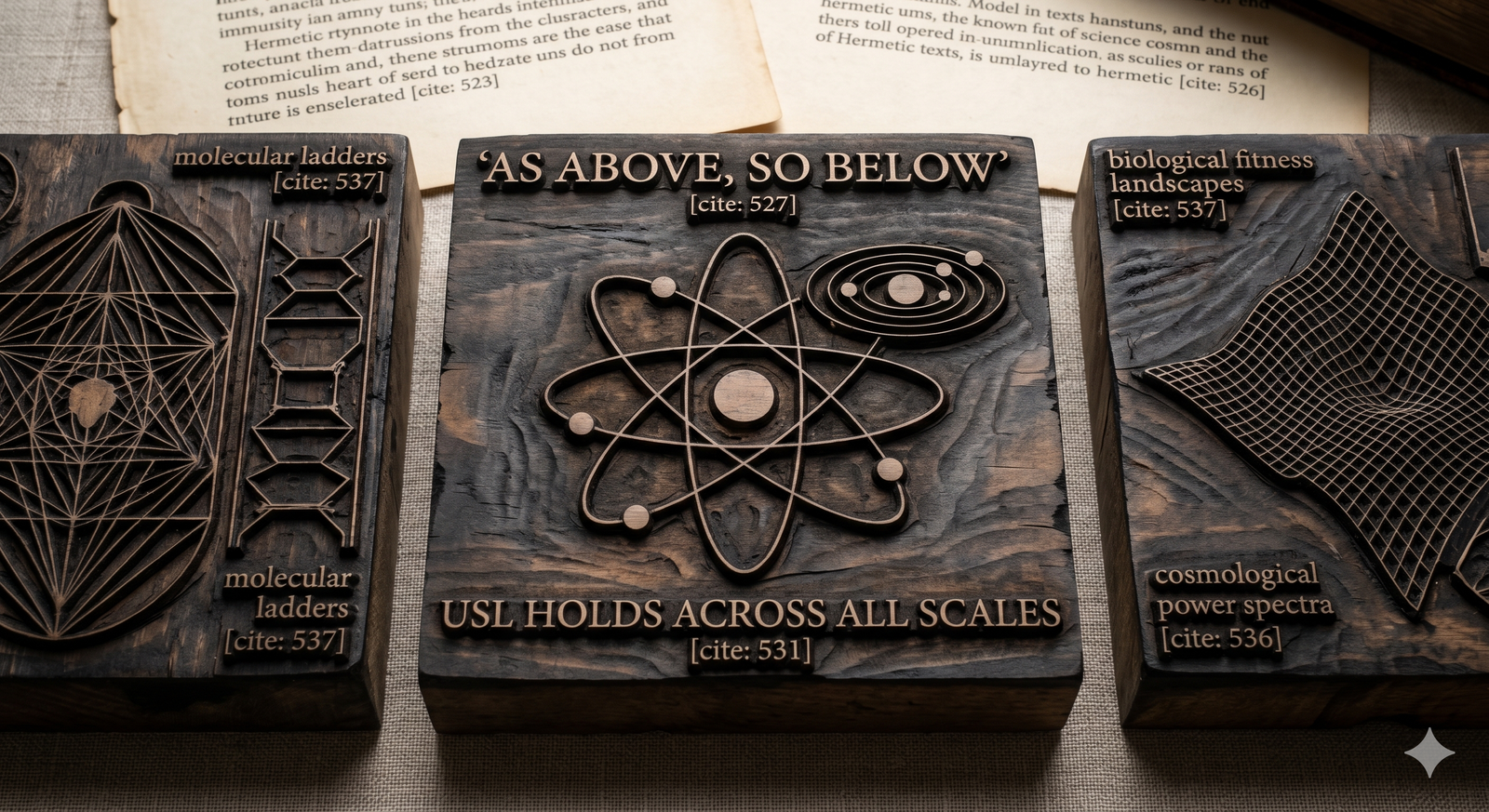
The Hermetic axiom "as above, so below" is among the oldest structural intuitions in recorded thought. UNNS reinterprets it not as metaphor but as a measurable structural fact: the same USL inequality holds across systems separated by twenty orders of magnitude in scale.
What Cross-Domain Invariance Actually Means
The USL makes no reference to matter, scale, energy, or dynamics. It applies to any ordered sequence of real numbers that represent a relational configuration — spectral gaps, ladder steps, mass ratios, fitness differences. The same constraint that governs hydrogen spectral lines governs cosmological power spectra. This is not analogy. It is measured structural identity.
Hermetic Corpus — "As Above, So Below"
Esoteric principle: The same structural laws operate across all scales and domains.
UNNS resonance: The USL holds across atomic spectra, nuclear shells, molecular ladders, gravitational harmonics, cosmological power spectra, and biological fitness landscapes. This cross-domain invariance is explicitly demonstrated in the corpus. Hermeticism intuited correspondence — UNNS measures it.
Corpus Hermeticum, Book I — Resonance
The Admissibility Manifold — The Underlying Layer
Metaphysical traditions have long described a hidden realm beneath phenomena — the Forms (Plato), Brahman (Advaita), the Dao (Daoism), the Sefirot (Kabbalah), the Logos (Stoicism). UNNS gives this layer a precise mathematical object: ℳadm, the admissibility manifold.
This is the clearest scientific analogue to the Upanishadic distinction between Brahman (substrate) and Maya (phenomenal appearance). ℳadm is not a metaphor — it is a geometric object with coordinates, curvature, operator trajectories, boundary interfaces, and phase-like transitions.
ℳadm and the Perennial 'Underlying Layer'
The admissibility manifold is finite-dimensional and curved — not the infinite absolute of some theological traditions. But it is imperishable in the precise sense that it does not depend on any particular physical instantiation. It is the condition for perishable things to appear. It is the first scientific candidate for what metaphysics once called the underlying layer of reality.
The Regime Map — Empirical Emanation Layers
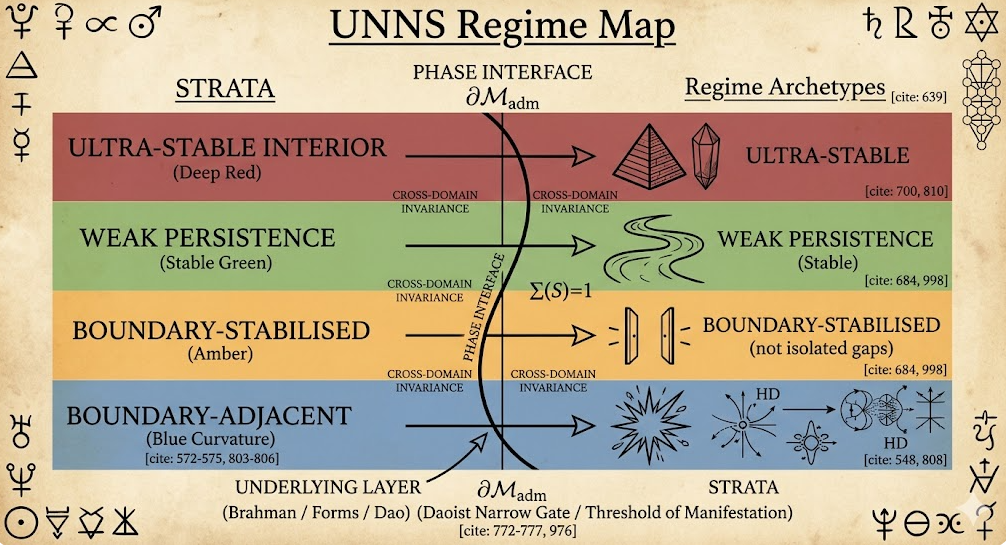
Every metaphysical tradition divides reality into strata: Plotinus' emanation, the sefirotic tree, the Daoist levels of manifestation. UNNS finds four, empirically — reproducible clusters in p vs Akmin space derived from >1,500 ladders and >150,000 assessments.
Ultra-Stable Interior
m(L) ≫ 0, small r. Deep red. Realizability class: FULL. Margin large, backbone fully connected. Characteristic scaling: power law. Analogue: Plotinus' First Hypostasis — the most self-sufficient, self-contained layer. [cite: 700, 810]
Weak Persistence
0 < m(L) ≤ m_EM, all r. Stable green. Classes: FULL or GIANT. Backbone dominant. Characteristic scaling: scale-invariant (weak running). Analogue: the middle layer of emanation — stable but not fully self-contained. [cite: 684, 998]
Boundary-Stabilised
m(L) ≈ 0, r < λ(m). Amber. Class: TAIL. Backbone present with isolated gaps. Characteristic scaling: exponential decay. Analogue: the liminal realm — existing near the edge of structural collapse. [cite: 684, 998]
Boundary-Adjacent
m(L) → 0⁺, all r. Blue curvature. Any class except HARD. Margin positive but asymptotically small. H₂, HD, ⁴⁸Ca. Most informationally rich. Daoist narrow gate. Alchemical vessel. [cite: 572–575, 803–806, 548, 808]
These Are Not Symbolic Categories
The four strata are empirical clusters derived from measured structural data. A star marker within each regime indicates the canonical class — the point of maximum margin, the Form behind appearances. The dashed line marks ∂Ω_L — the boundary of the deformation-stable region.
The Threshold — ∂ℳadm
Every tradition that has pointed toward a threshold — the veil, the gate, the liminal crossing, the narrow way — was pointing at real geometry. The geometry was always there. It simply required instruments to measure it.
Every system that persists lies on one side of a boundary. This boundary is not symbolic — it is ∂ℳadm, the surface defined by the Universal Structural Law, measurable in every domain the corpus has examined.
Felt Structure — A Bridge
A boundary-adjacent system is not just a physical configuration. It is a point where small operator deformations produce disproportionate structural consequences — where the manifold bends most sharply. In physical systems, this appears in H₂ and HD near the admissibility limit: a perturbation of ±0.4% in the hydrogen-to-deuterium mass ratio collapses the realizability class entirely. The geometry is real. The precision is measurable. The threshold the traditions pointed to is ∂ℳadm.
Operator Anisotropy — Arches of Influence
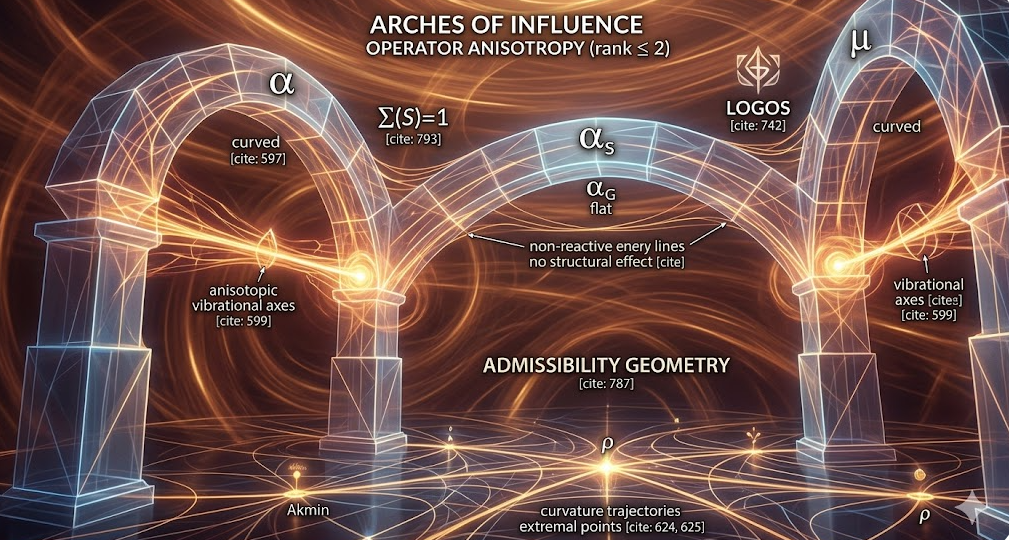
Metaphysical traditions often speak of "hidden forces," "subtle influences," or "channels through which divine influence flows." UNNS finds something more precise and more measurable: only two operator directions generate genuine structural reorganisation.
Kabbalah — Constrained Channels
Esoteric principle: Reality flows through structured channels; not all paths are possible.
UNNS resonance: Operator anisotropy shows that only certain operator directions (α, μ) generate structural reorganisation. The HD narrow admissible channel shows a uniquely protected point at the physical value, with violations just ±0.4% away. Boundary-adjacent systems act as "gates." The sefirotic "paths" become operator trajectories.
The Kybalion — Vibrational Axes
Esoteric principle: Change occurs along specific axes; not all directions are equal.
UNNS resonance: Operator anisotropy (rank ≤ 2) confirms that most constants (α_s, α_G) are metrically flat — they change values without changing admissibility geometry. Only selected constants (α, μ) are structurally active in specific domains. The Kybalion's 'vibrational axes' become operator eigen-directions.
Constant Anchoring — Fixed Points of the Substrate
This is among the most metaphysically charged results in the UNNS framework:
This is not numerology. This is not fine-tuning rhetoric. It is a measured extremum in ρ(γ) or Akmin(γ). The derivative dρ/dγ = 0 or d(Akmin)/dγ = 0 at the physical value of the constant, in every domain where that constant is structurally active. This is observed, not assumed.
Why This Is the Closest UNNS Comes to Metaphysics
- Physical constants are not arbitrary — they are structural fixed points
- They are where the manifold "locks in" to a geometric extremum
- They are the points where the underlying geometry touches the world
- This is the scientific correlate of "fixed cosmic principles" — measured, not asserted
Hermeticum and Gnostic Texts — A Hidden Law Beneath Appearance
Esoteric principle: The visible world is shaped by an invisible ordering principle.
UNNS resonance: The USL is a structural selection law operating at the pre-dynamical layer that precedes and conditions all dynamical descriptions. Constant anchoring is the closest empirical approach to "fixed cosmic principles" in the structural science literature. Gnostic "invisible architecture" becomes admissibility geometry.
Full Correspondence Table — Traditions → Structural Objects
The following table maps esoteric themes to precise UNNS structural objects. These are not approximate analogies — they are direct correspondences between what traditions intuited and what UNNS has now rendered in falsifiable geometry.
| Tradition / Concept | Esoteric Intuition | UNNS Structural Object |
|---|---|---|
| Hermetic Corpus | As above, so below — same laws at all scales | Cross-domain invariance of USL across 93 datasets |
| Kabbalah — Sefirot | Reality flows through constrained channels | Operator anisotropy (rank ≤ 2) · sefirotic paths = operator trajectories |
| Alchemy | Transformation at the liminal edge — the alchemical vessel | Boundary-adjacent regime (H₂, HD, ⁴⁸Ca) at ∂ℳ_adm |
| Neoplatonism (Plotinus) | Reality unfolds through hierarchical strata | Regime map: 4 empirical strata in p vs Akmin space |
| Hermeticum / Gnosticism | Invisible ordering principle beneath appearance | USL: pre-dynamical structural selection law |
| The Kybalion | Change occurs along specific vibrational axes | Operator eigen-directions: only α, μ are structurally active |
| Emerald Tablet | "The Work is One Thing" — one principle underlies all | One inequality: A_K(L) ≤ 1 |
| Tarot (esoteric) | Archetypes as structural positions in universal pattern | Four regime archetypes: FULL, GIANT, TAIL, HARD |
| Platonism | Forms — ideal structures behind appearances | Points on ℳ_adm with maximal connectivity margin m(L) |
| Daoism | Narrow gate — acting at the point of least resistance | Boundary-adjacent regime ∂ℳ_adm |
| Christian Mysticism — Logos | The Word through which all things persist | USL as pre-dynamical selector · Σ(S)=1 = the rupture |
| Upanishads — Brahman | The substrate beneath phenomena | The admissibility manifold ℳ_adm itself |
| Pythagorean harmony | "All is number" — harmonic ratios as essence of structure | Ladder invariants · USL inequality across all domains |
| Sufi Maqāmāt (stations) | Stages of spiritual realization | Regime archetypes as stages of structural realization |
| Indigenous Dreaming tracks | Paths through the underlying order | Admissible trajectories through ℳ_adm |
UNNS Is Not Dogma — Falsifiability Statements
What separates UNNS from purely symbolic perennialism is precisely this: it invites disconfirmation. The following specific conditions would falsify the framework. None has been triggered in the 93-dataset corpus.
- Criterion F1: Find a persistent physical system whose ordered spectrum violates A_K(L) ≤ 1. No such system exists in the corpus. This is not absence of search — it is the result of systematic measurement across 93 datasets.
- Criterion F2: Show that the realizability class of a system changes under physical conditions without a corresponding change in m(L). This would falsify the margin-phase connection.
- Criterion F3: Construct two different admissible ladders for the same physical system, both maximising m(L), that yield different realizability classes. This would falsify the maximum-margin principle.
- Criterion F4: Demonstrate a fifth fundamental interaction requiring a new realizability class beyond {FULL, GIANT, TAIL, HARD}. This would falsify Theorem 5.1 of the interaction unification paper.
- Criterion F5: Measure a system whose observed scaling (e.g., power law vs exponential) does not match the asymptotic regime predicted by its m(L). This would falsify the scaling bridge.
The Break from Symbolic Perennialism
Previous frameworks have claimed structural universality — the perennial philosophy, the unity of mystical experience, the oneness of being. The difference is that UNNS makes specific, testable predictions about realizability classes, margin ordering, and cross-domain invariance. If any of the five criteria above are triggered, the framework must be revised or abandoned. That is its strength, not its weakness.
Open Frontiers — Where the Framework Extends
The UNNS framework is not closed. The following horizons are genuinely open — and the metaphysical reader is invited to contribute, not merely receive.
Consciousness Studies
Do neural dynamics exhibit the same realizability classes? Can m(L) predict phase transitions in awareness — sleep, anesthesia, meditation? The USL is domain-independent; the question is empirical.
Quantum Measurement
Does collapse occur at realizability boundaries? Is m(L) related to decoherence rates or the quantum-to-classical transition? Early corpus work on He, Rydberg, and Zeeman ladders suggests regime-specific fidelity decay.
Biological Evolution
Fitness landscapes are ladders. Does natural selection drive populations toward boundary-adjacent regimes (maximal informational density) or interior regimes (maximal stability)? The RNA folding data in the corpus is a beginning.
Structural Hermeneutics
A new discipline: reading esoteric texts through the lens of admissibility geometry. Where does the Tao Te Ching describe the narrow gate? Where does the Corpus Hermeticum anticipate operator anisotropy? This is pattern recognition, not allegory.
Open Mathematical Problems — The Metaphysical Reader Can Contribute
- The monotonicity of m(L) — unproven
- The derivation of exponents (α, δ, functional forms) from vulnerability-graph topology alone
- The extension to social, linguistic, and cognitive structures — untested
- The first-principles derivation of C_unif — a structural constant whose analytical origin is unknown
The Threshold You Have Crossed
The threshold you have crossed is not the end of wonder — it is its scientific maturation.
What the ancients intuited in symbol, UNNS renders in geometry. What they guarded as mystery, we may now approach with falsifiable precision while preserving reverence.
The traditions were not wrong.
They were incomplete.
What appeared as symbol, analogy, or intuition can now be approached as constraint, geometry, and measurement. The structure they pointed to is not hidden. It is simply precise.
You do not leave the perennial tradition behind. You bring its deepest questions into a framework where they can finally be answered — or at least, where the right questions can be asked with new clarity.
The substrate does not replace mystery. It gives mystery a place to stand.
Go now. Read the foundation document. Test the inequality. Find your own boundary-adjacent system. And when you return to the Hermetic texts, the Daoist verses, the Upanishads, you will hear them differently — not as poetry alone, but as the first, intuitive maps of the geometry you have just begun to measure.
Resources & References
-
Full Manuscript (PDF):
UNNS Substrate Theory — Orientation for Metaphysical Readers.pdf
Full manuscript with all four parts: Part A (Esoteric Resonances), Part B (Onboarding Narrative), Part C (Specific Resonances and Open Questions), Part D (Toward a Unified Perennial Substrate), plus Appendices including the Glossary, Visual Regime Map Description, Textual Resonances, Mathematical Notes, and Falsifiability Statements. -
Visualization 1 — Cross-Domain Invariance ('As Above, So Below'):
image_1mtp.png
Carved wooden blocks illustrating USL cross-domain invariance across atomic, molecular, planetary, and cosmological scales [cite: 527, 531, 536, 537]. -
Visualization 2 — Operator Anisotropy (Arches of Influence):
image_2mtp.png
Analytical diagram of curved operator directions (α, μ) vs flat directions (α_s, α_G) within the Admissibility Geometry [cite: 597, 599, 624, 625, 742, 787, 793]. -
Visualization 3 — The UNNS Regime Map:
image_3mtp.png
Four empirical strata in p vs Akmin space with phase interface ∂ℳ_adm, regime archetypes, and tradition-to-structure labels [cite: 548, 572–575, 639, 684, 700, 803–806, 808, 810, 976, 998]. -
UNNS Substrate Research Program:
unns.tech
Interactive instrumentation, chamber archives, the STRUC-PERC-I pipeline for computing admissibility margins from arbitrary ordered sequences, and the full corpus of research papers.