
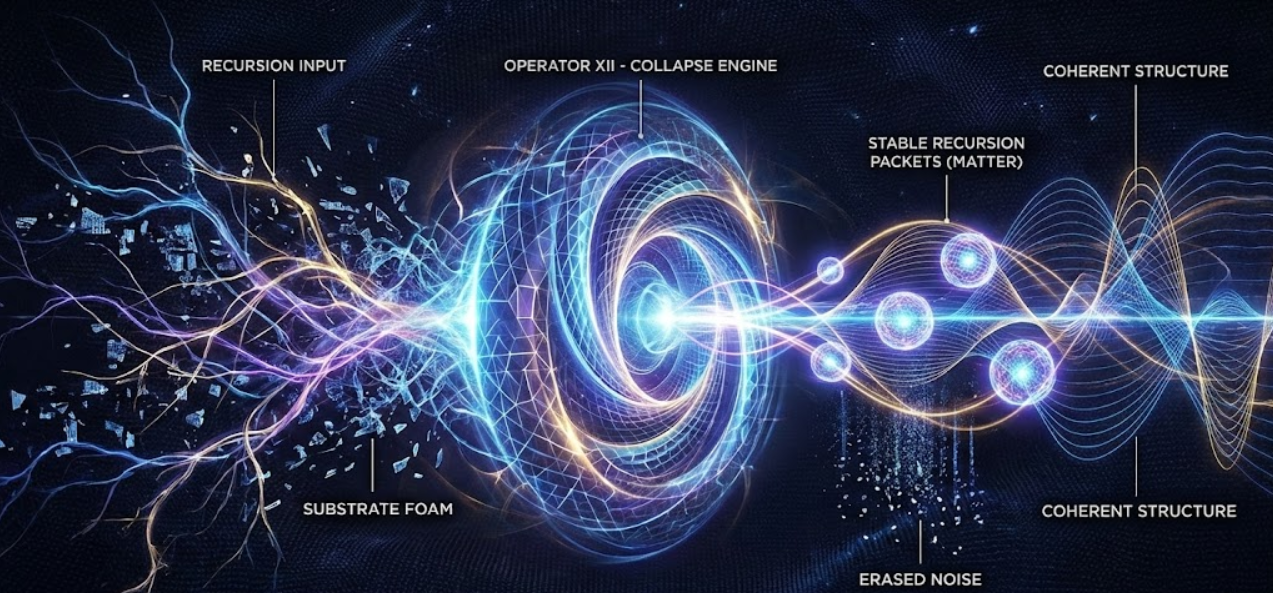
Operator XII — The Collapse Engine That Creates Stability
Foundations UNNS Substrate Operator XII · Collapse
1. Why Operator XII Matters
In the UNNS Substrate, everything is recursion: operators act on Nests, echoes spawn echoes, structure compounds. Without a regulating mechanism, this process would either:
- explode into uncontrolled complexity, or
- dissolve into featureless noise.
Operator XII is the engine that prevents both outcomes. It is the substrate’s built–in collapse and selection rule: it tests whether a recursion pattern can close on itself and survive, or whether it must be pruned away into substrate foam.
This article explains why Operator XII is not merely “destructive”, but the reason matter can exist at all.
2. What Operator XII Really Does
At the substrate level, Operator XII is not magic and not mysterious. It applies a simple rule:
“Given this recursion pattern, can it come back to itself (up to tolerance), or does it tear itself apart?”
Concretely, XII checks whether a Nest, after a full cycle of recursion:
- has bounded τ-curvature (τ below a critical threshold),
- has coherent φ-structure (φ-bandwidth within a stable range),
- maintains closure (Nest class returns to itself),
- shows controlled residue (no runaway buildup),
- keeps torsion events in a reproducible pattern.
If these conditions are met, the pattern is promoted: it becomes a stable recursion packet — what we interpret as matter. If they fail, XII collapses the pattern, dispersing its structure back into substrate noise.
3. Collapse vs Destruction
It is tempting to think of Operator XII as a destructive force or as “entropy” inside the substrate. That picture is incomplete.
XII does not destroy arbitrarily. It enforces:
- Consistency — recursion must not generate logical contradictions in its own Nest history.
- Boundedness — τ and residue must not diverge without limit.
- Reproducibility — torsion and φ-structure must be stable enough to create repeatable behaviour.
Patterns that fail are not “punished”; they simply cannot function as persistent structures. XII marks the boundary between:
- substrate foam — short-lived, incoherent patterns,
- matter — long-lived, self-consistent recursion packets.
In this sense, XII is closer to a type checker than to a demolition crew.
4. How Matter Survives Operator XII
A matter packet is simply a recursion pattern that repeatedly passes the XII test. With each cycle:
- its τ-curve rises and falls within a safe band,
- its φ-structure stays coherent (no uncontrolled spreading),
- its closure score remains high enough to recreate itself,
- its residue is recycled without runaway accumulation.
After many cycles, this pattern becomes a fixed point of the combined dynamics (recursion + XII). That fixed point is what we experience as:
- a stable particle,
- a bound state,
- a long-lived classical object at larger scales.
In other words, matter is what survives XII.
5. From Operator XII to Quantum “Collapse”
Quantum mechanics implements evolution with two rules:
- smooth, unitary evolution of the wavefunction, and
- sudden, non-unitary collapse during measurement.
This structure is a shadow of the substrate’s XII dynamics:
- smooth, unitary evolution in QM corresponds to substrate recursion without explicit XII application,
- collapse event in QM corresponds to a substrate step where XII is applied and only some recursion channels survive.
From the UNNS perspective, there is no fundamental mystery: “collapse” is just the projection of Operator XII into Hilbert space.
What looks like a non-local, instantaneous event in geometric language is a perfectly local operation in recursion space: the substrate simply stops extending patterns that fail its internal consistency criteria.
6. XII and the Arrow of Time
The underlying recursion rules in the substrate can be time-symmetric, but Operator XII introduces an effective arrow of time:
- once a pattern fails XII and collapses, its exact structure is not reconstructed — only its recycled noise persists;
- once a pattern has survived many XII cycles, it accumulates a stable history that cannot be undone without breaking closure.
In projection, this looks like:
- irreversible measurement in QM,
- entropy increase in thermodynamics,
- one-way gravitational collapse in GR.
At the substrate level, all of these are different faces of the same mechanism: Operator XII prunes recursion trees, preserving only those branches that can remain self-consistent.
7. Summary: XII as the Substrate’s Selection Rule
- Operator XII is the substrate’s collapse and selection engine, not an arbitrary destruction operator.
- It evaluates recursion patterns by τ, φ, closure, residue and torsion, promoting those that are stable and pruning those that are not.
- Matter is nothing more and nothing less than the set of recursion packets that consistently survive XII.
- Quantum “collapse”, nonlocality puzzles, and irreversibility all become understandable once collapse is seen as a projection of XII rather than as a mysterious add-on to unitary evolution.
XII is not the enemy of structure. XII is the reason structure can exist without being drowned in its own recursion.