
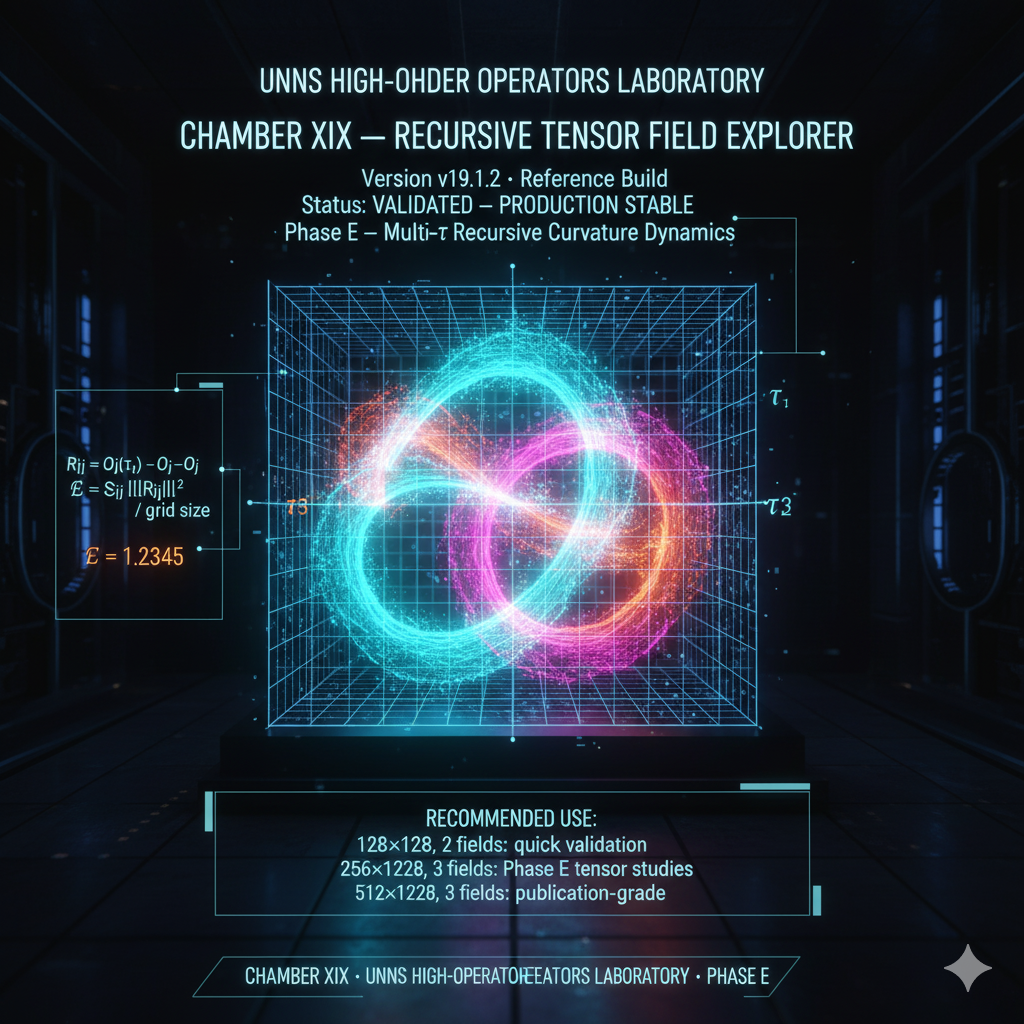
Chamber XIX — Recursive Tensor Field Explorer is the Phase E reference chamber for the UNNS Substrate, designed to study multi-field recursive curvature through the tensor Rij = Oi(τi) − Oj(τj). It quantifies how different operator modes distort their own τ-fields, establishing the computational groundwork for Phase F divergence fields and the planned UNNS–Maxwell bridge.
What Chamber XIX Explores
- Recursive tensor geometry — measures operator asymmetry between τ-fields via Rij.
- Multi-τ coupling — supports 2–3 fields (τ₁, τ₂, τ₃) with separable modes: standard, Φ-scale (Operator XIV), and 0-Prism (Operator XV).
- Energy-like curvature — scalar diagnostic ℰ = Σij ||Rij||² / grid size tracking how “expensive” non-commuting recursion becomes.
- Equilibrium detection — slope-based energy gradient plus stability tests on ℰ to distinguish true attractors from transient plateaus.
Recommended Use
- 128×128, 2 fields: quick validation and operator comparison.
- 256×256, 3 fields: Phase E tensor studies and reproducibility runs.
- 512×512, 3 fields: publication-grade curvature spectra (close other tabs; memory >≈ 2 GB required).
Validated Metrics & Optimizations
- Laplacian caching — ~60% fewer FD operations per step.
- ImageData rendering — direct pixel writes at up to 60 fps on 512².
- Manual min/max loops — ~2.5–3× faster normalization on large grids.
- Energy-gradient equilibrium test — reliable convergence indicator for 2–3 field systems.
Chamber XIX now serves as the tensor backbone for Phase F. The next step is a divergence chamber computing a recursive potential Φij = ∇·Rij, enabling spectral analysis and direct comparison with Maxwell-style field equations.
All diagnostics, JSON exports, and performance optimizations in v19.1.2 have been validated as the production reference for future UNNS tensor experiments.