
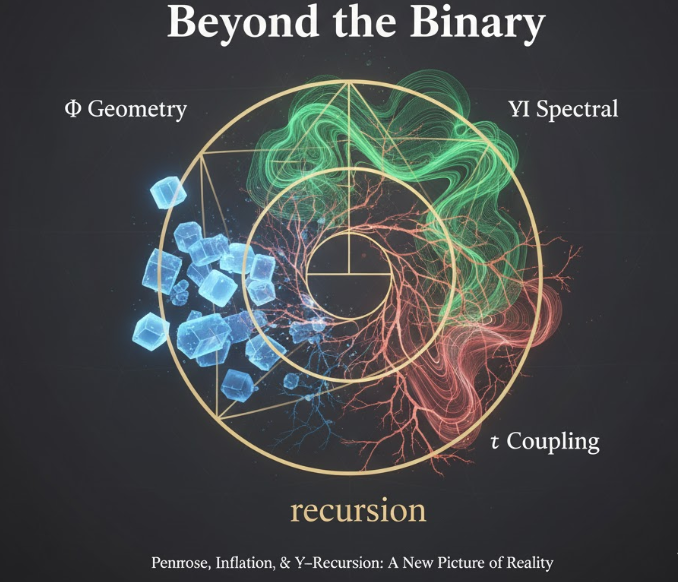
A UNNS reading of Roger Penrose’s criticisms of inflation, string theory, and quantum mechanics. Instead of the usual “observable vs meaningless” binary, the UNNS Substrate introduces a Φ–Ψ–τ recursion picture in which theories are judged by τ-closure and projection, not by a crude visibility test.
1. The Binary Worldview That Physics Never Had
A common internet trope goes roughly like this: if you cannot directly observe a structure, then it is not “real” physics. By this standard, speculative cosmology, string theory, and even parts of quantum mechanics are dismissed as “just math” or “philosophy”. A popular way to package this is to say that such theories are “not falsifiable”, so they are indistinguishable from saying “there is an Eiffel Tower on the far side of Pluto”.
This is a caricature. Neither Penrose nor serious critics of inflation or string theory argue from such a crude binary. Modern physics has always operated with indirect observables, effective theories, renormalized parameters, and projections. What is really at stake is not mere visibility but the structure that underlies what we can measure.
The UNNS Substrate makes this structural question explicit. It replaces the binary logic “observable vs meaningless” with a tripartite decomposition: Φ-geometry, Ψ-spectral coherence, and τ-coupling. Observables are not an absolute category; they arise when Ψ-structure is projected through τ into a Φ-accessible channel.
2. Φ–Ψ–τ Recursion Instead of True/False
In the UNNS Substrate, we model the underlying “space of possibilities” as a recursion manifold ℛ equipped with three intertwined modes:
- Φ — geometric mode: curvature, connectivity, large-scale structure.
- Ψ — spectral mode: coherence, interference, spectral branching.
- τ — coupling mode: transfer channels between Φ and Ψ, closing recursion.
A physical theory then appears as a projection of the Φ–Ψ–τ recursion onto a slice where we interpret some coordinates as “spacetime” and some as “fields” or “states”. The question is no longer “is this structure observable or meaningless?”, but:
- Does the recursion close under τ? (no uncontrolled leaks of structure)
- Is there a stable projection into Φ that can accumulate evidence?
- Is there a coherent Ψ-sector that maintains interference and consistency?
In this sense, “math” is not something external to physics. It is the invariant description of the recursion structure. A theory can be bad because it breaks τ-closure or fails to project coherently, not because it has “too much math”.
Placement of inflation, quantum mechanics, and string theory in the Φ–Ψ–τ triangle. Penrose’s “incompleteness zone” is very close to the τ-critical region where geometry and coherence must both be active.
3. Penrose on Inflation: Φ-Magnification Without τ-Closure
Penrose’s distrust of inflation is often presented as a crude “no evidence, therefore nonsense” stance. In fact, his concern is more subtle: inflation is a machinery that can be tuned to produce almost any large-scale universe you like. In UNNS language, it is a regime where Φ-modes expand so violently that τ-constraints become weak.
In a Φ-dominant regime, the recursion manifold ℛ is effectively dragged along by geometric expansion. The counting form ωUNNS and the τ-field Sτ still exist, but the projection into Φ washes out a lot of Ψ-sensitivity: small differences in initial spectral content are stretched beyond recognition.
The UNNS critique is not “inflation is unfalsifiable” but:
4. Penrose on String Theory: Ψ Without Φ
String theory, in turn, is an extremely rich Ψ-architecture. It offers a spectacularly coherent spectral space with higher-dimensional geometry, extended objects, dualities, and algebraic structure. Penrose’s worry is not that this is “just math”, but that the theory has not successfully locked itself into the Φ-projection in four dimensions with strong τ-constraints.
In UNNS terms, string theory lives high in the Ψ corner of the triangle, beautifully recursive in its own right, but largely τ-decoupled from the Φ-sector that we interpret as our universe. It has many internal consistency checks, but relatively few hard, low-energy Φ-signatures.
5. Quantum Mechanics as a Ψ-Dominant Projection
Quantum mechanics itself is often presented in those internet critiques as mysterious: “it works, but we do not know how”. In the UNNS Substrate, the “how” is clear: QM is the Ψ-dominant projection of recursion, where coherence and interference are preserved and Φ plays a minimal role.
In the τ-field picture, a quantum evolution trajectory γ is a curve in ℛ that is tangent to Sτ, and the UNNS action 𝒜UNNS[γ] = ∫θUNNS is stationary when no recursion flux crosses the variation surface. When τ is small but nonzero, interference patterns encoded in Ψ survive; decoherence is weak.
Penrose’s sense that QM is “incomplete” can thus be read as an intuition that the full Φ–Ψ–τ structure is not yet visible in the standard projection. He is not rejecting Ψ-recursion, but asking how it couples to Φ through τ in measurement-like events.
6. The τ-Critical Zone: Where Quantum and Geometry Meet
The real tension is not between “math” and “physics”, but between different regimes of τ. In the UNNS Substrate we can distinguish three zones:
- Ψ-dominant, small τ: quantum-like physics, strong coherence, weak geometric feedback.
- Φ-dominant, large τ: classical and geometric physics, curvature accumulation, decoherence.
- τ-critical: neither Φ nor Ψ dominates; both matter and the τ-field fully controls how recursion closes.
It is precisely in this τ-critical region that “quantum gravity” questions live: not as a new force, but as the place where Φ and Ψ must be handled on equal footing. Penrose’s dissatisfaction with both inflation and string theory can be seen as a dissatisfaction with theories that live far from this τ-critical interface.
7. Binary Falsifiability vs Recursion-Based Validity
The blog-style argument that triggered this discussion implicitly assumes:
UNNS replaces this with a recursion-based criterion:
Under this criterion:
- Quantum mechanics is a valid Ψ-projection with τ-closure; the question is how it extends into the τ-critical zone.
- Inflation is a Φ-dominant mechanism with weak τ-invertibility: not meaningless, but structurally delicate.
- String theory is a towering Ψ-structure with incomplete Φ–τ anchoring.
This is close to Penrose’s actual concerns. He is not saying “math is bad, observation is good”; he is asking whether our mathematical structures really lock into the spacetime geometry we inhabit, or whether they float in Ψ at a safe but disconnected distance.
8. Synthesis: What Counts as “Real” in the UNNS Substrate?
Reality is not split into “observable” and “meaningless”. It is structured by a Φ–Ψ–τ recursion. Observability is a property of Φ-projections under τ-closure, not an absolute filter on what is allowed to exist. A theory is not condemned for being “too mathematical”; it is examined for whether its recursion closes, its τ-field is well-defined, and its projections match the sectors of ℛ we can actually probe.
In this light, Penrose’s criticisms of inflation and string theory do not push physics back toward a naive empiricism. Instead, they resonate with a deeper question that UNNS makes explicit: how does Ψ-recursion attach to Φ geometry through τ, and where in that attachment does our universe sit?
The answer, from the τ-field point of view, is that both “math” and “physics” are shadows of an underlying recursion. The choice is not between algebra and experiment, but between shallow projections and structures that really survive τ-critical scrutiny. That is where the UNNS Substrate, and perhaps Penrose’s own instincts, invite us to look.