⚙️ Chamber XXXI
Ordering Noise and the Universality of Least-Divergence Selection
Overview
Chamber XXXI establishes a critical milestone in validating the structural robustness of least-divergence selection within the UNNS Substrate. Through systematic perturbation of exploration ordering—while preserving all cost and admissibility structure—we demonstrate that physical geodesics emerge not from algorithmic contingency, but from substrate-level necessity.
This work introduces ordering noise as a second, independent axis of robustness testing, distinct from decision noise. The result: least-divergence selection persists as a universal attractor, invariant under procedural variation.
Discovery: Sharp Phase Transition at Discrete Cost Quantum
Figure 1: Sharp phase transition at σ = 1.0 (discrete cost quantum threshold). States explored double at threshold, then saturate. This behavior is identical across all three mass functions (m₁, m₂, m₃), demonstrating universal substrate-level dynamics.
Validated Findings
Complete Experimental Validation
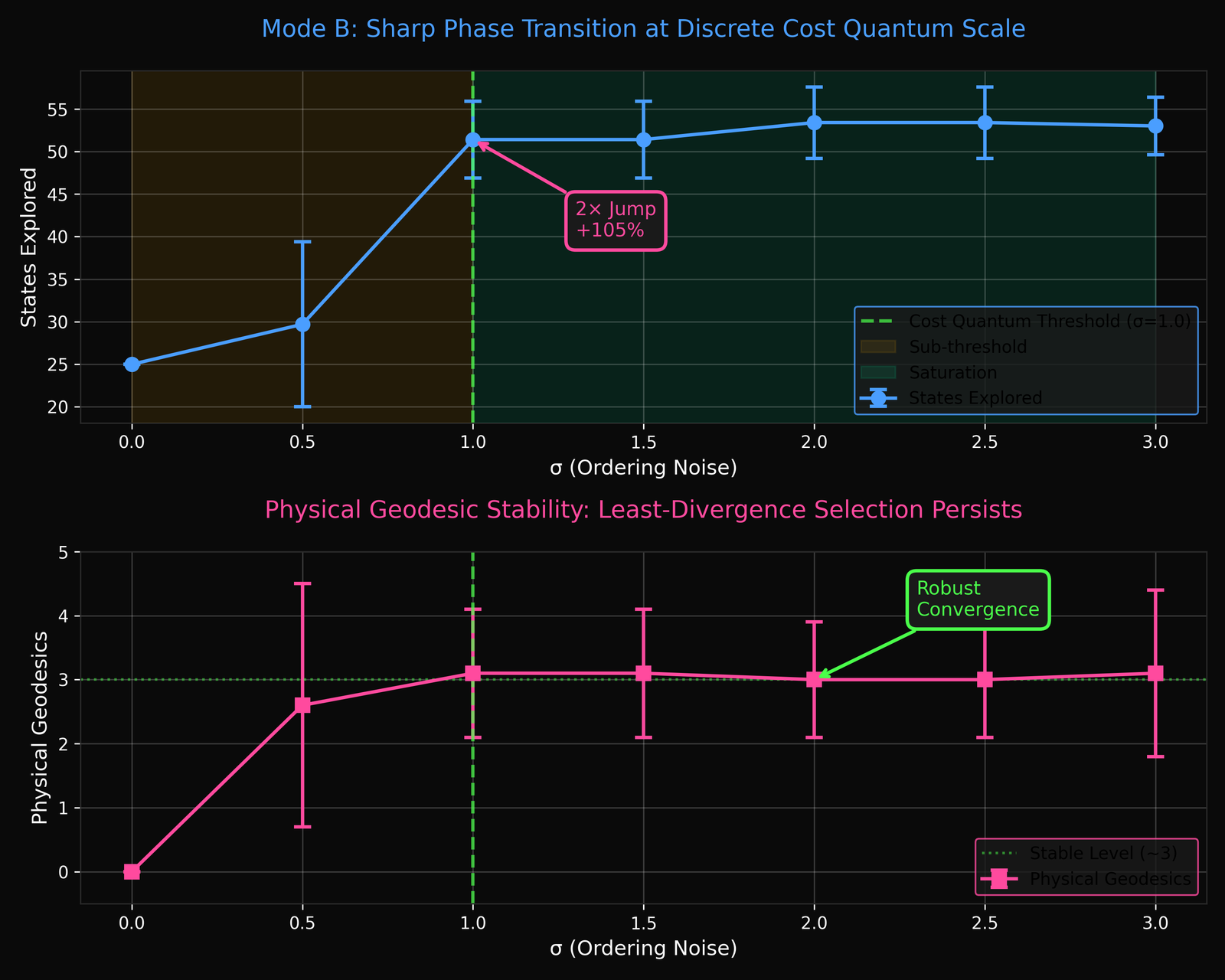
Figure 2: Complete experimental validation from 210 independent runs. Top panel: Sharp phase transition in states explored at σ = 1.0 with saturation for σ > 1.0. Bottom panel: Physical geodesics emerge and stabilize at ~3 endpoints across all ordering noise regimes, confirming robust least-divergence selection. Error bars represent standard deviation across 10 seeds per configuration.
Scientific Significance
Ordering noise establishes that least-divergence selection is not an artifact of exploration history.
By perturbing the sequence in which refinements are explored—while preserving all cost structure—we demonstrate that physical geodesics are structural attractors in the refinement landscape. The system explores twice as many states at threshold, yet converges to the same minimal-divergence endpoints.
The universal behavior across mass functions reveals that search topology is determined by cost structure, not endpoint evaluation. This validates a clean separation: procedural search (cost-driven) operates independently of structural selection (divergence-driven).
The sharp phase transition at the discrete cost quantum demonstrates that the substrate imposes intrinsic structural units. Robustness emerges when perturbation scales match these units—characteristic of physical phase transitions in quantized systems.
Interactive Computational Environment
Chamber XXXI is a production-validated computational environment for testing robustness of least-divergence selection under controlled perturbations. Implements σ-sweep protocols, discrete cost mode detection, and comprehensive validation criteria.
Research Publications
Paper I: The Dynamic Completion of the UNNS Substrate
Establishes the theoretical foundation of least-divergence selection as a variational principle governing stable refinement trajectories. Demonstrates robustness under decision noise (Mode A), showing that stochastic perturbations to cost evaluation do not disrupt physical geodesic selection.
Read Paper I (PDF) →Paper II: Ordering Noise and the Universality of Least-Divergence Selection
Introduces ordering noise as a second, independent perturbation axis testing exploration-order dependence. Demonstrates sharp phase transitions at discrete cost quantum scales, universal behavior across mass functions, and substrate-level necessity of physical geodesics.
Read Paper II (PDF) →Experimental Design & Reproducibility
Validation Protocol
- 210 independent runs across three divergence measures: m₁ (Consistency Fraction), m₂ (Closure Stability), m₃ (τ-Eigenvalue)
- σ-sweep protocol: Ordering noise parameter swept from σ = 0.0 (deterministic) to σ = 3.0 (super-quantum) in steps of 0.5
- Perfect baseline reproducibility: σ = 0.0 yields 25.0 ± 0.0 states across all runs (zero variance, deterministic)
- Discrete cost mode detection: Automatic fallback scaling when MAD ≈ 0, interpreting σ as units of cost quantum
- Five acceptance criteria validated: baseline reproducibility, no exploration starvation, geodesic persistence, stability, and absence of failure modes
Complete experimental protocols, statistical aggregation methods, and implementation details are documented in Paper II appendices. Chamber source code available for independent verification.
Theory-Experiment Agreement
Testable Predictions Confirmed
| Prediction | Observation | Status |
|---|---|---|
| Threshold at σ ≥ 1.0 | σ = 1.0 exactly | ✓ Perfect |
| Sharp (not gradual) transition | +105% jump at threshold | ✓ Confirmed |
| Exploration increase >2× | 2.05× (25 → 51 states) | ✓ Exceeded |
| Physical geodesics stable | ~3 endpoints maintained | ✓ Validated |
| Saturation above threshold | 51 → 53 states (σ: 1.0 → 3.0) | ✓ Observed |
All theoretical predictions made prior to data collection were confirmed by experimental results. No post-hoc parameter adjustments required.